

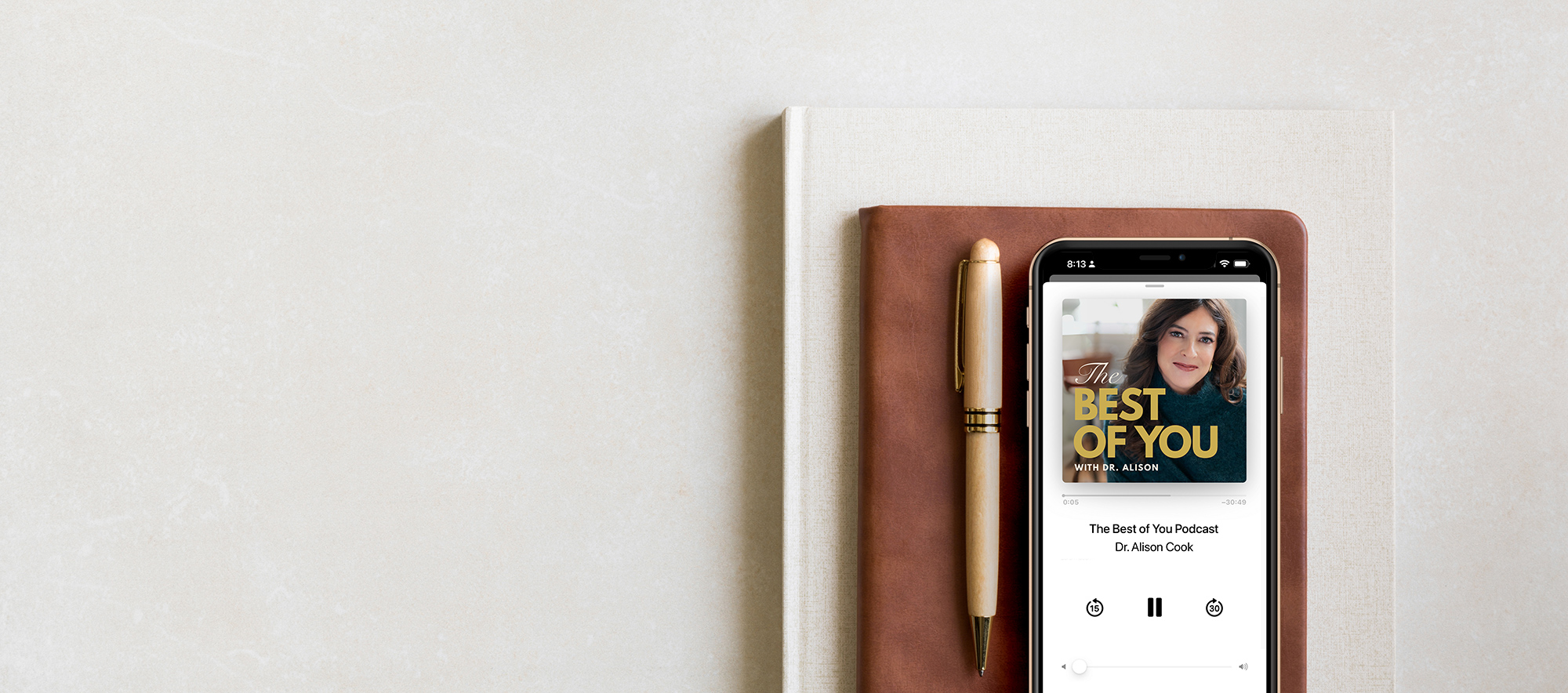

"I'm so grateful I found Dr. Cook's work—she is the best of both worlds. I trust her and I don't even know her. Morally authentic and kind with really strong clinical chops. Thank you Dr. Alison for helping me to stay hopeful when I had almost given up."
"I can't say enough about this podcast and Dr. Alison. I have listened to every episode and can't wait for the next one. She has shed so much light onto my spiritual pain. . . I am learning how to heal and live the life God has planned for me."
"I started this podcast roughly a year ago from start to finish. I was struggling, had tried several other podcasts, several counselors, and I was just lost but really could not identify why. I started listening to this podcast in the mornings and my life has really changed. It gives me the tools in the morning to wake up my emotions and really dive into some topics that have made me more self aware without shame!"
"I have learned so many new perspectives and tools through this podcast!"
"There are so many takeaways that have changed my perspective, illuminated my circumstances, or simply encouraged me to tears. Thank you, Dr. Alison!"
“Dr. Alison’s compassion and understanding of psychology in tandem with Scripture is excellent and so very helpful. One episode is better than the next and I often listen more than once and share them!”
Choose a category to narrow your search

In this episode, Dr. Dan Allender, a pioneer in Christian counseling and the founder of The Allender Center, joins Dr. Alison to explore the raw, real work of marriage, trauma, and intimacy. Known for his groundbreaking book, The Wounded Heart, Allender has spent decades teaching how personal trauma shapes relationships. And on the very day of his 48th wedding anniversary, he openly shares how these dynamics continue to play out in his own marriage.
In this episode, we dive into:
* The surprising (and hilarious) fight he and his wife had the night before their anniversary
* Why marriage is both heaven and hell—and why that’s actually a good thing
* The childhood wounds that have impacted his own marriage
* Why logic doesn’t help when we get emotionally hijacked
* How to fight well and grow through conflict
Check out The Deep Rooted Marriage anywhere books are sold.
Resources:
- The Wounded Heart: Hope for Adult Victims of Childhood Sexual Abuse by Dan Allender
- Episode 147: Breaking the Cycle—Making Sense of Your Family Story and Healing the Trauma of Being the “Chosen Child” with Therapist Adam Young
- The Allender Center
- The Deep-Rooted Marriage: Cultivating Intimacy, Healing, and Delight by Dr. Dan Allender and Dr. Steve Call
- Romans 8
- Matthew 7:3-5
- Romans 2:4
- Romans 8:38-39
- 1 John 3:1-3
If you liked this, you’ll love:
- Episode 137: The Mindful Marriage—Overcome Pain Cycles and Discover the Surprising Secret to Lasting Love with Ron and Nan Deal
Thanks to our sponsors:
- Go to Quince.com/bestofyou for 365-day returns, plus free shipping on your order!
- Go to AquaTru.com and enter code BESTOFYOU at checkout to get 20% OFF any AquaTru purifier!
- Contact Restoring the Soul today at www.restoringthesoul.com and learn how their Intensive Counseling Process can jump start your journey to the place you want to be. As a special gift for The Best of You podcast listeners, visit www.restoringthesoul.com/bestofyou to download their pdf called "5 Ways Unresolved Trauma May Be Derailing Your Relationship."
- Turn back time on the appearance of your skin with Purity Woods’s Age-Defying Dream Cream. Go to puritywoods.com/BESTOFYOU or enter code BESTOFYOU at checkout for an additional 10% off your first order.
Music by Andy Luiten/Sound editing by Kelly Kramarik
© 2024 Alison Cook. ALL RIGHTS RESERVED. Please do not copy or share the contents of this webpage without permission from the author. While Dr. Cook is a counselor, the content of this podcast and any of the products provided by Dr. Cook are not specific counseling advice nor are they a substitute for individual counseling. The content and products provided on this podcast are for informational purposes only.
Transcript:
Alison Cook: Hey everyone, and welcome back to this week's episode of The Best of You Podcast. I couldn't be more thrilled to share with you today's conversation with Dan Allender. Dan is a hero of mine, and for so many of us in this field of trying to bring together the best of psychology with faith and Christian spirituality,
Dan is a trailblazer in the field of counseling, especially known for his groundbreaking work in the book, The Wounded Heart. Adam Young refers to the significant role that Dan's book played in his journey in last week's episode, Episode 147.
Dan has also played such a significant role in training Christian therapists. He is a pioneer of a unique and innovative approach to trauma and abuse therapy called the Allender Theory, which has brought healing and transformation to hundreds of thousands of lives by bridging the story of the gospel and the stories of trauma and abuse that mark so many.
Many of you are probably familiar with his work at The Allender Center, which is part of the Seattle School of Theology and Psychology. The far reaching impact of Dan's work on so many of us seeking to combine Christian theology with psychology cannot be overstated. It's incredible.
To my delight, I discovered that the day on which Dan and I recorded today's episode was in fact, his 48th wedding anniversary. He's such an authentic, true soul. He opens up right away, telling me about a fight he and his wife of 48 years had on the eve of their anniversary. And that's what I loved about this conversation and about this brand new book that Dan has written.
It's called The Deep-Rooted Marriage: Cultivating Intimacy, Healing, and Delight, and it's filled with really honest stories. He doesn't mince words. He's a truth teller. In our conversation today, he shares some new stories about his own marriage and he talks about how he and his wife have learned, over these 48 years, how to uncover the deep roots of trauma in each of their individual lives and how those deep roots impact their ongoing interactions with each other.
This is such a powerful episode. I particularly love his challenge at the end of the episode about what he would like all couples to know about the reality of what it means to leave one's family of origin and cleave to your new partner, and how important that is to the health of your marriage.
He also shares, at the end of the episode, some personal reflections on his own 48 years of marriage. He had me laughing and he had me crying throughout this episode. I'm thrilled to bring you my conversation with one of my heroes in this field, Dan Allender.
***
Alison Cook: Dan, I have tears in my eyes. You've been such an amazing mentor and role model to so many of us in this field.
Dan Allender: Thank you.
Alison Cook: I'm so thrilled to get to have this conversation with you today. I feel so honored.
Dan Allender: Me too. These are the kinds of things where people don't realize how fun this is. Yeah.
Alison Cook: We put on these headsets, but really it's our modern way of getting to connect.
Dan Allender: Yeah. I prefer it to be in a nice coffee shop, but it's hard to bring in a few hundred other people or a thousand or whatever.
Alison Cook: Yeah. This new book, there's so many things we could talk about Dan, but I was saying before we started recording, I love what you're doing. You and your co-author, Steve, bring in this lens of trauma into marriage, and you write about it so beautifully. It's in many ways intuitive.
We know we bring our baggage into marriage, but the way that you're speaking into this current moment, where a lot of us are aware more and more of our baggage, how then does it affect our most significant relationships?
Dan, I would love it if you would start, like you do in the book, with a little bit of your own story and some of your own stuff that you unwittingly realized–oh my goodness, this is now coming into my marriage.
Dan Allender: First and foremost, Alison, what a delight to be with you. The reality is, people often see therapists or people who write books as those who have it all together and therefore want to offer from their vaunted high self the glory that we would wish other people to participate in.
But last night, Becky and I, my wife today of 48 years, our fight was over whether a baked potato was actually fit to eat. Whether it was done. We're in it. We're in it far enough that all of a sudden you realize, oh my God, we are actually having not a knock down drag out, but an unpleasant interaction.
So in some ways, to begin this process, as we've been married 48 years, it's getting worse and it's getting better. That's often the key to a good marriage. There has never been for me with any other human being more of a taste of what I believe eternity and heaven will be like.
But I'd also say with no other human being have I ever had such a taste of hell. Again, to hold that and to be able to say, what we have written is a good book. But it's an honest book about the reality that no matter how well prepared, thoughtful, and educated you may be, your marriage is one of the hardest relationships. And certainly, it's meant to be one of the best relationships you'll ever be in.
Alison Cook: I love the honesty. There's this quote toward the end of the book that I thought was so good. Essentially, it's about war. You say, “It is not likely at your wedding that the officiant said a war had to be fought for these two to be at this altar. Even more unlikely is that they'd continue. Now, in fact, there will commence an even greater war.”
It is a very hopeful book. But that reality testing pushes so much against our culture, especially in the last century in American culture, what we've come to understand to be love. And yet you and your wife share a beautiful love and some beautiful moments that bring you to tears.
Dan Allender: Oh, thank you. Again, there's no relationship, as I've said, that matters more to me. Yet, if you were to see the interaction, it's over a freaking baked potato. You'd go, what in the name of God is wrong with this couple?
The answer is that the reality of brokenness, the reality of sin, the reality of our own stories play out in every arena, but particularly, for some reason, our kitchen is the ground of engagement, to the degree we don't have language to name what's actually happening. We're lost in the fog.
Again, we're clearer about what happens than we may have been five or ten or twenty years ago. That only gives you the access to begin the process of humbling, honoring, blessing, and engaging the other for the ultimate purpose of drawing one another to be more like Jesus.
If that's not the goal, I get it. I get it. I like comfort. I like convenience. Marriage is the great character transformation place.
Alison Cook: Yeah, that word, humble yourself, that word, making conscious choices. So there's a fight, you tell them the story in front of the fridge, so it sounds like it might not be unlike the baked potato fight.
Dan Allender: Yes, I'm telling you, we've had, since COVID, I would say 80 percent of our conflict has happened in the space of our kitchen.
Alison Cook: Yeah. Let's talk about it, Dan, because you talk in the book very candidly, at least in your own life, about where some of that comes from. Here's the thing that's interesting, 48 years in. You can have all the self-knowledge and know, because in the book you talk about as a kid, food scarcity, the way that it triggers you.
You can know all that, your spouse can know all that, but still in that moment, you can get hijacked by that young part of you. It's not that it stops happening, it's what you do with it.
Dan Allender: I love that. It's so important to underscore that. When we, again, divide our brain in terms of left and right hemisphere, and again, it's too general, but there's some truth to the fact that our left hemisphere is much more logical, linear, able to “think”. Our right hemisphere is far more affective, far more visual, far more affected by the reality of trauma.
So what happens when we get hijacked? We got hijacked over whether or not the fork went deep enough into the baked potato to warrant being said to be done. I didn't think it was. She did. The kitchen has been the realm of where my wife has felt both her deepest pleasure and power.
It has been the realm for me of a lot of warfare. To begin with, my mother had borderline personality disorder. She was eccentric. She was incredibly powerful. She could be weak and frail, and then like Cruella de Vil. And you never knew what moment, but food was never her realm.
She didn't care whether or not we had food. A normal meal of mushy canned peas, corn, and ham baked on one side and pretty much raw on the other, that was actually a pretty big good meal. The rest were Swanson TV dinners.
Becky's world was a world in which she had a pretty vicious and cruel mom, but who loved to cook. So the kitchen was the one place where love was shown. So when I walk into the kitchen, at some level, the haunting presence is, this is a war zone. For Becky, it's a world of love and lush and delight, smell, good flavor.
For me to in any way question, or have any significant influence in the kitchen, oh my gosh. For some people, it's a bedroom. Again, not to say that we have not had our own sexual struggles with both of us having histories of past abuse, but the kitchen! A lot of struggle.
Alison Cook: Yeah. When you're describing that, I think about it through an IFS lens. You talk a lot about the brain in the book. There are so many different ways to look at this, but it's almost like parts of you when you walk in that kitchen, no matter how much work you've done, there's some stored memory.
It's in you, and so to this day, sometimes that comes up. I guess there are a couple of questions in that. One is, we can try to know, every time I go in the kitchen, okay, I've got to be on my best behavior. The willpower thing. But sometimes that can make it worse.
Dan Allender: Oh, it inevitably always makes it worse, because the pressure you put on yourself to escape what you perceive to be judgment only creates much more sensitivity to it.
Alison Cook: So if we can't do that, then we're going to have to acknowledge, from time to time, this is going to happen. We're going to erupt.
Dan Allender: Yes.
Alison Cook: How do you do that? Do you know that together?
Dan Allender: Again, without going through the entire dialogue, there was a point we started laughing. Because it was ridiculous that we're having what seems to be a significant war on the eve of our 48th anniversary over a baked potato. But, in the moment, and it's such an important category to understand about trauma, there are triggers.
Even if these events are 10, 20, 30, 40 years ago, our brain is wired for safety. When we have a sense of threat, even if it's not conscious, there is going to be a biological process of stress and chemical production. Cortisol is the one that most people know about, but adrenaline, noradrenaline, catecholamines, they're all working at that moment.
I'm being flooded with stress biochemicals over something that doesn't matter. Put ketchup on the baked potato, it'll be fine. To be able to have language, to be able then to go, oh, we're both getting triggered here. Oh, this is not the direction we thought dinner would go. But then, instead of being conciliatory, like “Oh, I'm sorry, oh, I'm sorry. Forgive me. Yes, let's have dinner.”
That's good. I'm not by any means saying that's not helpful, but to be able to go, wow, what came online for you and for me? A good portion of our discussion was going back to stories we've told one another multiple times and new stories about the reality of what gets triggered in that moment.
The more you understand the context, the roots of what's flooding you, the better you can be, on behalf of the other, bringing both compassion and kindness, but also curiosity. Gosh, were there other things going on in the day that brought us to this point? For us, we couldn't come up with anything other than I was standing in the realm of where my wife feels like she gets to lavish me with goodness.
I was questioning her. But again, whether the baked potato was truly done or not, you can imagine whether it's about sex, whether it's about finances, whether it's about where you vacation, almost every area is going to have the realm of difference. And difference, for most of us, triggers a sense of threat rather than warm, engaged curiosity.
We feel challenged or we feel threatened, and that now brings us into, how do you manage in the broadest sense of the word, any sense of threat? I'm much more of a stress-oriented “fight”. My wife is far more stress-oriented “flight”. So the fight-flight response of trauma, in the initial first five years, worked really well for us.
Until she began to mature and began to name my bluster and verbosity and intensity as contrary to the man I claim I want to be. So as we began to grow together, let's say growth itself always has at its core, a transformation that feels more dangerous than whatever the status quo was.
Alison Cook: Wow. It's deep. Hence the title of the book, The Deep Rooted Marriage. Okay, so Dan, the good news for the listener is, it's worth it. The reality news is, we're going to be doing this. I often find it hard to figure out referrals for couples in therapy, because there are a lot of false promises. There's a lot of, if you do this, this will happen, and scripts, tips, those kinds of things that can be helpful.
But in those moments that you described, that happened last night, it almost always involves these childhood parts of us. It does. There's this adaptation of IFS called “intimacy from the inside out”. Are you familiar with it? It's one I actually think is really powerful, because you don't solve anything.
What you do is you find compassion for your spouse. To your point, what was happening for you? You are recognizing that young part of me. I want that young part of me to be with me. But because I'm complex and because sometimes that young part of me shows up in the kitchen, it means that sometimes this thing happens.
You talk it through so beautifully in the book, how both you and Becky and your coauthor and his wife give your different viewpoints of the argument. For example, let's say at the fridge, where you walk us through what was happening to that young boy inside of you. Maybe then the Lord works on her pride. Maybe I need to get curious.
There's something here that is the magic of intimacy, of love, of marriage that doesn't necessarily take away those rough patches.
Dan Allender: If there's a portion of the Bible that I would say I go to often, it'd be Romans 8. It begins with, there is no condemnation for those who are in Christ Jesus. What if there was no condemnation in the context of our marriage? Now that's not the case, but what if?
What if there was a way of engaging one another with hurt, with difference, with struggle, but without contempt, without condemnation? We're not a contempt-free marriage, but it's one of our intentions. Whatever you make as an intention, here's the craziness. It exposes where you're not becoming what you intend, but it also creates the pathway for it to become more and more a portion of your life.
I want to have a contempt-free marriage. We fight, we argue, we see things differently on almost every spectrum. Nonetheless, it's actually fun. It's actually entertaining. There are moments that her differences knock me off my rocker to a point where it's like, I don't know how you married me.
It's one of the best con jobs I ever pulled off in my whole life to get this beautiful, remarkable woman to marry me. Yet, back to that image, there have been harsh moments where we feel the name Satan, meaning the accuser, the devil, from the Greek word diabolos, meaning the one who divides.
We’ve felt accusation. We've felt division, and it always brings to the surface, as you put it so well, the younger parts of us that either knew developmental trauma, which everybody does, but also very unique trauma. She had a significantly emotionally abusive mother. She has her own history of past abuse, which I'm allowed to say because it has been part of her public story.
Same with my mom. So having a mom who was as consuming as my mom was–I described even as a seventh grader feeling like I was living in the web of a black widow spider–I had to make sure I didn't move or if I did move, I created enough trauma in the web that the spider would move away.
So when you've got a woman, my wife, who lived by hiding literally in closets to avoid the rage of her mother, and me, lighting things on fire, stealing cars, selling drugs, creating havoc in my world, in part to keep my mother at bay, you've got a drama.
I don't hide in closets. She does. She doesn't burn things down. I do. Now, if you take that into consideration, these are the younger parts of us that found very different ways to not survive, but to find something that gave us even that modicum of life. Now it becomes clearer in the context of a normal fight why I'm loud and why she's stonewalling.
Again, with that inner play, you can stop and go, you need to learn how to communicate better. Yes, indeed. But if we don't deal with the heart, then it becomes the moral gospel rather than the gospel of there is no condemnation.
Alison Cook: Yeah, I have, very legalistically, as a trained therapist, said the correct words to my husband to let him know that I know what we should be saying in this moment to not be in conflict. It doesn't go over very well.
Dan Allender: No, I'm hoping he's at least at some point said to you, you're not my therapist and I don't pay you.
Alison Cook: It's the most humbling. Oh, he would actually love it if I'd get mad instead, because it's all about the heart, but to your point, if my heart is very pious in those moments, that's leading to contempt.
Dan Allender: Yes, exactly. Oh, so well said.
Alison Cook: What do you think is the key attribute in each individual that has to be cultivated to transform what can be a war into these moments of glory?
Dan Allender: Gosh, I often go back to the Luke 7 passage about dealing with the log in your own eye, and sadly we think of the word log as sin, but no, it's anything that keeps you from being able to see well. So to have compassion for a young four and five year old who's having to hide in a closet, it breaks my heart.
Yet, so often, including the baked potato, it was so interactive in a way in which I'm literally sending her back into the closet. For me to realize I'm replicating some of the same harm she endured as a young child breaks my heart. So the capacity to look at the log in your own eye and to say, with kindness, to those young parts, this is how you survived.
You learned to be verbose. You learned to talk loud. You learned to talk quickly in order to keep a woman who might have eaten you at bay. So with a phrase like Romans 2:4, it is the kindness of God that leads to repentance. The question is, can we join God in kindness for the young parts of our own hearts, let alone our partner’s?
What you find is kindness is not niceness. It's not even pleasant-ness. It's the capacity to see the other with eyes that are full of truth and yet are wrapped up in compassion. Therefore, it offers true curiosity, not interrogation, but true curiosity, like God in the garden when he says, where are you, Adam?
The question that I sometimes ask couples is, how do you hear that phrase? Because how you hear it will determine so much of your response. Are you being accused? Or are you being invited?
The idea that we could be in our own pain and suffering, and yet invite our spouse into an engagement where there's honor and ultimately the goal of delight, it changes the tonality, let alone the content of our interactions.
Alison Cook: You open the book with a scene on a ski slope, and you're pretty angry, primarily at your younger son. I won't take everybody through the whole story, but you're worked up. This is early in your marriage. What you're saying reminds me of that moment that you described, where your wife calls out the better angels of your nature, through strength.
Dan Allender: Yes, I was told by my wife to ski down about 200 yards. “Get out. You're trying to get your son down by force and power. It's not working. Go on down”. I came back up when it became clear that her empathetic and gracious, kind way was leaving him on the ground. So I had to come back 200, 300 yards, and I was boiling angry yet cold as ice inside.
As I put my skis on and made my move toward the two of them, she skied in front of him and it was clear she's protecting our insecure son. I mouthed to her the word, move. She shook her head very kindly, and said no. No force, no. When I got to her, and I'm like, move, she put her hand on my heart, and she said the words, I know the men who have humiliated you.
And I am not expecting my life story to be brought in one sentence to bear. Literally, that sense of being haunted, like my father, a coach, several pastors…all of a sudden, at the top of the slope, it's busy and there are people there, she said, “I know that's not what you want to bring to your son”.
Alison Cook: Wow.
Dan Allender: Again, I would wish that each and every time there had been some truth like that, that my heart had softened. But at that moment, tears came. All I experienced was her hand even more firmly on my heart, and she said, “you're a good man” and then skied away, leaving my son and I on the top of that slope to negotiate how we would get down.
That is a family story. My son tells that story. My daughters who had left to go down and get lunch early, though they weren't part of it, they were part of it, because they have known something of my own failure as a father. So all that to say, without being the face of God on behalf of one another, who do we become?
That's what a marriage, from my standpoint, is. The gift of you getting to be the face of God on behalf of your spouse. My wife's face was disruptive, was inviting, but also called me to be who I claim I wish to be.
Alison Cook: I love that story. I love that moment. My guess is, there are moments when you've had to do that for her in different ways. So there are a couple of things going on that soften you. Did I hear you correctly that your 48th anniversary is today?
Dan Allender: Yeah. Today.
Alison Cook: Amazing. Happy 48th anniversary! That's amazing. So over 48 years, moments like that start to crack open the hardness around the heart. It doesn't mean that magically you became the world's best husband or parent. It's a long journey, but it cracks you open, and then you have the capacity, something shifts inside of you.
There are those moments where our spouse holds up that mirror of God. I get that part of it. You lay that out so beautifully in the book, but again, back to these moments where we're both in our worst self. I'm thinking this through because marriage is such a dance, and there are so many different facets of it.
There are those moments that are so powerful, and I have those with my husband where it's like, oh my gosh, he cracked something open inside of me. I still have to work it out, but something shifted,
Dan Allender: Absolutely.
Alison Cook: And I know I've done that for him. Then we have those baked potato moments. Still, I'm intrigued by this. How do you make sense of that? You go back to that moment. You're like, something shifted in me. I guess I'm trying to get at the dance of the marriage, the being seen, the being witnessed changes you, changes her.
You each grow individually, but then you're also constantly coming back to each other with all those new things in motion. It's not static.
Dan Allender: No, but again, certain themes play out pretty predictably. I am the messy one. Oh my gosh, Becky is so orderly. But, again, she had to be, to escape the wrath of a mother who would have found fault if a piece of paper were on her desk and not being utilized at that moment.
Whereas chaos was part of my camouflage to escape the pursuit of my mother. So again, I'm not here to blame my mother or my father or her mother or father. I understand that all of us, generation by generation, all the way back to Adam and Eve, we all have trauma.
We all have often managed that trauma by a kind of survival structure that's deeply broken, and sometimes still showing a lot of beauty. Can we stop long enough to go, this is heartbreaking, and I understand it. Can it be used for good? Can it be used for good?
I've created, and I say with some grief, but also some pleasure, I've created a lot of complexity for the believing community asking people to deal with sexual abuse back in the mid-80s. I'm proud of that.
Alison Cook: Good for you.
Dan Allender: I'm proud of being able to have listened to my clients and written. There are a lot of people who hate my guts. I'm not thrilled with that, but if part of the adversarial interaction with my own mother gave me some basic structure for being able to have some thickness of skin to bear that, there's some beauty to it as well.
Unfortunately, the one person in the world who matters most to me, oftentimes gets the prickly, angry part. Yet because we both have language and experience, and we have shared lots of stories, not facts, but stories of the harm that we each have endured, that begins to create a kind of connection on the basis of compassion.
It allows you to intervene on behalf of one another more quickly. We had a traffic situation and she said, people are carrying guns. I'm not ready for you to be shot. Not today. Her humor, her playfulness, her exposure of my anger, I'm like, yeah, you're right.
People are carrying guns more often. It's an angrier world, and I don't think I want to get shot today. It's something that could have been felt on my part as something not very respectful. She's mocking me. But no, she is playfully, prophetically, exposing and inviting. We were able to laugh about that interaction and the baked potato.
Eventually, when you are able to, in one sense, escape the worst parts, there's much more gratitude. But what you were naming earlier is, there are times where both of us are in it. Those are the moments where one has to come back and say, I don't really understand all that occurred, but I know I harmed you. I know I feel harmed by you.
How do we hold together, from the vows we made and from the dreams we have, of how we want our lives to end? You need to know the alpha and you need to know the omega in order to deal with the middle. A lot of our messes are middle messes.
Alison Cook: Which is such a theme in the book. When we have one of those situations where we both go somewhere we don't understand, we call it a Seinfeld. It's an episode about nothing. We both go, oh my gosh, that was a Seinfeld. We don't even know what that was about.
We then can laugh about it, but there's a category for it. There's a naming. But Dan, while you were talking, I got tears listening to it, and here's where I hear the hope in this. Because marriage is hard and you're so honest about that. Here's where I hear the hope. I'm gonna take you off the spot for a second.
You're talking about anger and you're so honest about that. The part of me that's a people pleaser, my husband gets the good of that part when he sees me be kind to our kids. He was a widower when we met, so they’re our kids now, but they were his kids. And my empathy, he fell in love with that part of me.
Also, into marriage, boy, does he get the worst of the codependency of the people pleasing. He sees the worst of it–it's heaven and hell. As an individual, I can be like, why can't I get rid of this part? I know I'm not supposed to think that way, but I still do sometimes.
What you're saying is, this is love. Love is over time. Yes, I do get some of the worst of those parts, but I also get the best, and I'm willing to stick it out to see more and more of the best, and I'm willing to stick it out to see more and more of when you're able to go, yeah, that was the worst.
That's the hope, is that being seen in all of the glory of those parts also demands that we're going to be seen in the worst of it. That's powerful.
Dan Allender: Oh, to me, it's the end of Romans 8, where there's nothing that can divide us from the love of God in Christ Jesus, neither death nor life, nor angels, nor powers, nor principalities, etc. So when you begin to go, oh, we have hurt one another so deeply at times.
In those moments, I won't go into all the details, but my wife had three miscarriages in our early years, and whenever one of our younger friends is in the middle of a miscarriage, the two of us look at one another with a look like, oh, that is still broken, barren ground.
My inattentiveness to what she was going through in that loss, I go, who were you? How could you? Yet, the reality of how our culture has changed and come to own the affect of miscarriage today, I'm not excusing myself, I'm simply saying that we are meant to grow through the community that grows in an understanding of heartache and loss and yet goodness.
So when we hold something of our past together, there's forgiveness. But there's still joint suffering we can enter, without accusation. It's without demand, without fear. Nothing can separate us. That's the ultimate truth and our ultimate desire in a marriage. Now, will we get close?
Yeah, closer, but as 1 John 3 says, when we see him, then we will be as he is until that day. The radical notion of sanctification is, the more we grow, the more we see how far we have to grow. So it's not American democracy nor capitalism, where the more you get, the more you have. It’s, the more you see, the more you're aware of the desire for redemption to be the deepest reality of how I engage, not just my wife, but my children, my grandchildren, the grand-dogs.
I have three grand dogs. When I had children, I knew there might be a day with grandchildren. Nobody told me about grand-dogs, and tending to them for a week while they vacation. So all that to say, none of us really ever fully understood what we were getting into. Yet the more we're in it, the more it is that I can't believe we get to love one another as we journey.
Alison Cook: That's beautiful, because I never thought about that sanctification process. The closer we get to God, the more we see our need for him, which is hard, but it would apply to marriage as well. The beauty part is, you're also seeing your spouse, your significant other, see that you're with them in it.
You're not bypassing it. You're not saying, oh no, it's fine. You're saying, yeah, there were some really rough patches. Also, here we are. Before we wind up, because I want to honor your time, this part of the book hit me and I want to get your thoughts on it. We've touched on this, but I want to circle back to it. I thought this was so powerful.
You write, as much as I loved Becky, I was more loyal to the role and demands of my family. As much as Becky loved me, she was more loyal to hers. You were more loyal to the demands of your mother. As much as Becky loved me, she was more loyal to being the bright sunlight for her father, and we didn't know it.
You're part of this becoming one. It's cliche, but there's so much depth to how you write about it in the book, of leaving those family of origin patterns that are so strong. 48 years in, they're still there. I really resonated with that.
You talked about how early on, the thing that attracts you about this person, because you get to leave these things of your family of origin behind, might then become the thing that you then dislike, because you actually have to change.
Dan Allender: Yes. Yes. I love how you put it. You put it so brilliantly and clearly. What do you want me to do other than to go, “Amen, sister”! I remember I had the privilege of officiating all three of my childrens’ weddings, and I remember sitting with one of them, and she said, look, dad, you've done this a lot.
You've had the privilege of marrying other people. What do you recommend for my future husband and I? I said, at some point during the ceremony, you should turn to us. I'll go from the front, sit with mom, and you and Driscoll will look at your parents and say, thank you for all that you've given us.
But from this moment on, as I turn my back on you, my loyalty no longer is to you but to my spouse. My daughter looked at me and she goes, it'd be the weirdest wedding in the world–I'm not gonna do that. And I'm like, oh yeah, I guess it would be, because nobody says that.
Nobody comes even close to saying what the scriptures say: leave your mother and father. Now, that's not geographic and it's not financial, because what we know about the ancient Near East, it was an agrarian culture. You didn't leave and go to the city. Your finances were bound into the larger family. So it is a deeply, shall we say, interior psychological process.
Right from the beginning, when you don't leave, the next portion of becoming one flesh, becoming one soul, ain't gonna work out. So much of what we're trying to do in The Deep-Rooted Marriage is to invite people to look at structures of how they interact with the history of what the roots are that allow you to make this transformation.
As you put it, and you put it so well, the passage and process is endless, but not hopeless. At times I find myself going, really? You didn't get this? I've written three books on marriage. Two with my best friend, Tremper Longman, and then with my dear friend, Steve Call.
Like, do you not get it? It's part of the kindness of God that his response is, of course you don't, but you do. So let's move on with what you do, but allow your heart to be open to what you don't see and have not named yet. Trauma experts will say, we need to engage traumatic stories up to 30 times for the neuroplasticity of our brain to change.
So if one were to measure my cellular process, there have been immense changes in the last 48 years. That's why, as an older man married to an older woman, every day we walk for about a 45 minute period, and it's our time to talk about the day, to pray, to laugh, to anticipate what the day holds.
The simple phrase of count your days. Becky and I don't know how much longer we will be on this earth. Count your days, that you might grow in wisdom. If what you want is a comfortable marriage, this is not a good book for you. But if what you want is something of the wild life of God, then I can't invite you any more to what your spouse reveals about you and what your spouse reveals about your heart with God.
What a process. Nobody could have told me when I made the vows I made 48 years ago today, at about 4:30 Pacific Standard Time, 7:30 Eastern Standard Time, what I was getting myself into, but I would not trade it for a living second, not for billions of dollars.
Now ask me if I'd be willing to have my children again, and it would take a second. Yes, the answer is yes, but give me a second. Much of my career, nah, I wouldn't do it again. But my wife, yeah, without a question.
Alison Cook: I want to do another podcast episode on that. That's interesting. I love it. It's so encouraging because it's so honest. It's so honest. That's your gift, Dan, that's why so many of us revere you. You talked about things before anybody else was talking about them. You said the hard things.
That's why it's so powerful. Now, when you're like, that's great, people love me for that. Guess what? Here's the other side of it. Let my wife talk to you about that. But it's hopeful to me here in my age where I've been writing books about codependency and boundaries, and I'm going through a whole ‘nother round of being horrible at it all.
And it's actually oddly hopeful to go, I’ll probably have another iteration of it as a grandparent. I'll have another iteration of it–
Dan Allender: –with grand dogs.
Alison Cook: Life is never boring. It’s a joy having someone like you and Becky to share the stories. There are so many good stories in the book. Sometimes I laughed out loud. I want to ask you questions I ask all my guests, Dan. The first one is, what would you say to young, newly married Dan now? What would you say to him now from who you are now?
Dan Allender: Hey, you got one of the most amazing human beings to marry you. And, yes, you pulled this off. You lied to her directly. She said at one point, I can't wait someday to walk the Appalachian Trail. I didn't know what the Appalachian Trail was, but I said, oh my gosh, me too. If she said, I want to go to the moon, it'd be like, that's absolutely my dream.
So yeah, courtship is a hopefully beneficial line without absolute cruelty. But you're on a journey that you cannot comprehend until you enter it. Even after you've been on it for 48 years, you can't imagine what's going to be required of you to die together. So you better know this is about life and death.
It isn't about owning a home or having children or having a nice vacation. This will shape you to be who you are and what you become for eternity. You are not up for it. You do not have the capacity. So you will have to depend upon me. I wish a good, wise, kind man or woman would have said that to me.
Alison Cook: Wow. What's bringing out the best of you right now on this day?
Dan Allender: Here's the intersection. We've had such a good day so far. Early in the morning, we took our walk and then we opened up our wedding photos. It's not the first time, but we laughed about where we were, what we saw. About two hours later, we got the news that a dear friend's wife has intractable and incurable cancer.
When we got the news, we sat on a couch and wept together. So a day where you laugh and you weep is a good anniversary.
Alison Cook: Oh, I love that. That's beautiful. Yeah. You do it together. That's beautiful. Dan, thank you so much. Where can people find the book?
Dan Allender: I'm not that fond of Amazon or its owner, but let's say Amazon's probably the quickest place to be able to get the book. But Alison, thank you. Thank you for the time with you. Your wisdom is very deep and sweet. So to join you in that, it's a great honor.
Alison Cook: It's been a pleasure. I hope we get to do it again and bless you on your anniversary. Blessings to Becky. Thanks, Dan.

In this powerful episode, Dr. Alison welcomes Adam Young, a psychotherapist and author of the new book, “Make Sense of Your Story”, to dive into the complexities of family dynamics, and how the stories we tell about our families shape our adult lives. Adam shares his personal experiences and professional insights on how being triangulated within his family as a child impacted his psychological development and emotional health.
Here's what you'll learn:
* Why it’s crucial to identify family myths
* The unique trauma of being the chosen child
* Idealizing families—why we do it & how it hurts us
* The danger of self-betrayal in relationships
* The #1 way to heal childhood attachment wounds
* Traits of securely attached relationships
Resources:
- Make Sense of Your Story: Why Engaging Your Past with Kindness Changes Everything by Adam Young
- The Place We Find Ourselves podcast
- The Wounded Heart: Hope for Adult Victims of Childhood Sexual Abuse by Dan Allender
- Boundaries For Your Soul by Dr. Alison Cook and Kimberly Miller
- The Wild Edge of Sorrow: Rituals of Renewal and the Sacred Work of Grief by Francis Weller
- adamyoungcounseling.com
If you liked this, you’ll love:
- Episode 79: Surviving Trauma & A Path to Forgiveness—Finding God In the Hardest Parts of Your Story With Esau McCaulley
Thanks to our sponsors:
- Go to www.organifi.com/bestofyou today and use code BESTOFYOU for 20% off your order today.
- This episode is sponsored by BetterHelp. Give online therapy a try at betterhelp.com/BESTOFYOU and get on your way to being your best self.
- Contact Restoring the Soul today at www.restoringthesoul.com and learn how their Intensive Counseling Process can jump start your journey to the place you want to be. As a special gift for The Best of You podcast listeners, visit www.restoringthesoul.com/bestofyou to download their pdf called "5 Ways Unresolved Trauma May Be Derailing Your Relationship."
- Go to Quince.com/bestofyou for 365-day returns, plus free shipping on your order!
Music by Andy Luiten/Sound editing by Kelly Kramarik
© 2024 Alison Cook. ALL RIGHTS RESERVED. Please do not copy or share the contents of this webpage without permission from the author. While Dr. Cook is a counselor, the content of this podcast and any of the products provided by Dr. Cook are not specific counseling advice nor are they a substitute for individual counseling. The content and products provided on this podcast are for informational purposes only.
Transcript:
Alison Cook: Hey everyone, and welcome back to this week's episode of The Best of You Podcast. I am so thrilled you are here today for this incredibly powerful episode with someone many of you are probably already familiar with. My conversation today is with Adam Young.
Adam is a gifted psychotherapist and now a brand new author. His new book is hitting the shelves this week. It's called Make Sense of Your Story: Why Engaging Your Past with Kindness Changes Everything. For those of you who may not know him yet, Adam has profoundly impacted the field of trauma and recovery with his insightful approaches to therapy.
His podcast, The Place We Find Ourselves, has been a huge resource for so many people in understanding the narratives of their lives and the psychological underpinnings behind them. Adam's work, especially this new book which we talk about today, invites all of us to do the work of digging into the narratives that shape us.
What's so compelling about Adam's approach is his transparency in sharing his own journey, exploring his early family dynamics and how these dynamics have influenced his adult life. He shares so honestly about some of this on the podcast today, and his invitation to explore our stories is never about casting blame, but instead about naming.
It's something we talk about a lot on the podcast. We have to name things in order to brave a path to healing and to freedom and to healthier, more deeply connected lives. Adam discusses the crucial role of examining our formative relationships and their lasting impact.
He shares personal stories about his own discoveries and some of the painful realizations he had about his own family of origin and how these revelations have reshaped his understanding of himself.
Honestly, it's so rare to find someone who's willing to open up so personally about his own story in a way that both educates and heals. I am thrilled to bring you my conversation with Adam young.
***
Alison Cook: Adam, I am so thrilled to have you here today. We have known of each other and been aware of each other and followed each other for a long time, but finally here we are. I'm so thrilled to have you on the podcast today.
Adam: Thank you. Thanks for your generosity and for inviting me. I'm happy to be here.
Alison Cook: I want to dive into this beautiful new book. Is this your first book?
Adam: First book.
Alison Cook: It's so powerful. It got me thinking about my own story. The title of it is: Make Sense of Your Story. One of the things I love about what you do in this book, like all good teachers, is you take us into your own exploration.
I'd love to start there if you're okay with it. One of the invitations in the book, there are many, but one of them is the importance of exploring our early family dynamics. I want to get into that, because it's not to blame, it's not to shame, it's to understand ourselves.
You talk about a specific dynamic in your own family of origin that over time, as you untangled the knots of it, revealed some things about yourself. Can you take us back a little bit and share with our listeners about what you uncovered about your own family dynamics and that part of your story?
Adam: Sure. Sure. When I was 35 years old, I would have said that I didn't have a story. I would have said I had a normal upbringing, and nothing really traumatic happened to me. I just don't have much to report. That would have been my answer, if you had asked me to tell you about my story.
But beginning in my mid-thirties, I began to explore the nature of my relationship with my mother and my father during my growing up years. The way I had made sense of my relationship with my parents as a 35 year old was, God gave me my sweet, tender mother to compensate for an often violent and emotionally distant father.
In my mind, the connectedness and the sweetness that I felt in my relationship with my mom was buoyed up in my heart, because it was often bludgeoned by the violence of my father. The dilemma with that is that it's not untrue. It's just not the full truth. What I came to explore and to understand was that I was what's called “triangulated” by my mother, which is just a fancy word for saying that my mother, from a very young age, trained me.
She groomed me and used me like an adult, like a surrogate spouse, because my father, her husband, was checked out emotionally from the marriage. When I came out of the womb, I became a very sensitive, tender boy, full of wonder, and extremely attuned to the insides of my mother. In time, that became sexualized and eroticized by my mother.
What I came to realize, and it took years to explore this, but what I eventually came to name, was that my mother used me as a surrogate spouse because her husband, my father was absent.
Alison Cook: There's so much in this. The first part is, there was a story until you were 35. So we have to understand that we create stories out of our families of origin, and there was truth in it, small t truth. There were truth pieces in it. Your dad was distant, you've experienced your mother as loving and close, but it wasn't the full story.
And it's important, because in the initial version of the story, there's a hero and a villain, and as you begin to untangle the knots of that, as that first story crumbled, I would imagine, Adam, that had to be a little bit anxiety-producing to let go of that first story.
Adam: Yeah. It wasn't merely anxiety producing. It was deeply disorienting. It was as if the foundation of my life had been pulled out from under me. I was falling through the earth. It's because my compass was whacked. My compass, as a 35 year old, was, Mom is true north.
She's the sweet, tender, in my dad's words, lamb of God. That was the word he used to describe her. She could do no wrong. My dad was violent, traumatized from the Vietnam War, and so my dad was true south. What I came to realize was, oh no, Adam, your compass is not oriented to the fullness of the truth of your story.
There is a wickedness and a darkness in your mother that is masquerading as an angel of light, to use a Pauline phrase. It was hard to name that, and deeply disorienting.
Alison Cook: My guess is there was an impetus at 35 for you needing to name that. Are you comfortable sharing that?
Adam: Sure. I had so many symptoms. Problems with anger, problems with anxiety–deep, debilitating anxiety, I couldn't get out of bed in the morning anxiety. I would have immense experiences of fear, trepidation, and overwhelming shame, particularly in my close relationships, like marriage and parenting, and I didn't know how to understand these symptoms.
More importantly, I couldn't find relief from them. I didn't know what was going on, why I was feeling these things in my body. What began the process of healing for me was somebody gave me a book called The Wounded Heart by Dan Allender, and that was my introduction to the idea that I had a story from my growing up years that was deeply related to the symptoms I was experiencing in my adult life.
Alison Cook: Were you a therapist at the time?
Adam: No. Oh no.
Alison Cook: Okay. Got it. So this was an opening to this whole idea that you'd been shaped by these forces and the story that you'd been told. As you went through this disorientation, how did you cope? Did you seek out therapy?
Adam: Yes. I sought out therapy. I went to what's called Recovery Week, which is a week-long program for men or women that have been sexually abused with Dan Allender out in Seattle. I had no category for being sexually abused. I would not have said that I was sexually abused. Why did I go to a recovery week for sexually abused men?
I can't tell you, except I wanted to be with the man who wrote the book that described the landscape of my heart better than anything I had read. So I read The Wounded Heart, and I'm like, okay, the author of this book understands something about what it's like for me on the inside.
I flew out to be with him, and he was the first person to name that my relationship with my mother was not what I thought it was.
Alison Cook: Wow. You talk in the book about how we have these fragments of memories, these scraps of memories, and I find this to be so powerful. I do a lot of IFS work, and in the work that I do, there's often this memory that in general is like, why is that important to me? Why do I care about that?
I tell a story in Boundaries For Your Soul about not making a basketball team. I was like, why is this an important memory? I minimized that for years. I'm like, this is ridiculous. Until suddenly, you go to the root of the memory and you're like, it's there for a reason. It's lit up in my mind for a reason.
Adam: Yes.
Alison Cook: In your story, there were these snapshots of times with your mom, where there was impropriety. The memories were there, but you'd minimize them or rationalize them or bypass them. Tell us a little bit about one or two of those where you began to go, oh, there's a reason for these.
Adam: Every day, when I would come home from school, walk in the door, the first thought I had was, do I need to tend to my mother? Does my mother need a hug? Does my mother need conversation? Does my mother need engagement? In other words, I was always taking the temperature of my mom's insides.
Then I was, automatically, based on what we can say is implicit memory, responding to my mother's needs. It was automatic and unconscious. I didn't think it was a story at all. It's just the water that I swam in as a boy. It was just normal for me.
It was not until other people spoke into that story with their perspective that I began to tilt my head and go, you mean you didn't do that with your mom? They would be like, no. I didn't ever do that. So then I was like, oh. Maybe there's something about this story that I'm not telling truthfully to myself.
Alison Cook: Yeah. It starts to crack that veneer. So Adam, I'm curious about this word
“triangulation”. You talk about it a lot, I talk about it as well. My experience with it was a little bit different, and I really want to have this conversation with you, because I actually think it's common in different forms in family dynamics.
You describe being triangulated where your mom leaned on you emotionally, essentially made you her surrogate spouse, and worked through her stuff with you. Instead of working through her stuff with your dad, she brings you in as that third person. Am I saying that right?
Adam: You're saying it right.
Alison Cook: I'm reading your book going, oh my gosh, there are so many ways this can happen. Again, not to lay blame–in many ways, people are doing the best they can, but to name. Adam, I love that you're such a truth teller; you name, and you don't mince words. We have to name what's really happening.
Tell me a little bit about what is happening in the person who is put in that middle position, who is put in that role they were never supposed to be in. Why is that so devastating to our psyches?
Adam: Two reasons. I'll just speak out of my story, at least to begin with, and then you can ask follow-up questions. The two dynamics of triangulation that the chosen child is burdened with is number one, they are consumed.
Usually, as in my case, by the opposite sex parent, but it doesn't have to be the opposite sex parent. They are consumed by one parent. My goodness, my tenderness, and my sensitivity was used by my mother to meet her emotional needs. Are her emotional needs valid? Absolutely. But they are designed to be taken to another adult, not to a child.
Dynamic number two is, as a result, there's a closeness, a connectedness between me and my mother, that everyone in our family knows. I have twin brothers, and if you interviewed them, they would say, mom and Adam were the two closest people in our family, besides the twins. The twins were probably closer to each other.
That enmity with my father, and it's not my fault, but my father was understandably envious that his wife preferred a child to him as a confidant, companion, and lover.
Alison Cook: That word “consumption” is such a powerful word. You're consumed for the purpose of the other person, and there is a power differential. The adult has the power. You are innocent. You have no way of understanding. It is supposed to be the reverse.
When you come home from school, all of those things that were going through your mind are what should be going through a parent's mind. How can I be there for my child? What does he need? It's crazy-making.
Adam: It is. It is madness for the chosen child, because here's the madness. There is a specialness that I understandably felt, and a power. It's not a good power, but it is a power. As children of a powerful God, we are designed to feel a sense of our own power.
The dilemma is, it's not to be in this particular way. I was not supposed to be the golden child who could come through for my adult mother. I was supposed to be 5. I was supposed to be 11. I was supposed to be 15. I was supposed to be needy, and I'm not using the term needy pejoratively. I bless the neediness.
Children are needy, but when you're serving another adult like that, you can't be needy. You can't be a child when you're functioning as an adult.
Alison Cook: You use that phrase, “the chosen one” and “the power”. I have power in my family that in some ways can feel good, and it's toxic in so many ways. It's power I'm not supposed to have. Figuring out how to give that power back to where the power belongs is so challenging for children who are chosen in that sense, the golden child.
It's so fascinating to me, Adam. Some of this was, your mom picked up on these natural gifts in you of being a healer, and instead of helping you steward those gifts, she exploited those gifts. How do you go on?
I'm thinking of the listeners who have high sensitivity, high empathy, are intuitive about other people, and deeply kind. And a parent or a sibling or whomever exploits those gifts. How do you learn how to steward those gifts in a healthy way? I know that's a huge question.
Adam: It's a brilliant question, and it's a necessary question for healing. I'll say the one word answer and then I'll expound on it. The one word answer is blessing. What does blessing mean? Blessing is naming the goodness, the gloriousness, the godliness of that ten year old boy who could attune to an adult woman, who could adjust, who could adapt, who could tend to her, and with his God-given sensitivity, who loved her.
There has to be a blessing of the goodness of that boy's heart. And, at the same time, there has to be a grieving of how that goodness was exploited and used. Both blessing and grieving have to be there for healing to occur in the brain.
Alison Cook: I want to bring this to the beautiful book you've written and this invitation, because the first step of that is you have to tell the truth.
Adam: That's right.
Alison Cook: You have to tell the truth of the reality of your story. Why is that hard? What are the obstacles? Why are we fearful of looking at the truth of our stories?
Adam: That's a great question. There are a couple of answers to that. Number one, truth is largely lacking in our world. According to Jesus, it's the truth that will set us free. The nature of being human is very often to idealize our parents, our upbringing, our growing up years. Why?
It's not because we are deceitful, per se. It's because we want Eden. We want it to be good. A seven year old boy, a nine year old girl, does not have the mental capacity to lay down at night, put her head on her pillow at night, and say, my alcoholic father, or my sexually abusive stepfather, is doing what he's doing with some measure of intentionality.
A child's brain cannot confess that, if you will, or acknowledge it. It's overwhelming to their nervous system. So they make sense of it in other ways. The biggest way we make sense of the dysfunction of our families is with some measure of self-contempt, a turning on the self, like the problem is me.
That's how our narrative becomes coherent. For many of us, it’s well into our 30s, 40s, and 50s, until we begin the hard but good labor of exploring what was actually true for us.
Alison Cook: So we have to be willing to give up that story. It was there for a reason and we used it to survive in many ways, because I needed to tell myself as a child that this is normal, that this is good, and often we're parroting the story that was told to us. Parts of us have to be willing to let go.
Adam: Yes.
Alison Cook: That's hard. Sometimes that narrative is easier than the truth. How do you help people? I know this is what you're trying to do with the book. How do you help people move past that and move into healing? Because sometimes it feels worse before it feels better.
Adam: Yes, the starting point, in my opinion, and this is what I tried to get across in the book, is that you need to write one or two of your stories. Now, what do I mean by your stories? I don't mean an overarching, 25 minute telling of your life from 0 to 18. Like, my parents got divorced when I was 7, and then we switched schools, and then we moved towns, and then this happened.
You didn't make the basketball team. I want to hear that story. I want to hear when you saw the roster on the gym wall and your name was not on it. What did that stir in your heart and body? What was the interaction with your mother and father like when you told them? That's a story.
That story will give me more access to how the neurons in your brain have been shaped than if you tell me a 30,000 foot view of your overarching life narrative. It's in the details, on the ground, that our hearts are formed.
Alison Cook: Okay, I get what you're saying. We can have all the knowledge. We can give all the data, the fact points. But you're saying, actually begin to notice those scraps, those shreds, those stories that stick around even though you don't know why.
Adam: I love the word sticky. You remembered not making the team and you weren't sure why. My guess is, at some level, you minimize the story as this shouldn't be a big deal. This shouldn't still be affecting me. Why do I still remember this? But at some point, you found a new level of kindness, a new level of curiosity, and you gave that story weight.
Something opened up for you in that space when you gave the story weight. What my hope is for the listeners is that they would give their memories weight, even if they don't see how that story could possibly be a big deal.
Alison Cook: Yeah. You invite people to do this, to take this approach, not only with family of origin stories, but with spiritual stories, with God, and cultural stories. Talk to us a little bit about that. What are some other categories for us to consider these stories that may be a portal into deeper understanding and truth-telling?
Adam: Sure. You've named two already. Everybody has a story with regard to God. Even if you don't believe in God, there's a sense in which the cosmos has broken your heart, or let you down, or disappointed you. But for people who do believe in God, how do you come to terms with your unmet desires and your deep disappointments?
Because at some level, God is the one who's implicated in those deep disappointments and unmet desires. The question is, will you wrestle with God honestly and candidly about the true feelings in your heart and body with regard to how your story has unfolded so far?
Alison Cook: That's good. That's good. So there might even be the same story. There might be a relation back to parents and underneath that, a relationship or a belief system or a disappointment that came in with our attachment to God.
Adam: Yes, absolutely. Any time a boy or girl's heart is broken by heartache, by abuse, by trauma, the nature of the human heart is to make sense of that story in some way and then to resolve to live differently so that bad thing never happens to me again.
Very often, those resolutions or those commitments or those vows or agreements are made about God. They're made about how the world operates. Those become what we call our personality. Okay, so somebody says, I'm a diligent hard worker who doesn't trust anyone. I do it by myself. That's my personality.
I'm not going to argue with the language, but it's far more accurate to say, your heart was shattered as a child, in a particular moment or moments, and you made sense of the world as “I am alone and on my own”. I go to a gym here in Fort Collins, and there's this big sign. “If it is to be, it is up to me”.
Look, I get it for physical fitness. I get it. But sadly, many people go through life believing that's true about their life. That it is up to me. That is an incredibly lonely way of being in the world.
Alison Cook: Yeah. Adam, you provide so many practical ways in the book for people to begin to do this work. There are exercises, there are questions. There are so many ways into this work. It's so good. One of the things I've noticed, both in my work with clients and in my own life, and something you're saying there, is that we have a need to be seen, to be mirrored.
When you're walking in the front door, you need a parent who sees you and says, how was your day, Adam? You look a little down. When you haven't had that, and now you begin to realize and you begin to tell the truth and you're now in adulthood, how do you replicate that?
I know some of that is what we do as therapists. We provide some of that for our clients. And we can begin to map that onto God. I'm curious, how do you both in your personal life and in your practice when you're helping others? How do you remind yourself, wait a minute, it's not all on me? Because that's where that kind of comes from.
There's this almost Christ-figure feeling–it's me out here to be there for the world. Oh no. Wait a minute. I can start to use my imagination to go, wait a minute. Someone out there can see me and I can be small and held in that presence. But that takes a lot of mental work. I'm curious how you do that work in your own life and how you encourage others to do that work.
Adam: Sure. Neuroscientist Dan Siegel says that the greatest way to experience healing is by getting in as many relationships with a securely attached person as you can.
Alison Cook: I love it.
Adam: And that's a brilliant comment. What does he mean by that? He means that the way the human heart heals, the way the human nervous system heals, is by having healthy experiences of relationship.
By relationship, I mean navigating rupture and repair with other human beings and with God. The most healing thing for me has been relationships, and that includes my therapeutic relationships, when I'm getting therapy. I've had those relationships and I have them still, but I have non-therapist relationships also, where I experience and navigate rupture and repair.
And that does more to heal the fragmented neural networks in my brain than anything else. Relationships. Why? Because we are created in the image of the relationship. We are so relational in our core. The way the human heart heals is through relationship with God and relationship with human beings.
Alison Cook: You talk about attachment a lot. A lot of what we're talking about here are these secure attachments. How do you define and how do you experience a securely attached, reparative relationship?
Adam: If you and I were securely attached to each other in a relationship, we just met, but if we developed a relationship, here's how I would know. Whenever there was conflict between us, you would be able to bring your true feelings and experience to the dialogue. I would be able to bring mine.
We would both have an embodied sense of hopefulness that this will get repaired soon, without you having to sacrifice your perspective or your individuality and without me having to sacrifice mine.
What many people do is they either sacrifice their own truth, their own gut, their own experience. They ignore it. They dismiss it. They discount it. Why? Because they want a relational connection with the other person.
Alison Cook: Yeah. Do you find that through the process of healing, when you begin to tell the truth about your story, you begin to realize that you conflate the comfort of that actually-not-securely-attached relationship with your mother, and map that onto adult relationships?
To use terms like codependency, where I can feel connected to someone that is not actually a secure relationship. I know this is the experience of a lot of listeners. You're really saying something important here.
It can feel good when I'm abandoning myself to make you feel great. I might feel like, oh, I feel good in this relationship, when in fact that is not healthy.
Adam: Because you are dismissing an important part of your heart. You're doing it with some intentionality.
Alison Cook: Yeah.
Adam: I'm not blaming. I understand why you're doing it, because you are so relational. This relationship matters to you, and you are picking up, through your attunement to the other person, that if you don't swallow your feelings, it will jeopardize the relational connection. And that feels unbearable to your heart.
Alison Cook: Early on in the healing process, it can almost be like a backwards day at school. I remember when I was dating my now husband, I was like, this is weird. I don't feel right. It took me a long time to realize, this is health. Because we're not in that enmeshment, where I'm constantly picking up on his emotions and meeting them before he even realizes it.
I'm expected to show up as an adult in this relationship. It didn't necessarily feel safe initially. It didn't feel unsafe.
Adam: It didn't feel familiar.
Alison Cook: That's right. That's the word. That's right.
Adam: In the unfamiliarity, there was a disorientation in your body that you came to sort through as, oh, this is a healthy connection or a healthier connection than I am not accustomed to experiencing. I'm not doing what my brain typically does in relationship and it felt a little weird
Alison Cook: Yes. Did you go through that in your own experience?
Adam: I have gone through that. I've had experiences of that.
Alison Cook: It is actually this healthy back and forth. Someone is also attuning to me, when I'm showing up with my own sometimes negative emotions, and it is leading us to a better place because we're working through something. This is actually a secure attachment, versus that enmeshment.
Adam, one of the things I love about your approach, both in the book and just as I hear you and listen to you, is you're a truth teller. You use this word “intentionality”. You don't want to remove accountability from anyone, and simultaneously, you are deeply kind and you emphasize the importance of kindness. How do you hold those two intentions? That's rare in this world.
Adam: I think the way you hold those two in tension is with the word honor. For me to honor you, Alison, is to tell you how I experience you. There is nothing more honoring to another person than the gift of being told how you experienced them. So for example, my daughter tells me frequently how she experiences me.
I'll never forget. She's 8 years old. She's furious at me. She's at the top of the stairs looking down and she says, dad, the rocket ship of not caring about me is blasting off and you're driving it. Okay, now that is an 8 year old girl who is willing to name intentionality and harm.
She's expressing how she feels about how I just interacted with her, without trepidation. She's just telling me like it is. That was honoring to me.
Alison Cook: That is a brilliant example, because that shows how safe you are.
Adam: That's right.
Alison Cook: That she can tell you, dad, this is my experience of you right now. That you'll receive that. That's so interesting. So what you're saying there is, she's telling the truth of her experience. She's not being mean. She's honoring the fact that you're somebody who she cares about enough to let you know, this is what's going on.
Adam: Yes. For me to honor my father and mother is to tell the truth about my relationship with my father and mother. My parents are both dead now, but I did get to speak with my father before he died in a very honoring way about the ways that he harmed me. How did that transpire?
I called him up. Dad, would you be willing to have some conversations about some of the ways that I felt harmed by you as a boy? To my astonishment, he said yes. We began talking every Friday at 4 p.m. in 2009. It lasted nine months. I would share with him the stories of his harm to me. We would talk it through.
He owned what he could own. It was incredibly healing. However, for many people, the idea of picking up the phone and saying to their mom, dad, stepmom, stepdad, hey, could we sit down to dinner and have a conversation about some of the ways I felt harmed by you? That would cause World War III in their family constellation.
Alison Cook: It would not be safe.
Adam: It may not be safe. So not everyone can do that. But then the question is, how is it that your mother or father is unwilling to hear your heart? That is a devastating realization, whether you're four or 54.
Alison Cook: Therefore, if you cannot do it with them, all the more that you have to find a place to tell the truth.
Adam: Yes. If you cannot tell the truth to your parents, your nervous system is going to be shaped in such a way that you will be very reluctant to tell the truth to your spouse or your coworker or your boss, or your best friend.
You have learned, and your neurons have wired in response to your experience of telling the truth, that “Ouch, that hurt me dad” never goes well.
Alison Cook: Yeah. It leads to breach. It leads to rupture with no repair, which is a void. So Adam, this gets back to what you said about the antidote. If you cannot find it with the people who hurt you, you need to build up as many securely attached relationships where you can practice that muscle.
Adam: Yes, and that's what, in a book called The Wild Edge of Sorrow by Francis Weller, he calls the village. He says, in contemporary American society, the village is largely absent. What does he mean by the village?
He means other elders, like warrior princes and princesses who have engaged their own story, suffered their own grief, and know how to use their power on behalf of the wounded. That's the village. We are sadly, often longing for one or two people that can be the village for us, and we don't know how to find them.
What you keep returning us to in this conversation is we need those people in our lives to heal. You're absolutely right.
Alison Cook: Yeah. As we wind down here, one last question–you allude to this in the book, as we grow that muscle to be able to tell the truth about our stories, do you think it facilitates our ability to tell the truth about ourselves and face the truth about ourselves?
Adam: Oh, absolutely. Look, truth-telling is a holistic endeavor. The more truthful I am about how you, mother, have harmed me, the more truthful I can be about how I've harmed my son. The invitation is into the light of truth, 360, all the way around.
If I can tell the truth about my own failures, as a father, as a husband, if I can tell the truth and own those without shame, but with integrity and honor for the other person, which means to repair, then why am I unwilling to tell the truth about the ways my heart has been harmed by others?
Alison Cook: So good. It's so good. For many of us, it's easier to tell the truth about our own shortcomings than to tell the truth about how we've been harmed. Just to listen to you say that, I imagine even when your little girl says that to you, you have the capacity as a dad to hold that, without shaming yourself as a parent.
You also have the ability, in the way that God holds up that mirror of truth for us, you can also hold up that mirror of truth for others. It's so freeing. It's so worth doing the hard work of facing your story and the things that we don't want to face. It's so worth it. I'm so grateful for your voice, that you're talking about it and that you've brought this book into the world.
Would you tell our listeners how they can find you? A lot of them already are listening to your podcast, but how can they find you and your work and your book and all the things that you're putting out there?
Adam: Sure. You can find me at adamyoungcounseling.com, or you can listen to the podcast that I host called The Place We Find Ourselves, which is on all podcast platforms. The book comes out March 4th, 2025. It's called Make Sense of Your Story, and you can pre-order it anywhere books are sold.
Alison Cook: Adam, I want to close by asking you a couple of questions I like to ask all my guests. What would you say to that younger version of you, that young boy showing up worried about mom after school on the front doorstep, what would you say to him now?
Adam: Your heart for relationships is so good. Your heart for bringing goodness into this world is so holy.
Alison Cook: And what is bringing out the best of you right now?
Adam: My marriage. Engaging with my wife. Engaging is a fancy word of saying: fighting, listening, refusing to misattune to her, and refusing to ignore myself, which is to say, refusing to misattune to me. Bringing attunement to my heart, my perspective, my reality, and bringing attention to her perspective, her heart, and her reality.
And then especially what God is mysteriously and playfully doing through our fights. That's bringing out the best of me.
Alison Cook: Wow. That's a podcast episode. I love that. Adam, you are bringing so much good. into this world. This is a powerful book. It's impactful. It will make you consider your own story in new ways. I am so grateful that you're putting such goodness into the world. Thank you. Thank you for being here.
Adam: Thank you, Alison. This was a delightful conversation.

In this special bonus episode of The Best of You podcast, Dr. Alison welcomes Annie F. Downs, New York Times bestselling author and founder of the That Sounds Fun network. Together, they explore the balance between joy and hardship, and the crucial differences between escapism and genuine relief. Annie also shares the story behind her new children’s book, Where Did TJ Go? as well as insights into how fun and play can be integral to healing.
Here’s what we cover:
* The negative internal messages Annie had to overcome
* The difference between real relief and escapism
* Annie's personal journey through grief and how it has deepened her understanding of joy
* Practical advice on integrating play into everyday life
* An exclusive look into Annie’s new children's book, Where Did TJ Go?, a heartfelt tool for families navigating grief
Purchase Annie's new children's book Where did TJ Go?
Resources:
- That Sounds Fun networkThat Sounds Fun podcast
- Books by Annie F. Downs
- Single Purpose League Patreon
- singlepurposeleague.com
- Romans 5:3-4
- AnnieFDowns.com/pastoringsingles
- wheredidTJgo.com
- anniefdowns.com
If you liked this, you’ll love:
- Episode 142: Digital Detox—Surprising Insights from 7 Screen-Free Weeks with Monks & Amish Farmers Featuring Carlos Whittaker
Thanks to our sponsors:
- Go to Quince.com/bestofyou for 365-day returns, plus free shipping on your order!
- Contact Restoring the Soul today and learn how their Intensive Counseling Process can jump start your journey or launch. And be sure to visit www.restoringthesoul.com/bestofyou to download their pdf called "5 Ways Unresolved Trauma May Be Derailing Your Relationship."
Music by Andy Luiten/Sound editing by Kelly Kramarik
© 2024 Alison Cook. ALL RIGHTS RESERVED. Please do not copy or share the contents of this webpage without permission from the author. While Dr. Cook is a counselor, the content of this podcast and any of the products provided by Dr. Cook are not specific counseling advice nor are they a substitute for individual counseling. The content and products provided on this podcast are for informational purposes only.
Transcript:
Alison Cook: Hey everyone, and welcome back to another very special bonus episode of The Best of You Podcast. I am so thrilled to bring you today's conversation. I first met our guest today when I joined her podcast network. When you look at The Best of You Podcast, you'll see that I am part of the That Sounds Fun network.
It's a group of podcasts where they really support us and they also help us work with advertising partners, which allows us to bring you this content for free. Annie's “That Sounds Fun” network is really the people behind that whole part of this podcast. I don't even have to think about it. I would not do it if I had to be the one trying to figure out those ad placements. They do all of that work for us and I'm really grateful for that.
I will say, in today's episode, we touch on this. Initially I thought to myself, is it strange for a podcast all about healing from trauma, healing childhood wounds, taking charge of our mental and emotional health, does it make sense for this podcast to be on a network called That Sounds Fun?
The truth is, it is my deepest joy to dive into this content, both for my own work and with other mental health experts out there to bring this content to you. So to me, this is the absolute definition of joy and vitality that underlies this idea of fun, as Annie and I talk about in today's episode.
I also am so grateful that as I've gotten to know Annie, she really embodies the both-and. That's why I'm so thrilled to bring you this conversation today, because it speaks to something we all need, especially in the midst of life's challenges.
We need to be able to hold both joy and hardship to cultivate lightness even in heavy, hard seasons, and to reclaim, as we've talked about in past episodes, the parts of us that have been buried under the weight of responsibility, fear, or pain. That's part of the work that we are doing here.
That's why I'm thrilled to have Annie on the podcast today. Now, Annie is all about fun. That's the name of her podcast, That Sounds Fun. That's the name of our podcast network. She brings this infectious energy wherever she goes, whether she's talking about faith, friendships, or the struggles in her own life.
But what I have learned to really respect and love about Annie is that her joy is not shallow or naive. It has been shaped by grief, by loss, by her own pain, and by the hard and deeply formative work she's had to do to hold on to hope.
That makes me want to listen even more when she talks about the importance of fun and of joy and play. So in our conversation today, that's exactly what we do. We explore the both-and, how to navigate heartache and struggles without losing sight of joy, and how playfulness can actually be a sign of wholeness, integration, and healing.
Fun is not a luxury or a side note, but a really important component in healthy relationships and a flourishing life. Annie shares how for much of her early life, she actually wondered if her love for fun was a weakness, if it was keeping her from being taken seriously, or even from growing up in the ways she thought she should.
She shares more about how she learned to integrate that part of her into her internal family. As a result of all that work, she has some really profound insights about the difference between getting real relief through play and through fun versus escapism, when we're trying to run away from things or avoid things.
She's had to learn how to work through that the hard way. Then in the last part of our conversation, we go deeper into how Annie created meaning through a profound heartbreak. A couple of years ago, her family experienced the devastating loss of her baby nephew, TJ, and Annie shares with us how she processed that in her own unique way, through writing a children's book.
She initially wrote it for her family, but actually discovered that there's a real need for books such as this. The book is called, Where Did TJ Go?. Today, she shares that story with us. So if you're in a season that's really hard and you're hanging on by your fingernails, I hope this episode will give you a bit of relief or a bit of a vision of what's possible.
Or if you're someone who needs permission or simply a reminder to recover your sense of play or your desire for fun, you're going to find so much encouragement and insight in this conversation.
Annie F. Downs is a New York Times bestselling author, sought after speaker, and host of the popular That Sounds Fun podcast. Her books include That Sounds Fun and Chase the Fun. Annie is also the founder of the That Sounds Fun network, which supports and uplifts other voices in the podcasting world, including yours truly.
She's also the founder of the Single Purpose League, which is a community for Christian singles seeking connection and purpose. She shares a little bit about that on today's episode as well. Most recently, Annie channeled her personal experience of loss into a children's book called Where Did TJ Go?. It's written for families who are navigating the grief of losing a child.
I'm so thrilled to bring you my conversation with Annie F Downs.
***
Alison Cook: Annie, I'm so thrilled to have you here today. I got to know you actually through your books. I had read most of your books before I even really knew you as a podcast host. One of the things I really love about you, you have what I'm going to call a spiritual gift of playfulness.
Annie: Yeah.
Alison Cook: You call it fun. The Bible calls it joy. Sometimes that can feel heavy-handed. But in the work that I do for my listeners, we talk a lot about IFS, internal family systems. That's my background. That's the core of my work. One of the qualities that Dick Schwartz, the founder of the model, attributes to what he calls the self, what I call the spirit-led self, when we're walking in our true self, is playfulness.
I love this quality because it gets at this side of life sometimes, especially for those of us who can get into what's hard, who in some ways have had some of that robbed through painful childhood experiences, where we're supposed to hone that playfulness, that sense of wonder.
I see that in your work. There are times of looking for love and remembering God and chasing the fun, where I needed your voice to help take me back to what I believe is a quality of the spirit-led self.
Tell us a little bit, Annie, I'm curious, was that always a part of you? What were you like in your early twenties? What was that like for you when you were younger? Were you always someone who wanted to find joy, wanted to find fun? How did that show up in you as a younger woman?
Annie: That has always been me. The transformation has been probably in my twenties. I asked more questions like, how did everybody else stop having fun? I don't want to stop having fun. I deeply dislike this phrase because I don't think it's true or real, but I felt more like a “late bloomer".
I thought, everyone else is growing up and I'm not. I didn't have a theology around fun, and I didn't have a theology around or a psychology around, what does it mean if this is how God made me? It was not that it became part of me–it was always part of me.
The more work I've done, the more counseling I've done, the more growth I've done, the more I've embraced that as part of me and let it be part of the mature me, versus trying to get it out of me, and thinking I wasn't mature.
Alison Cook: Oh, wow. I think about Jesus' words, “become like little children”. I think about the work that I'm doing and some of my colleagues are doing with folks who've lost that sense of play and that sense of wonder as a result of childhood wounding and childhood trauma. We're trying to restore that.
It almost sounds like your experience was the opposite. I feel like there's something wrong with me. Why am I wanting to keep this part of me?
Annie: My childhood wounding feelings were more around, I'm an Enneagram seven. Our main question is, who's going to take care of me? So a lot of my entertaining myself, a lot of it was, if there's chaos going on around you and it doesn't directly affect you, can you go have fun? Can you eject out of that and go have fun?
I was able to entertain myself a lot and have the fun that I needed. As I grew up in that, one of my counselors from onsite is Jim Kress, who I know and love. One of the things Jim taught us at onsite that he has repeated to me multiple times is, the tools you needed to survive as a child are not tools you necessarily need anymore.
What does that mean? Every kid has to survive something: being picked on, all sorts of levels of something. For me, being an entertainer and entertaining myself was a tool that I didn't have to let go. I've been in therapy since 2013 regularly, like monthly or weekly for 11 years, going on 12 years.
A lot of the work has been, you don't have to let go of that tool. Let's figure out how to actually use it in a way that reflects who you are. That's been different. I didn't get there until my thirties, probably.
Alison Cook: I get it. I love that. There's a way in which there was a part of you that helped you, and it also probably helped others, but you had to learn how to exercise agency. There's a time for it, but there's also a time for other things. I love that you didn't lose it.
Annie: Yeah. So I'm 44, and I've never been married, and don't have any kids. In my twenties, when people were partnering off and getting married, the other narrative that was in my head was, you must not be mature enough, because you still love fun and nobody's marrying you.
So you must not be as grown up as everyone else is. I felt I was stunted in a lot of ways in my 20s. Can you imagine if I'd have killed the fun? My entire career is based on that word. Everything God is doing in my life, publicly, is through the concept of what you said. It is what I am known for.
I'm known for my friendships, and I'm known for having fun. I would tell you what the enemy tried to steal, kill, and destroy in my 20s was, hey, this part of you is actually keeping you from being who you want to be. Meanwhile, what God was saying is, no, this is exactly how I made you. Can you mature in it versus trying and believing it needs to be removed from you?
Alison Cook: 100%. Yeah I relate to that. I relate to that with the “achiever” part of me. There are these really beautiful and good parts, and they map onto the Enneagram for sure. For me, being single into my late thirties had me feeling like that part of me that loved being in school was maybe wrong, because maybe it was a little bit different.
As opposed to knowing that part of me is a beautiful part of how God made me. But we have to learn how to hold that part in tension with the rest of us. So Annie, one of the things I love about you and about your writing is you do go to what's hard. I've wanted you on the podcast because in the process of talking about hard things, we need this art.
It's an art. It's a spiritual discipline. I love how you use the word “theology” of play, of fun. It's so important when we're hurting, not to lose that. I have seen that quality be so essential in marriage, in being a good friend to someone, that there's an art. You don't want to be that person that shuts down someone when they need to grieve, but you also can strategically use play when there's annoyance or when someone's done something.
There's a way when we are spirit-led, that it becomes such a tool for harmony and laughter. It is such an art that I don't want to lose. One of the things I noticed about you is I have friends, for example, who I know will make me laugh and I'm like, oh man, I need to do something fun. But I might not call them when I'm hurting, and there's that dissonance there.
Putting you on the spot here as my case study, how have you cultivated the both-and?
Annie: I'm not sure my friends call me when things are really hard. I'm not sure that's the phone call I get, when they're in a deep, emotional, sad place. Now, there are some of my up close best friends, where we talk about everything. That's true, but that second tier and beyond?
When they think, man, when I'm going through something, this is who I'm going to call. I don't think I'm that for a lot of friends, and I'm totally okay with that. Because, genuinely, I don't enjoy it either. I'm not helpful. I didn't sign up to be a counselor for a reason.
My college best friend is a therapist, and at the end of our work days, when we're Marco Poloing back and forth, I'm like, you listened to people all day? What a nightmare! I cannot fathom that. I'm not built like that at all. I am really built for emergencies.
I am very good in traumatic situations and in emergencies when you need someone to come in and get things right and get people fed, because my emotions are not my first stop in my life train. My train's going to different stations. My emotions are not the first stop. I am very good when everyone else is very emotional.
I get that call far more than I get the, “will you sit in my pain with me” call. I got it today. Hey, we're going through a really traumatic thing with our family. I said, okay, I've got dinner. Tell me the restaurant and I'll send you too much food. I can do that.
I can do the, hey, thanks for coming over to dinner tonight. Our kids have had a tough week at school, and it is so good that you're the one coming to dinner because our kids laugh so much when you're here.
So those are what I get, more than the “hey, I'm processing this really hard, painful thing, and you're a second or third tier friend that I want to process that with”. I don't get that call unless it's someone I'm discipling. There are a handful of women I disciple, and that makes sense because I'm a leader to them, but that is not who I am for my peers.
But I'll tell you one thing I do pretty regularly, Alison. There's a game called Tenzi. Do you know Tenzi? It's so easy. You buy a four set of 10 dice. So 10 dice that are orange, green, blue, purple. It is the easiest game where everyone has a dice of their color, and you roll them until they all match.
It's like a version of Yahtzee, but you can play it in two minutes. It's a really easy game to bring with me anywhere, because then you sit down and when you're playing a game or when you're out on a walk or if you're doing anything like that, there's a space for conversation that may not happen if you're sitting around the table drinking coffee.
Now, some of our friends listening and some of my real life friends love going to coffee with someone and talking for two and a half hours. I do not. I do not think a long amount of time equals a quality amount of time. I'd much rather go on a walk with you for 45 minutes and talk. I'm also like, hey, if we went and saw a movie together, that's quality time too.
Alison Cook: Yeah.
Annie: I'm built a little bit different from the people who you go to when you are in your saddest moments.
Alison Cook: I love that. I love the self-awareness and I love that we need all different kinds of people. I love that you're the one that's prepared to show up to bless your friends with the game. I also think I heard you say somewhere, Annie, that sometimes you will act as a fun coach.
Annie: Yes. Yeah. Now, no one pays me to do it. I don't have time to do it. But yes, when we did the That Sounds Fun Tour a couple of years ago, one of the segments every night was fun coaching, where we brought someone on stage who had presented a fun problem. Because here's the reality, Alison, that anybody who's looking for fun is looking for something deeper.
Alison Cook: Yes!
Annie: You really need peace. You really need joy. You really need relief. Because fun can go a couple of different ways. If you're pursuing fun, you can either do it in a way that is redeeming, or you can do it in a way that is escapism. There's redemption and relief, and then there's escape. Those are the two paths.
I got questions on tour. Maybe in Indy, a young woman was like, my dad died and he was the fun person. How do we do holidays? I can pretty quickly think up fun things you can try. Or, I want to be a fun mom, but we don't have the budget to go to Disney World once a year. What do we do?
I'm always like, go to four Mexican restaurants in your town and taste the guacamole at all of them. It's a three to five dollar investment every time. Give your kids scorecards. Y'all score the guacamole, and you've spent $20 that night. But you've given your kids this ridiculous experience that they can't believe they're going to four Mexican restaurants in a night.
My brain thinks that up pretty quickly. So that's what the fun coaching looks like, though it is not for hire currently.
Alison Cook: I do think it's a gift, because there's an art to it too. Like you're saying, I had a friend, I remember, I was so down. I was so bummed out, telling this friend of mine who has this gift, that all of my friends were getting married. I was consistently finding myself demoted.
I'm so glad we can talk about this on the podcast for my listeners, because we've had a few episodes recently on marriage. There are some fantastic books coming out on marriage this quarter. I always think about my listeners who are single or divorced, and what that feels like. I remember being in those shoes.
I visited my seventh friend, it's 27 dresses, my seventh wedding, and I was feeling woe is me. This friend, I'll never forget it, just turned it and by the end of it, we were laughing hysterically. Every single thing that had been hurting me or causing pain or making me feel bad, she would turn it into a joke and we would start laughing and it was therapeutic.
It was cathartic. It released all of that. It's a gift. I don't have it. To your point, I wish I had that gift because it has meant so much to me when others have offered that gift to me. It's healing when we can go right in there. Because to your point, it's coming out of pain, when we need to find that release and when it's done well, not as escapism, but as I see you, I get it, I know what's going on and I can bring into this some levity and some lightness–it's really a gift.
Annie: It is. What I would encourage our friends listening is, if it feels easy, it's probably a gift. If it feels easy to you, it's probably a gift. Because there are some people who are like, the easiest thing for me is to sit and listen to people talk about their problems. That is so easy for me. That isn't a heavy lift nine out of 10 days.
Honestly, if someone would have told Annie at 21 that this is a gift, in my 20s and my 30s I'd have been easier on myself. If I would have thought, this could be a gift. But I'll tell you the other thing, Dr. Alison, that the image I use a lot to separate relief from escapism is, especially when we're helping other people, is that you don't want to take the whale out of the ocean.
You want to bring the whale to the top of the ocean and let them blow out their blowhole. It's not ours to remove people from their pain. It's not ours to take them out. It is ours to figure out a way to help them come up from the depths and get to the surface, and then go back down. So it's an hour. It's two hours. It's an evening.
You may have read this in Looking for Lovely, but there was a time when I got on a plane and flew away from everybody and didn't tell. And that is taking the whale out of the ocean. That was not a relief. That was an escape. When we do that for ourselves or for other people, we aren't actually helping them heal.
We're a whale that can't survive outside of the ocean. But real whales have to come up to the surface. We have to. We need to do that for our friends too. How can I help them get to the surface, and not try to take them out of the ocean? That is how we can help shape relief versus escapism for each other.
Alison Cook: That's so good, Annie. That's the art of it. I can't pluck you out of this and rescue you, but man, I can give you the gift of a few moments to come up for air. I love that.
Annie: We don't actually want to rescue them. I was talking to Tyler Staten about this. He has a book coming out about the Holy Spirit and he has been through a pretty serious cancer battle. He said, I don't ever want to do that again. But would I go back and choose this again for what I have gained from God? Yes.
Scripture says suffering produces perseverance; perseverance, character; and character, hope. This is hard when there are kids involved. This is hard when there are people we love involved. We actually don't want them not to suffer. We actually want people to walk through this, through what God has for them, so that they get the gifts God has for them.
So we can't take them out of the ocean, because the ocean is full of the gifts from God, but we can help them. Okay. I know this is the hardest season. I know you've never been through anything like this. Let's go get pedicures and put our headphones in our earbuds in and listen to an audio book. We don't even have to talk.
Can I help you get to the surface for two hours? Then you can go back to what you need to go back to. A cooking class, a pedicure, going to a movie, going on a drive, going on a walk–there are lots of things we can do for ourselves and for each other that help us come to the surface.
Alison Cook: There's an authority with which you talk about this. I can tell when someone is doing that with that intention. They're not afraid of my pain. They're not like, oh, let's go do this because I don't want to see your pain. This is the gift I have to bring; that's what I hear you saying.
There's a self-awareness which has to have come out of your own ability to learn, maybe it's not my favorite thing to do. I don't want to be the one to sit and process all your emotions with you for two hours. But I can see your pain. I can see it. I get it. I've been there myself. I've been to those places in myself, which gives me an authority. That's what I hear.
Annie: The self-awareness of, the deeper you go in a conversation does not the best friend make. I had to come to terms with this. I'm thinking of my friend, also named Annie, which is complicated. Annie can get in this with you and she can talk it through with you. Annie Downs can help you have fun.
Experiencing both Annies, one is not necessarily a better friend. That's the work I had to do. To go, I want to be a good friend. I want someone to call me their best friend. Do I have to be serious to be someone's best friend?
For some people you do. For my closest friends, the closer you get in with somebody, the more they experience a 360 of you. My coworkers and my best friends get all the sides of me that can sit in pain with you. That's the work I had to do, Alison, of saying to myself, hey, you aren't a lower tier friend because of the gifts you offer. You're a different kind of friend because of the gifts you offer.
Alison Cook: I love that. How much do you think that in the Christian world, there was another overlay of second-guessing? That's why I keep wanting to call it a spiritual gift, because it's lacking. There can be a heaviness sometimes, but I'm curious if that's your experience.
Annie: The teaching, whether it was caught or taught, especially as a teenager, was more about how not to be rebellious and escape. Here's what you don't do. I don't know if there was good teaching that I recall that said, here's what redemptive fun can look like, and fun can be mature.
But I also don't remember there being teaching against it. I didn't grow up in a church culture that said you shouldn't laugh or you shouldn't have fun. Or if you're laughing, you're doing this wrong. We grew up and had a ton of fun. Our youth group had a ton of fun.
I remember thinking, especially in college, because I was really involved with my college ministry at the University of Georgia, the Wesley Foundation. I remember thinking, I feel like I'm spiritually maturing. Why do I feel like I'm behind in every other way?
Alison Cook: That's so interesting.
Annie: That's probably what I thought the most, versus the church telling me not to have fun. I thought, is everyone else growing up without me? It feels like they might be growing up without me. Because I had different gifts.
I've probably bought my counselor a boat. It has taken work to get here. To some degree, that work did mature me. I wasn't right, but I was right in some ways, because I was slower to accept my gifts than some other people.
Alison Cook: That's the irony.
Annie: That's the irony. Again, the term late bloomer is so unkind because who scheduled anything? Who decided? I don't use that term as much as I say, I probably matured a little slower because there were other people who accepted their gifts quicker.
Alison Cook: Interesting. Yeah, “integration” is the word. This takes time. We are all complex, but when there's a complexity of parts, where there's that fun side of you, there's that business savvy, culture-building side of you, that spiritual side of you, that deeply feeling side of you that I see come out in your writing, I relate to a lot of that, when you use that word late bloomer.
I resonate with you, because I feel like it took me a while. I have a lot of different sides. There's a therapist part of me, but there's a really lighthearted, playful part of me. How do those go together? There's a driven part of me. How does that work with these other pieces?
Listening to you, Annie, and I love that you embody this and having this chance to talk to you when you're able to own being good at fun and good at helping people. Like, I know what I'm doing and I know what I'm bringing and I know what I don't bring. There's an inner peace that spills out and frees other people.
That kind of healing that flows out of you may not look like being the therapist in the therapy chair, but it's impacting so many people and I love hearing that from you and seeing your eyes light up as you describe that. It took a while to get there.
Annie: Yes. Yeah. Once you learn what you're really good at and what you're not good at, I'll tell you, it can be polarizing for people. They know whether they like you or not. It's polarizing in dating, it's polarizing in friendship, it's polarizing in coworking, where you're like, the reason I'm in therapy is I need someone else keeping me between the lines at all times.
So I'm not saying this is me, deal with it. What I'm saying is, I know my strengths and my weaknesses as I continue to grow as a person. If these don't match your strengths, if this isn't attractive to you in friendship or dating or coworking, go with God. I wish you well, because my gifts aren't going to change. My maturity will hopefully keep changing. My gifts don't change.
Alison Cook: I love that. There's an inner acceptance, recognizing that the more I become who I am and the more I embrace it and own it and put it into the world, some people may not go for me.
Annie: If I thought I was perfect and everyone should come in alignment with me, that's a whole other problem. I say a lot, I have perfect attendance to my wins, and I have perfect attendance to my sins. I know exactly who I am. I know my weaknesses. I know that I laid in my bed and scrolled on my phone this morning instead of reading my Bible.
I know me. Because of that, when I'm like, man, I can still get disappointed and still get my feelings hurt. I'm like, I brought myself and you did not choose me. I can't change myself, but I can grow. I brought to you the basics of me, and the basics weren't interesting to you. Go with God.
You know what else? This is true about you, Dr. Alison, and I'm thinking of some other friends too. Sometimes, people walk away because they haven't done the work to know their strengths and weaknesses. It causes an internal turmoil that has nothing to do with you.
Sometimes they walk away because they don't like you. You may never know why. But there are people that I could go, oh, I don't think I like you, and a lot of times, it's because they're living a truth that I'm unwilling to live. I wish them well.
Alison Cook: Before we shift to the book, I've noticed you're doing more to gather community for single folks, especially single folks in the church. I know that for me, being single in my thirties in the church in particular were some of my loneliest years, and I hate to say that. I don't want that to be true, and I spent a lot of time trying to explain to people what was helpful and what wasn't.
I see you doing it a lot more publicly. I hate that you have to do it, Annie, because there's so much more to you, and I almost don't want to ask you about it, but for those listening, are there places where they can find your work and the good work that you're doing there?
Annie: I'll tell you briefly why this became a yes for me. I have been unmarried the entire time I've been a public figure, the entire time I've been a person, but the entire time I've had a public job, I have not been married. I made a pretty strong decision early on that I did not want to talk about being single because I didn't want to be the poster child.
I’m very uninterested in being the poster child of this. A couple of summers ago, we did a dating series on That Sounds Fun called Summer Lovin’. I got on Instagram and I said, hey, if you're single, I want to tell you something. Can I have your email address? I'm not selling anything, I want to tell you something.
We were hoping for a thousand email addresses. By the end of the week, we had 20,000 email addresses, Alison. What that said to me was not that other people weren't doing work for singles in the church. There's a lot of good work being done. What it said to me is, there is an audience waiting for you to talk about it.
I was like, yeah, I'm still not very interested in that. Then the Lord had this conversation with me, Alison. I'm pausing to be like, do I want to tell the world that? I said to the Lord how much I didn't want to do this. The Lord said, it's only a season. Now, does that mean I get married? No, it does not.
What it means is I could get married. Or I could die or Jesus could come back. If any of those three things happen, Alison, I lose the influence I have right now over unmarried people. I lose some of it. People will be happy for me. Then they will say, she doesn't understand us anymore.
When the Lord said that, I was like, he knows me. He knows the only thing he's got to do is go, hey, if there's a timeline on this, will you let me squeeze everything out of the window when I've got it? He knows that's like catnip to me. I'm like, then let's go.
And it could be 30 more years, Alison. But what the Lord said to me is, this is only a season. Can I have it? When he did that, a lot of things changed for me, where I went, let's talk about it then. Most of the information is at singlepurposeleague.com, which is the group people can be a part of that is 2,000 plus singles, mostly females, mostly Christian, who are trying to figure out, not necessarily how to be married, because a handful of them don't care. They want community.
Then there are a bunch of us who do want to get married, and hope. I'll say to people, listen, I know you don't want to be in here. I know this isn't what you wanted to be in. Me neither. But we're here. So what do we do? How do we actually make this time count?
We did a survey about a year ago, a little less than a year ago, in the Single Purpose League. We said, do you feel supported by your church? 65 percent of people said no, or not really. Then we said, where do you want to meet somebody? And the top four out of the top ten were church or church-adjacent.
Then it was like, we got to tell the pastors, because pastors are wishing they could figure out how to help singles. Singles are saying, I don't feel supported, but I'm not going anywhere. So we gotta get everybody on the same team. If you have any pastor friends listening or leaders, we have this resource for pastoring singles.
It's free. You take it. It's at AnnieFDowns.com/pastoringsingles. We're like, start some conversations in churches. We've had over a thousand people download it and have it. We don't care. So that's where all that stuff is.
My promise to God is that as long as I'm not married and as long as he'll give me influence over this audience, as long as I have a voice to these people, I'll use it. But I know my voice is more profoundly helpful when I'm one of them. I get to do that right now.
Alison Cook: Wow. I am so grateful. I wish you'd been around.
Annie: But I wasn't talking about it.
Alison Cook: Yeah, but Annie, I get it. I get it. I don't know why it's so fraught. I wish it wasn't, especially for women. I don't know why it's so hard. It adds this whole extra layer of self-doubt. It did to me too. I wish it didn't.
I've seen so many clients come through my door, and I remember saying this to my therapist, they're there for the structure and the support and the company. I'm like, I will be that for you. I want to be that person for you because I get it. I get it. I get that marriage does not solve all of life's problems. It does not.
Also, there's this layer of alienation that you can feel in our culture. I'm grateful that you're doing it. I hope the listener will check it out. Thank you for talking about it.
You've also been through this incredible tragedy in the last couple of years. I know it happened a few years ago. I don't think the grief ever fully goes away. Let’s pivot here to this children's book that you've written out of a personal tragedy that you've gone through with your family. You wrote the book with your sister. Can you tell us a little bit about this?
Annie: Only the Lord would be like, you know what you're gonna talk about in 2025, Annie? Being single and your nephew who passed away. Have fun.
Alison Cook: Grief and singleness.
Annie: Come up for air when you want to. Don't escape, but relief. I have had so many conversations, as you can imagine, I've had so many conversations with the Lord in the last six months. I'm really good at folding a fitted sheet. Where's the ministry around that? Because we'd love for that to be it.
But I am also really thankful that the life God hands us, he does not waste. TJ is a part of my family and a part of my life. I'm glad God has kept finding ways to use his little life. But my sister and her husband were pregnant with TJ in 2022.
They knew very early. They have another son named Sam, who's two years older. They knew pretty early in their pregnancy that TJ was sick and that he had a life-limiting diagnosis. The grief and joy we held in the middle of that was, we know what the doctors are saying, and we know what God could do.
We spent Tatum's pregnancy hopeful that God would change the story from what we were told. Meanwhile, there's a two year old in the story as well. There's a two year old who thinks his little brother's coming. There's a two year old who calls his brother TJ. There's a two year old that we all care about.
I jokingly say he's a little bit of an idol in my life. I love him so much. But as we got closer to the birth of TJ, and as the doctors kept saying, his lungs have not developed, his heart has not developed, you need to be prepared that he will not live. If he lives days, we'll be surprised, probably more like hours.
I may have emailed you, Alison. I started calling therapists, counselors, and other friends I have that have lost children while raising other children. I said, what's the book we read? And there was no answer. There was a recommendation of one that's pretty popular, but it doesn't have a gospel story. It's a mainstream story, which it's still helpful.
Then there were ones where one family liked it, but another family didn't. David Thomas and Sissy Goff, when they didn't have a resource and they are the experts to me for raising kids, I thought, there's a problem here. How do I help Sam, my nephew?
So I wrote a book for Sam. I was like, if we can't find it, I'll write it. Again, knowing my skill set, I knew what I couldn't do was I couldn't rescue my family from the pain. I'm not a doctor. I couldn't do anything about that, but I could help Sam understand what was gonna happen to TJ. I wrote it the week before TJ was born, thinking he would never come home from the hospital.
That's what plays out in the book. The mom is pregnant. When I tell you, it looks like my sister and my brother in law, my nephews, I'm like, y'all are very kind to let us draw pictures that look like you. So as TJ is being born the week before, we don't think he'll live. In the book, the baby dies in the hospital. We were very clear in the book that TJ died.
We need to use facts, is what David Thomas says. In fact, he wrote a letter in the back of the book for parents to help them as they're reading the book with kids. I thought, we need some expert stuff in here. I need you to tell them what to do after they read this, which was very generous of him to do that.
I write it out in Word and steal clip art from the internet, go to FedEx and print it out, laminate it, and make a copy for my parents and a copy for my sister. I thought, that's what we were going to do with it. I thought it was going to be for Sam. Then, as we started reading it to Sam, TJ ended up living 56 days, 3 weeks, in the NICU, and then 5 weeks at Tatum and Jacob's house in hospice, 24/7 care.
Unbelievable. The trauma was unbelievable for our family, particularly for Tatum and Jacob and Sam, but they didn't leave their house for five weeks. People were with them constantly, doctors and nurses and family and friends. A while after he died, Tatum started reading it to Sam, and then I sent it to my agent and I said, hey, this has helped us.
I want to write the book that when people call David and Sissy and say, how do I help my family? They go, here it is. Where did TJ go? Especially in the loss of another kid. I said to my agent, will you ask the publisher? This is such a niche book. I wasn't sure they'd say yes.
Because they don't have to. They don't have to pick a book that is so niche in who it'll serve. But they were like, you're right, this doesn't exist, and we need it. The through line, Alison, is there is good news even in sad stories. That's the gospel. There's good news even in sad stories.
Parents need that, and kids need that. What we've seen as we've announced it and made it public is, sadly, it is massively needed more than we think. One in four women have a miscarriage. Because TJ doesn't go home from the hospital in the book, it is a book that can be read to families who had miscarriages or stillbirths or had to make tough medical decisions or that the baby never came home. We're thankful for who it's serving.
Alison Cook: I love that you're putting your finger on that need. It is so common. It is so hard to know what to say. So many times people say something well-intended that isn't helpful. The book is there to help reframe some of that and give language. I know so many of my listeners have that need. How do you talk about it with kids?
Annie: While you're grieving, as the mom or dad, you're barely surviving the grief of losing one of your children. And you've got three others who need breakfast. I don't know how they do it. I don't know how they do it, but our hope is that Where Did TJ Go? will be a tool that helps maybe a grandparent or an aunt or a friend or a partner.
And the parents read it when they can. But you're right, it is this go between that hopefully helps.
Alison Cook: It's naming something for kids, because we know that kids suffer more when things go unspoken.
Annie: That's right, they know. You and I know, the trauma that happened in our house when we were kids that's never been talked about? You feel it in your guts. Kids know.
Alison Cook: It's a beautiful offering. Thanks for coming on and sharing about it with us. Tell everybody before I ask you my last two questions that I ask everybody, where can people find the book? Where can they find all things Annie Downs?
Annie: Yeah, wheredidTJgo.com will help you. The book is everywhere you love to buy books. It comes out February 18th, anywhere you love to buy books. There's something we're doing until people don't want me to do it anymore, where if you have lost a child in your family, we have these “in loving memory of” book plates, where I'll sign your child's name.
That's one of the most important things to families, is that you say the name of the baby or the child that is with the Lord now. In the first week, there were over 300 book plates I signed, Alison. Unbelievable. So that's available at wheredidTJgo.com as well.
Embarrassingly, I'm everywhere. Anywhere you're looking for me, it's Annie F Downs. You can get to everything from anniefdowns.com. Single Purpose League is there, the That Sounds Fun Podcast, all that you can find at anniefdowns.com.
Alison Cook: We'll link to everything in the show notes. Annie, before we wind down, a couple of questions I ask all my guests. What would you want 25 year old Annie to know with what you know now?
Annie: I get to answer this a lot because it's a question that goes into Q and As. What would you go back and say to yourself? Number one, I always say, wear your retainers. Your parents already paid for your braces.
Alison Cook: I knew you'd deliver something we hadn't heard.
Annie: Nighttime for a lifetime, because spoiler alert, what happens is, 40 year old Annie had to pay for Invisalign because 25 year old Annie quit wearing her retainers. So wear your retainers!
The other thing that I would go back and tell myself that we have talked about today without using this language is, fall in love with your life. Whatever life God's given you today, fall in love with it. Because when you fall in love with the life that you have, then everything is a bonus.
Everything's a bonus. Every gift, every person, every relationship is a bonus. I already loved what God had given. Now, the week after TJ died, was I in love with my life? Of course not. I understand there are nuances to that sentence.
But, in general, can I figure out how to fall in love with the life God has given me right now so that I can see gifts when they show up? That's the goal.
Alison Cook: I love that. Your energy is infectious. Annie, what's bringing out the best of you right now?
Annie: Oh, what is bringing out the best in me right now? Self-tanner is bringing out the best in me right now. I feel different when I'm tanned in the middle of winter. That is a gift.
Alison Cook: I get it.
Annie: I've had a really interesting couple of years with surgeries. I've not had surgery in my whole life until the last three years. I've had one a year, the last three years, and two of the three were repairing my knees. The other thing that's given me life right now is how much I'm enjoying getting my legs stronger so that my knees are stronger. It is really fun to get stronger.
Alison Cook: Oh, cool. Yeah. I love it.
Annie: I cannot have surgery in ‘25. That's my motto. No surgery in ‘25. August of ‘22, August of ‘23, August of ‘24. Brutal. Brutal.
Alison Cook: Alright, thank you so much for coming on. Thanks, Annie.
Annie: That was great. Thank you so much.
This week Dr. Alison dives into a heartfelt exploration of rejection, including how we internalize rejection from early life experiences, and how these moments shape our sensitivity to social dynamics and self-perception later in life. Dr. Alison shares personal stories and scientific insights to unpack the physical and emotional impacts of rejection, offering a pathway to healing and acceptance.
You’ll learn:
* How early experiences of rejection influence our reactions and relationships in adulthood
* The scientific basis for why rejection hurts so much
* Strategies for reframing our internal narratives
* Practical tips for engaging with the parts of ourselves that still feel the sting of past rejections
Resources:
- Episode 143: Reparenting Your Younger Self—How to Stop Seeking Approval From Others & Find Inner Security
- Psalm 34:18
If you liked this, you’ll love:
- Episode 87: A Surprising Way to Break Free From Self-Criticism & Comparing Yourself to Others
Thanks to our sponsors:
- Go to www.organifi.com/bestofyou today and use code BESTOFYOU for 20% off your order today.
- Turn back time on the appearance of your skin with Purity Woods’s Age-Defying Dream Cream. Go to puritywoods.com/BESTOFYOU or enter code BESTOFYOU at checkout for an additional 10% off your first order.
- Go to Quince.com/bestofyou for 365-day returns, plus free shipping on your order!
Music by Andy Luiten/Sound editing by Kelly Kramarik
© 2024 Alison Cook. ALL RIGHTS RESERVED. Please do not copy or share the contents of this webpage without permission from the author. While Dr. Cook is a counselor, the content of this podcast and any of the products provided by Dr. Cook are not specific counseling advice nor are they a substitute for individual counseling. The content and products provided on this podcast are for informational purposes only.
Transcript:
Alison Cook: Hey everyone, and welcome back to this week's episode of The Best of You Podcast. I'm so glad you're here with me this week. I've received so many responses from you to our latest episodes, especially Episode 143, where I shared about reconnecting with a young part of myself.
I felt pretty vulnerable after recording that episode, and I so appreciated your notes and emails. Many of you reached out to share with me from your own experiences. It was so interesting to me to hear how much that resonated with you, even though maybe you didn't have the language to understand what was happening at the time.
One of you described that inner feeling as if you were smiling from ear to ear, or feeling giddy internally. It seems like that young part of us seems to emerge often when we're doing something alone. That was really interesting for me.
As I read some of your stories, I heard some of you share about being on a trip that maybe you were scared to take, but then that little young part of you couldn't stop smiling. A couple of you wrote to me about an experience of being at a restaurant by yourself. I have to admit, I also relate to that one.
It's almost like those young parts of us are like, oh my gosh, here we are. We're doing this very adult thing, this kind of sophisticated thing all by ourselves, and there's that childlike wonder that overcomes us. It was really interesting that in some of these moments that might even otherwise feel intimidating, they can also have the power to create opportunities to invite these young, playful, wonder-seeking parts of us to come to the surface.
I'm so grateful for your notes, for your emails. They mean a lot to me. Sometimes they challenge me. In fact, several of you have written to me over the past month or so asking me specifically about rejection, how hard it is as an adult, and what its relationship is to these younger parts.
That's exactly what we're going to dive into in this episode today. I have to admit, a part of me kind of winces a little bit. I have a very strong protector that doesn't like to think about rejection. In fact, I had to get curious about my aversion to the topic myself. Sure enough, that part of me doesn't want me to feel those painful, painful feelings that come from experiences of rejection.
But as we all know, it can be so helpful and so informative when we get curious about those feelings, and even befriend those feelings, because they are powerful lessons. They teach us about how to navigate those experiences in our adult lives more successfully.
I wanted to start out today's episode by sharing one of the stories that emerged for me about my own experience with rejection. Then I'll talk a little bit about the science of rejection, why it hurts so much, and how it can become a conduit for healing, even more confidence, even more courage, and even the clarity to step authentically into the lives we actually crave.
So here's my story. The truth is, I experienced rejection kind of a lot as a child. Honestly, I think most of us did, in one way or another. For me, it was not making the sports teams, or missing out on the role I wanted in a school play, or the subtle but still stinging pain of not being invited to join a group of girls or to attend a party.
One particularly sharp and poignant memory involves a boy I had a huge crush on in high school. I was not the girl that the boys were drawn to from middle school to high school. As much as my adult self can look back with relief and say, gosh, I missed out on so much unnecessary drama during those years at the time, it was really painful.
Speaking of rejection, it’s never being the girl that was chosen, to be asked by the object of my affection. I remember this night so vividly, I had been homesick, I had missed a couple days of school, and this boy that I had a crush on came over to my house. I couldn't believe he had showed up at my doorstep.
We were kind of friendly with each other, but it was an unusual occurrence that he rang our doorbell. As we sat there, my heart was soaring and I was wondering why he was there. Suddenly he began to share with me the real reason he'd stopped by was to confess his feelings for my best friend.
He wanted to confide in me and to get my support. Oh, it was heartbreaking. It was also a role I know all too well, the one others turned to for support, whether it be boys or female friendships, and rarely the person who was chosen to be the leading lady, to be the star, to be the one out in the front.
These early experiences have shaped me in many ways, and I wish that they hadn't, but they have. I still can be very sensitive to social dynamics. Sometimes that's why it's hard for me to be on social media. I'm aware of different groups of people, even different cliques, different in-groups that I might not be a part of. I feel it at large women's conferences, where I'll feel like no matter what I try or no matter what I do, I'll always feel a little bit on the periphery.
I've never wanted to blame others for those feelings, but that sensitivity is very real and it lingers. I often think of this part of me as highly sensitive. It's very aware of rejection, even when other people aren't necessarily doing it. Sometimes they are being cruel and sometimes they're not.
Regardless, I've had to learn how to work with this part of me and how to reframe the messages that this part of me often picks up. It's part of my own ongoing work of healing, of learning to both affirm the feelings of this part of me, as well as to reframe some of the unhelpful, untrue messages and beliefs this part of me has held onto for far too long.
Before we get into some of that healing reframing work, I want to touch on why rejection hurts so much. There are a lot of reasons that I think it hurts. I've already talked about the factor of being highly sensitive people. That's something we've talked a lot about on the podcast. In fact, I probably need to do a whole episode on what that means.
I think that many of us who are very empathetic, very aware of other people's feelings, also have deeply feeling parts of ourselves. So that's one piece of it, but the other piece of it is simply universal. There are studies in social psychology that tell us the pain of rejection isn't emotional. It's actually physical.
I have a dear friend who is a leading neuropsychologist, who actually worked on some of these early studies, where scientists discovered that our brains process social pain or the pain of rejection similarly to how it processes physical pain.
When they do these studies on people who are experiencing rejection or being excluded by a group, the same part of the brain that registers physical pain, as if you were punched, lights up. When you experience the pain of rejection, it's almost a literal punch to the gut and that's how it feels inside of us.
There is such a thing as social survival, and being excluded from a group hurts. Our brains treat social rejection as a serious threat. Often, these wounds go back to those formative years in middle school and high school when we're really shifting our attention to seeking approval and connection and validation from our peer groups.
Inevitably, when we experience pain during those seasons, a wound is so often created, and these childhood experiences play a big role in how we process rejection as adults. If we feel rejected early in life, often these moments happen in secret and we dismiss them, or we shame ourselves for them, or we tell ourselves it's my fault that I don't belong.
This is what I began to notice as I began to unpack this as an adult. At one point, several years ago, I was invited to attend a large women's conference, and I noticed from the start, this familiar feeling of, I don't belong. No one wants me here. No one's really reaching out to me to make me feel a part of this group.
It's not that anybody was being overtly cruel. They weren't, but I became instantly aware in sort of that teenage/preteen angsty way of, oh, I don't belong here. I felt awkward in the clothes I was wearing. I was very aware right away, oh, I'm not dressed in the same styles that everybody else is.
I could feel it, that people would nod and say hello, but they weren't really interested in drawing me into their already established groups. I don't know that anybody around me was necessarily doing anything wrong. I know in that moment, I felt like I stuck out like that proverbial sore thumb.
I felt that awkward, angsty, teenage part of me, desperate to look effortless, to look cool, to be part of the cool kids. I remember finally what I did for myself in that moment, what I didn't have the courage to do for myself back when I was a teenager, I took myself out of that experience.
In this case, I left the large group and walked all the way to the back of the stadium where no one could see me. I sat by myself, and I sat for that moment with that young 15-year old part of me and said, dear sweet girl, you do not have to do this. You do not have to turn yourself inside out to fit in with them.
You can be here with me. I love who you are. You do not have to do that work to try to fit in with them. And that moment was so healing, so freeing. It was the start of what I learned about reframing some of those old messages.
You see, that younger part of me had picked up the belief, this burden, that if other people aren't seamlessly inviting me in, there's something wrong with me. The first step was to get her out of that situation with someone who really loved her for who she was. In this case, that person was me.
So recognizing these patterns, these moments, when we feel that sharp sting of rejection, whether it's on social media, seeing a group of friends gathering that you weren't invited to, or whether it's at your church group where you're aware that other people seem to all be part of something that you feel on the outs of, or maybe it happens at work or in another community where you feel overlooked.
You're not given the promotion or you're not called upon in group conversations, and you feel like an outsider, you feel rejected. Believe it or not, recognizing those moments and pausing to get curious about your own responses to them is the first step toward healing.
So let's talk about how we heal from the sting of rejection. How do we comfort these parts of us that very understandably feel left out, ignored, overlooked, invisible, not good enough? How do we help comfort them and remove that sting of rejection? There's an old saying you'll often hear that says rejection is God's protection.
I actually really like that saying. I think there's a lot of truth in it. I know that when I look back on my high school years, I am so grateful for God's protection that saved me from heartache in a lot of ways. Even when I look back at jobs I didn't get, or promotions I didn't get, or communities that rejected me, often hindsight is 20-20 and I'm so grateful that God closed those doors.
Even today, when I'm more in the midst of it, when I'm aware, oh, there's a group of women over there that isn't showing any interest in me, or I feel rejected by colleagues or by peers or even online, yes, I can still feel that way on social media, I can more easily remind myself, wait a minute, there's a reason for that.
Either they will come around, or they're not the right fit for me. To really let the truth of that message sink in deeply into the parts of ourselves, we do need to connect first with the part of us that feels the sting. Otherwise, we bypass the pain. We give ourselves a superficial fix.
We tell ourselves not to feel that way and inevitably end up numbing or distracting ourselves because we haven't really gotten down to the root of where that sting might be festering. So here are three ways to get to the root of some of the sting of rejection so that you can begin to heal it deep down inside, which makes it a little bit easier to reframe what's happening in your present life.
Number one: get curious about the rejected part of you. When you feel rejected, pause, like I did at that conference. Pause and notice the part of you that's feeling that pain. Don't shoo it away or try to rationalize yourself out of it or logic yourself out of it. Get curious about that part of you.
My guess is that part of you is a younger version of yourself. She might go all the way back to childhood and have a memory of being rejected very early on. She might go back to your teenage years, but no doubt she's got memories of those feelings of rejection. If you're able, connect to her with compassion.
I see that you're here. I understand. I get it. This does hurt. I'm here with you now. God is here with us too. We're not alone in this experience of rejection.
Now listen, if you've got deep trauma as it relates to rejection and you've never really looked at some of those memories, don't do this work alone. Get the help of a therapist or a trusted advisor to take a look at some of those stories with you.
But as you develop trust with these younger parts of you, they will recognize that you are in fact the adult now in the room, and you can honor that part of you that feels so rejected, so left out, by extending to her your compassionate listening. I get it. This is hard. This does hurt. I wish you didn't have to go through this. You connect first to the part of yourself feeling rejected with compassion.
Second, get curious about what beliefs this part of you carries. What does she think is happening in this situation? If it's helpful, imagine yourself talking this through with your own child or a niece or a nephew that you love who is feeling rejected, and you're helping walk them through it.
Imagine this part of you as a beloved young child and ask her, what sense are you making of this? What do you believe is happening here? For example, in my case, at that large women's conference, this part of me was saying, this always happens to me. I'm never the one who easily enters into the party. I'm always on the edges.
I had a parade of images of being in high school and feeling on the periphery, never the one necessarily being pushed out cruelly, that wasn't my story, but also never the one really being invited in. I often felt on the periphery. That was the story that this part of me had. When I asked her more about the messages she believed, sure enough, she said, what's wrong with me?
What's wrong with me? It must be me. I'm the problem. And when I felt the angst of that energy in my spirit, it was almost like a light bulb going off. I could turn to that part of me and say, no, you misunderstand. There was never anything wrong with you.
That wasn't your time. That wasn't your season. Those weren't your people. That wasn't your guy. That wasn't your friend group. There was never anything wrong with you. You were made for something different from that.
I could reframe that message for the younger part of me, and that got the healing deeper into my soul. I knew that already on one level, but those younger parts of us, they're stubborn. They hang on to those old messages. So for you, what are some of those messages that young parts of you have picked up and kind of stubbornly cling to, even though parts of you know they're not true?
Some common ones as it relates to rejection are: "I'm not good enough” or “There must be something wrong with me” or “I don't belong anywhere. Nobody really wants me” or “I'll never succeed”. These are not true. These are messages that young parts of us feel and cling to at the depths of our being.
But as we connect to these young parts of us, we can help them reframe these messages and have a different experience as they connect with us, our adult self, and with God's Spirit.
Here are some truthful messages: I'm not good enough becomes maybe they're not good enough for me.
There must be something wrong with me becomes this isn't a good fit for how God made me to be.
I don't belong anywhere becomes I haven't found my people or my place or my work yet, but I will. God has that for me.
Nobody wants me becomes I'm going to commit to finding those people who do get me, who do see me, who do invite me in.
I'll never succeed becomes I may not have found my place yet, but with God's help, I will.
Shift to these more empowering messages, these messages you needed way back then. Imagine a wise parent sitting with you as a child saying, listen, it hurts to be rejected. I'm so sorry it happened, but this is not the end for you. There will be people out there. There will be opportunities for you.
You will find places to use your gift. This will happen for you. I'm here with you, and with God's help, I'm going to help you find those opportunities, those places, those people.
You are not alone in this, and I can help you find the things that make you thrive, that make you feel alive, that make your heart sing, because that's what makes God's heart sing.
You never got that parenting back then. You never got that reframing of those messages, but you can give those messages to the parts of yourself now.
Lastly, as you honor the part of you that feels the sting of rejection and you work with some of those old painful messages that parts of you have believed in the past and are tempted to believe in the present, you can now shift your energy toward finding those people, finding those places, finding that work that is meaningful for you, that does accept you, that does embrace you, that does make you feel valuable.
It may take some time, it may come quickly, but I promise you that as you put your energy into seeing yourself how God sees you, as worthy of love and capable of making deep contributions in this life you've been given, you will find doors that open for you.
Looking back, you'll realize that what seemed like insurmountable brick walls of rejection, of feeling on the outside, were actually the catalyst propelling you onto a new path, a better path, a path leading to a more fulfilling, more satisfying, more deeply authentic experience of yourself, of your relationships, and of your work and of every aspect of this life.
These are the gifts that God wants for you. So often we are so busy looking over at who's not inviting us in at the places we haven't felt included, that we are missing out on this path into green meadows and beautiful pastures. The path God actually has for us. These paths may not look like what parts of us have envisioned, but they will represent the absolute most beautiful life God has for us.
The paradox of facing the pain of rejection is that when we do, they present opportunities for us to dive even deeper into our understanding of ourselves, to really clarify our true desires and our deepest longings. This is where God loves to meet us.
I'm reminded of Psalm 34:18. The Lord is close to the brokenhearted and he saves those who are crushed in spirit. Remember that the word saves, sozo, also means to heal. He heals those places deep inside us where we felt the sting of rejection. And we have a part to play.
We have to walk into those places and take a look at them with God's help. We have to grieve what wasn't fair, what was unjust, what we wanted and what we should have gotten but did not get, in addition to grieving what we wanted and was never ours to have. When we do that work, the healing begins.
As we confront those wounds and move toward acceptance, a beautiful thing starts to happen inside our own souls. We refuse to reject ourselves. We say heck no to those shaming messages, that somehow we are the reason for those rejections. We refuse those messages, and instead we affirm deep within our souls, this is a good soul.
God, this person you made me to be, who I am, God, this is a good gift. This person you have made me to be, regardless of what anybody else thinks. I want to become more of who you made me to be. I want to delight in this person you made me to be, as much as you delight in this person.
You start accepting and embracing and honoring the person God made you to be. You see yourself as the beautiful soul made in God's image that we all in fact are, one who is uniquely designed for loving relationships, for purpose, for a crucial role in God's Kingdom in this earthly life
This is what is true. What's so amazing is that you will start to believe this truth about you. Will other people still reject you at times? Probably. In fact, embracing ourselves fully often means acknowledging that everyone else will not choose us, and that's okay. It's part of life.
When we accept our inherent belovedness and the beauty of our God-made soul, and learn to delight in the different parts of ourselves in the core of who we are as God delights in us, we are then empowered to move toward those who do see us, who do choose us, who do truly understand and love and delight in us too.
This journey of self-acceptance and of healing begins when we first face and confront those feelings of rejection that we all feel at times. It means reframing the messages that we tell ourselves about those experiences, and then moving toward deep inner acceptance with God's help.
The Lord is close to the broken-hearted and he heals those who are crushed in spirit. Healing starts inside of you.
In this profoundly insightful episode, Dr. Alison explores the often overlooked "young places" within our souls with John Eldredge, New York Times bestselling author, counselor, and the author of the new book "Experience Jesus. Really." Together, they explore how these inner areas of wounding can lead to transformative encounters with Jesus, providing opportunities for deeper healing through experiencing God’s loving presence.
Here’s what we cover:
*John's challenge to move past our over-reliance on left-brain thinking
*The surprising ways God beckons our souls toward healing
*A powerful example of how Jesus responds to young parts carrying trauma
*The critical mistake many make when seeking healing
*Why John believes we are all like amphibians
*The difference between the illusion of security and the reality of safety
Resources:
- Boundaries For Your Soul by Dr. Alison Cook and Kimberly Miller
- The Sacred Romance by John Eldredge and Brent Curtis
- Experience Jesus. Really: Finding Refuge, Strength, and Wonder through Everyday Encounters with God by John Eldredge
- John 14
- Isaiah 61. Revelation 3
- Psalm 91
- John 7
If you liked this, you’ll love:
- Episode 76: When Self-Help Isn’t Enough—Finding the Faith & Strength to Move Forward after Loss & Heartache With Granger Smith
Thanks to our sponsors:
- Go to www.organifi.com/bestofyou today and use code BESTOFYOU for 20% off your order today.
- This episode is sponsored by BetterHelp. Give online therapy a try at betterhelp.com/BESTOFYOU and get on your way to being your best self.
- Go to Quince.com/bestofyou for 365-day returns, plus free shipping on your order!
- As a listener of The Best of You Podcast, you can qualify to see a registered dietitian for as little as $0 by visiting faynutrition.com/bestofyou.
Music by Andy Luiten/Sound editing by Kelly Kramarik
© 2024 Alison Cook. ALL RIGHTS RESERVED. Please do not copy or share the contents of this webpage without permission from the author. While Dr. Cook is a counselor, the content of this podcast and any of the products provided by Dr. Cook are not specific counseling advice nor are they a substitute for individual counseling. The content and products provided on this podcast are for informational purposes only.
Transcript:
Alison Cook: Hey everyone, and welcome back to this week's episode of The Best of You Podcast. I am so thrilled you're here for this episode, because we are diving into something that honestly, I couldn't stop thinking about.
You know when you have those moments when you come across an idea, or you're reading a book, and it starts to connect a whole bunch of dots? In this case, it began to pull together a bunch of different threads from my own life.
That's exactly what happened as I was reading today's guest’s book, all the way to the very end, when he actually mentions the internal family systems model, which I was shocked by. I didn't know that this author was familiar with that model and there were definitely threads of that throughout this book.
Now, if you've been around this podcast for a while, we talk a lot about internal family systems, IFS. If you're new to the podcast, this is a powerful way of understanding the different parts of ourselves and how these different parts of us shape our behaviors, our emotions, and are often a huge part of our healing, of becoming more integrated and becoming more whole.
It's the topic of my first book that I wrote with Kimberly Miller called Boundaries For Your Soul. Today, to my surprise, my guest and I ended up taking that conversation into the intersection of IFS with mysticism.
Now, mysticism can sound like this lofty word that's reserved for saints who go out into the desert for weeks without food or whatever image you have in your mind about that word. It's really a way of describing a deeper, more experiential, more deeply intimate side of our faith.
As my guest will share with us today, it's how he believes we all should be living in this world as children of God. I had no idea until John and I started talking that the way I personally experienced IFS was what he describes as a form of mysticism. This conversation was really fun.
I have to admit, when I listened back to it for the first time, I felt a little embarrassed or a little chagrined because I talk a lot in this episode. I couldn't help myself. John's book resonated so deeply with different parts of my own story. He comes at these topics from a different angle, but we wind up at very similar places.
I found so many overlaps that I wanted to have this conversation with him as two people who have been circling around different wells and arriving at some similar themes from different places. It was a really fun conversation for me to have with John.
I really hope you will find it enjoyable as well. I promise you, though, if you're someone who came to this podcast because of my work in Boundaries for Your Soul, you'll be fascinated by this episode. Or if you're someone who has felt stuck in overanalyzing your faith where there's this divide between what you believe and what you know to be true in your mind, and what you experience in your heart, I really think this episode and John's newest book is going to speak to you.
So let me introduce you to today's guest. I don't think he is new to most of you. John Eldredge is a New York Times bestselling author. He's a counselor and a teacher who has spent decades helping people recover their hearts and encounter the presence of God in a deeply personal way.
You may know him from his book, The Sacred Romance, which is how I was first introduced to his work, but today we're talking about his latest book, where he invites us to reclaim an ancient way of connecting with God.
Not through self help formulas or mental gymnastics, or trying to will ourselves into believing certain things that we don't really feel, but instead through the life of what John calls “the ordinary mystic”. The book is called Experience Jesus. Really: Finding Refuge, Strength, and Wonder through Everyday Encounters with God
We talk about why so many of us have lost touch with wonder and mystery and deep personal encounters with God, and how our modern world often keeps us stuck in left brain pragmatism. We also talk about how reclaiming this connection with Jesus isn't for a select few–it's actually how God designed us to live.
Please stick around to the end of our conversation, because John shares a simple but profound practice that can help you start experiencing this shift in your own life today. It's something I wasn't expecting, and it left me thinking about my own faith and how I relate to God in a new way.
I cannot wait for you to hear this conversation. Please enjoy my conversation with John Eldredge.
***
Alison Cook: John, I am so thrilled to get to meet you for the first time and to have you on the podcast today. Thank you so much for being here. I'm surprised that this is our first meeting, given the similarity of our work. So I feel like I'm meeting a friend.
John Eldredge: I feel the same. I've known your work for a long time and you've informed a lot of my own thinking from early on, when I was trying to figure out how to bring together faith with psychology. You were one of those early voices, really trying to help us understand the inner work from that faithful perspective.
Alison Cook: I'm really grateful for you and grateful to talk to you about this new book. Man, it intersects with much of my life in so many ways. I'm thrilled to have this conversation with you.
John Eldredge: Great. Me too.
Alison Cook: The focus of your new book, John, is on what you call ordinary mysticism. I was laughing as we're getting ready to record, because most of my favorite saints are right behind us, which is not the way it normally is. I didn't plan that.
You are really bringing to life some of these beautiful thinkers from the past. I want to tell the listener, there are some really neat intersections with what John's doing in this book and with parts work in IFS, which we talk a lot about on the podcast.
We're going to get to that, but before we get there, I would love for you to talk about what you refer to as this discipleship we have to the internet, to pragmatism, this self-help gospel. The antidote to it is so surprising. You really had me in those first pages. You lay out the problem and you're like, here's my surprising offering to you. Tell us a little bit about what you're trying to do with the book.
John Eldredge: Yeah. Alison, if I were to tell you, hey, prayer is really important, you would go, sure. If I were to tell you, hey, I saw this study that shows the neuroscience of these nuns and how prayer shaped them over time, you would go, oh, that's so cool. We are such disciples of the internet. We've been trained.
None of us meant this to happen to us. It is the world we grew up in. We believe that the latest science is the coolest thing in the world. We believe that you can get to the bottom of any mystery. You can uncover any cover-up.
We also have come to fear and distrust anything that's right-brained, anything that's intuitive, that is apprehending truth through a means other than reason. Immediately our reaction is, that's the scary stuff. But the problem is, we are weary from this way of life. We are all such pragmatists and materialists.
Meanwhile, the soul is starving for the rest of God and for the rest of reality. So the surprise that you alluded to is the way out of the current madness. And it is to become an ordinary mystic.
Alison Cook: I love it. It captures me, because it's not a five step plan. I intellectually know that five step plans rarely work, but I've been so conditioned by our culture, to your point. In your book, you're really taking us back into this way of being that has become so foreign to us. Tell us a little bit, what do you mean by an ordinary mystic?
John Eldredge: Yeah. It’s foreign to us at this current moment. You don't realize what a hostage you are to this moment. This is normative. If you read the lives of the saints down through the ages, Protestant, Catholic, Orthodox, if you read the lives of these beautiful women and men, there is a common theme of a rich experience of Jesus.
And there is a way into that. It's almost by saying to yourself, I'm going to become an ordinary mystic. I'm not going to fear mystery, I'm going to embrace it. I'm not going to insist that God answer me like the internet does in 0.003 seconds.
Our soul has been so conditioned to immediate responses. We want to make God practical, just give me the three steps, show me how it works. I'm going to say, you know what? Go right brain. I'm going to wait, drop into an openness to experiencing God apart from the pragmatic, and see what happens.
Alison Cook: Okay, so I love this. You talk about this in the book, that this is a problem not only in the scientific rational world, but it has infiltrated the church world, where we need the steps and our pat answers. I've experienced it in both. When I started my doctoral work at the University of Denver in counseling psychology, we were studying statistics.
We're studying ANOVA, MANOVA, we're doing design studies, and I didn't mind it. The left brain part of me was like, this is interesting, but I was like, how is this going to help me heal humans? It's that gap in the educational process. I switched my degree, which in some ways made it harder for me to practice, because I switched to a joint degree in psychology and religious studies.
This is where I began to get more into what you're describing, this kind of less utilitarian, less quantifiable understanding of God and of myself. But that kind of took me out of the realm of psychology. And I entered the field of psychology, John, because I loved the human soul, the psyche, the beauty of the God-made soul.
I couldn't figure out how to find that in an institution of higher learning. Now, it's changed a little bit, and I began to really love IFS when I was introduced to it later. So it's in our training, it's in our institutions, but tell me how you also see it in some of our church culture.
John Eldredge: It's baked into church life for most people now. You take the average marriage conference in churches, and they are trying so hard to make it quick. They don't ask people for a lot of time. We're gonna do it on Saturday morning, and we try to make it practical.
If it's not practical, we can't get people to attend. So we're going to give you the tools, that's the language, to a better marriage, and it ends up missing all of the romance, the intuitive non-verbals, of an actual happy marriage. We're trying to fix it like you're fixing your car.
We are utterly enchanted with the latest science, the left brain, the practical. You were talking about healing souls–the soul is healed through union with Christ. If we are not leading people in their particular trauma into union with Christ, we can't heal their souls.
Alison Cook: It's experiential, that encounter.
John Eldredge: Yep. It’s an encounter. You and I have had clients who could tell you all about their eating disorder.
Alison Cook: All their diagnoses.
John Eldredge: Yes, they've got all the language, the latest jargon, and they're no better. There are these little epiphanies, folks, and one of them is, understanding does not equal restoration. Clarity does not equal healing.
Alison Cook: That's good. That's the left brain. I can have all the knowledge in the world, but it doesn't translate into the soul and bring me into that encounter with Christ. I had mentioned to you, this has been such a great week for me, a beautiful gift of a week, because I got to interview Dan Allender yesterday and I know you guys are good friends.
I got to read both of your books, and here's what's interesting. I want to try to put it into words. He tells stories from his own marriage. There's very little “how-to”. You tell story after story of these mystics. You tell stories of how it shows up in our ordinary lives, in nature, through the thrill of adventure.
I feel it in my being, and you definitely give us practical ways to approach this for sure, but I feel it. So even in your writing, you're doing what it is that you're trying to teach us. You're showing us, this is a different way. I really loved that.
John Eldredge: Yeah. You know what this is, Alison? This is like, the number of studies…and here I go. I have to do the studies. This is our lingua franca. It's the highly urbanized children who literally don't know what a duck is, or a turtle, and the level of deprivation of an experience of nature that they were created for is so profound.
So we're not talking about optional things here, not saying this is for some people, but not for others. God created a world in which everything has its habitat. Penguins want cold icy water, and hummingbirds love colorful gardens. The human soul is literally meant to live within the habitat of God, to dwell within the refuge of the Most High.
But also to be saturated with the presence of God. Most people are like a child who's never heard of a turtle. What's that? That's how low our baseline has fallen. This is normative.
Alison Cook: Wow. Yeah, I see what you're saying. It's like we're fish made for water and we don't even know what water is.
John Eldredge: Exactly. And rather than telling you about water, I take you there and throw you in it.
Alison Cook: Yeah. It's like, wait, what is happening here? This is a different experience. It's beautiful. Yeah. It's not that science is bad. I want to put that out here. Gosh, it can be so helpful to, like you said, cite a study or to understand. That's a part of the whole, but it is not the whole, it is a part of it. It's not the end.
John Eldredge: Yes. The mind is a beautiful instrument, but it was actually never meant to be the center of our life.
Alison Cook: So good.
John Eldredge: The heart is the center of your life. That's why God put it in the center of your body. The heart is the new tabernacle. The heart is the dwelling place of God. To live purely in the mind, or mostly for the mind, or to mostly only trust the mind, you are depriving your heart of oxygen, the lovely presence of God that human beings need to live and flourish by.
Alison Cook: Yeah. I love this. So you're painting a picture. We've got to find our way back. I'm going to ask the million dollar question: how do we do it? It starts with recognizing this longing in our hearts. You talk in the book about how children inherently understand this. What do we have to learn from children, and how do we reclaim that?
John Eldredge: I'm gonna say something that might need some unpacking. Friends, you are using your resistance to mystery, you are using your fear of encounter, you are using your insistence on the pragmatic as self-defense. What was the invitation? Unless you become like a little child, you won't enter the kingdom of God.
He's saying, look, all of that cynicism that you learn by adulthood, the instinctive mistrust and the default pragmatism, he says, you got to let all that go. We all do it as self-protection. You're going to have to lay that down and open the heart up to believe again, and to wonder.
What Jesus is saying is, you can do it. You can do it. It's okay. You can do this. It's actually possible.
Alison Cook: Okay. Everything you're saying is sending off all these bells in my mind. When I was in this doctoral program, years in my left brain, I started to have a lot of anxiety. This was in my early thirties, and I had to take time away. It sounds woo-woo, and this is sometimes challenging for Christians, but there was this deep thing inside of me.
I understand it now, but at the time it was like, I want to act, I want to be in a play, and the idea was, I wanted to play, and for some reason, because I was so at rock bottom, I couldn't stop having panic attacks. Everything I'd been trying with my left brain had failed me. It created, in IFS terms, that exiled child in me that used to love to play dress up and be silly and create and not have to have a reason for doing things.
So I signed up and took an acting class and I reconnected with that imagination. It was therapeutic. Here's the thing, John, that's so interesting for our field. At the time, I went to a therapist, and not all therapists do this, but they kept me in my left brain.
This cognitive behavior, it was all the rage back then. It didn't help me. I was like, I can tell you all the rational things. It was that acting class where I began to find my heart, to your point. It brings tears to my eyes, because at the time I felt like I didn't know how to make sense of that in my Christian context.
I knew it was okay before God. But I didn't know how to talk about that, either in my academic community nor in my Christian context. I knew it was what I needed.
John Eldredge: Isn't that beautiful? The soul will find a way.
Alison Cook: Yes!
John Eldredge: That's what's so lovely. Listen to your soul folks. It will tell you a lot about how you're doing, and what you need. Give your heart a voice. Yeah, that's beautiful. That's a big piece of it we want to add to the conversation. God has been healing human souls for thousands of years, before any of the latest science.
Right now, we're discovering many beautiful things. I'm super grateful for science. Like, my goodness. I look stuff up, I'm like any other person–I use Google. But God has been healing human souls for thousands of years, and he's really good at it.
There is a simplicity to the life of the ordinary mystic that will bring you the healing that you're seeking. There is a life that is available. It's not about taking on more activity. John Eldredge has a new program for you! God help us, we've all tried it. Instead, it is a different way of apprehending God that the saints knew, down through the ages.
Alison Cook: How have you come to inhabit this life of the ordinary mystic? What are some key moments where you began to really realize, oh, this is the way?
John Eldredge: The primary place has been in healing human souls. Because we began to encounter things that were outside our training–for example, spiritual darkness and the presence of evil, in people who were not former occult members or that sort of thing. You go, wait a second.
There is an unseen realm that is thwarting this dear soul's recovery. We need to learn about that. That would be one thing. Another is this very simple, beautiful practice of learning to hear the voice of God. Dallas Willard, who many of us respect and have learned so much from, an absolutely brilliant guy, maybe the smartest man of the 20th century, he wrote many books.
In his very first book, he chose to start with a book on hearing the voice of God, because he thought it was so essential to navigating your life, navigating a very complex world.
So as we began to listen, and oftentimes this would be in work with people, Jesus would gently say, ask them about the parakeet. I'd be like, no way man. That's woo-woo, that is crazy stuff. He's like, trust me. And I'd say okay, tell me about the parakeet, and they're bawling. At three, four years old, the death of the parakeet that their dad raged at.
Boom, we were at something that would have taken us a year to find. It was learning to hear the voice of Jesus and dealing with the unseen realm.
The third thing, and this will get us right into parts stuff, we also began to encounter young places within people, and going wait a second, they don't need left-brain cognitive therapy, they need reintegration. As we would invite Jesus into that, some of the most extraordinary experiences began to take place that were absolutely breathtaking.
The human soul is a lovely thing, and God is really great at healing it. Why don't we get him more involved in this process here?
Alison Cook: Yes. So this is where our work dovetails. When Kim and I, my coauthor, were writing Boundaries for Your Soul, we wanted to honor the IFS model, the idea of parts, but we made two key changes to the model. Dick Schwartz, he did bless us, he did sign off on it, which we're grateful for, but he talks about the Self as being the agent of healing.
We call it the Spirit-led self. It's the place inside where the Holy Spirit, John 14, comes to live. That is where we connect with the power of God inside our souls. So number one, that the parts are connecting with that Spirit-led place.
And then we added a step; you're not just focusing on the parts and learning about the parts–you're inviting Jesus in. We added that third step. Invite Jesus to be near the part and see what happens. To what you're saying in your book, it's fascinating what happens when we find those young places.
It's beyond what our left brain, what our best skills, could come up with. So I really loved that in the book. That was what was transformational to me. I never thought about it this way, but it brought me back into that inner mystic. You say in the book that children are little mystics.
John Eldredge: They are.
Alison Cook: I love that. Tell me more about that.
John Eldredge: Stace, my wife, took two of our grandchildren to Peter Pan this weekend, and there's the part at which Tinkerbell is dying and you need to clap. Everybody, you need to clap to bring Tinkerbell back to life. Our four year old grandson, with all his heart, is absolutely clapping and clapping and clapping, because he is not going to let Tinkerbell die on his watch.
Here is the capacity to believe, the capacity to trust the unseen, the capacity to enjoy something you don't need to understand. You can actually enjoy things, folks, that you don't fully understand. This is how you love any person in your life, by the way. You can enjoy them without figuring out why they're so quirky.
Children don't have the cynicism yet, they don't have the suspicion, the “prove it to me” attitude. There's an openness to belief and to wonder. So yeah, inviting Jesus in. Saint John of the Cross, as he writes some of his poetry about the intimacy of the soul with Christ, it sounds like parts work
Alison Cook: Oh wow.
John Eldredge: This is 500 years ago. Yes. You read the saints and you go, oh, they were coming in through the doorway of intimacy with God, and in that intimacy, they found the healing of their souls.
That's Isaiah 61. Revelation 3. I stand at the door and knock if you let me in.
Alison Cook: Yeah, it's David: I've learned to wean my soul like a child within me.
John Eldredge: Yes. He says, have mercy on me Lord and deliver me for my heart is wounded within me. He's inviting what the old saints called “consolation of God” into his wounded soul. It heals. And the more that we pay attention, the more we can experience Jesus showing up in a playful way on some days, in a very serious way on other days.
Sometimes he will show you something. For me, this has been going on at home in the last couple of weeks. It's been going on around four in the morning. He's been waking me up, and I call it “before the internal editor is on”. Your heart is more open. He's been putting his finger on things.
John, that fear, we need to go there together. Let's walk into this part of your soul together. I've been having this exquisite healing of my soul lying there in the dark at 4am. That's the life of the ordinary mystic. I don't fully have to explain it. I don't have to justify it. I can tell you it's 100 percent real.
Alison Cook: I get it. It sounds revolutionary, but actually, this is the way it's been. This is the way it's been. I love the way you phrase that we go there together, where there's a with-ness to it.
John Eldredge: Yes, very much so, because the mistake that many people make is they ask God to heal their soul from a distance. And that doesn't work.
Alison Cook: Okay. So this was exactly where I wanted to go with this. Tell me what you mean by that.
John Eldredge: The door opens from the inside. Jesus will never ever kick the door in. He doesn't do it. You see this. He'll let people go 30, 40 years in their rage, or their addiction, or whatever. He won't crash the door down, because he's very gentle with human souls. You have to go there in your soul and open the door from the inside, to ask Jesus to walk in. Together, you take the healing journey.
Alison Cook: Okay. This is to your point about the heart being at the center. Being someone who can really go into my left brain, what I got from this as I was reading your book, and it was so funny even reading, because this is not a book one can read with just their left brain.
It's beautifully constructed–it's an experience in and of itself. You're going into those places as you read. It's beautiful. It's a gift. I was thinking, early in my Christian walk, I theologically knew a lot of knowledge. I loved God. There was an experiential, emotional component, but I experienced it as inviting God in from the outside.
But what you said, that's it. We actually have to go into the broken place itself, which means we have to feel it, which means we have to go into the fear, into the pain, into the wound, into the brokenness, and invite Jesus in from the inside. That's powerful.
John Eldredge: Yes. Stay present to him while he does the healing work, because then he will usually begin asking us questions. He'll often start with young places. He usually asks the young parts, what are you feeling? He gives them a voice because older us has been exiling them for decades.
Alison Cook: Shaming them.
John Eldredge: Yeah. All that. He gives them a voice. What's really precious is the young places typically gravitate to Jesus very quickly. They know he's good and they know he's a healer. He'll ask questions like, where are you? And then they'll say, in my bedroom, or usually in the location the trauma took place, or in the location they used to feel safe.
I'm in the backyard, I'm at school on the playground, on the swings, that kind of thing. Jesus again, in his gentleness, will say, can I come and be with you? Your work is to let Jesus come to the part. And then to watch it from there.
There was this lovely session where he comes to this young little girl, and what Christ always wants to do is remove them from the painful memory. So this is a little bit like the theophostic approach. He paused and he asked the little girl, what would you like to do? They were looking at the house that she had been abused in as a child.
It was very much like that scene from Forrest Gump, but this is a little girl. Jesus says, what would you like to do? She said to him, I want to burn it down. Jesus said, me too. They torched the house, and it was a resolution. That house is ashes now. We're not going back there anymore.
Then what he will typically do is he will take the young places and say, I want to show you where I live, Alison, in the center of your being. They get to come home. They get to come back into an integrated life.
Alison Cook: I love that. It's empowering. There's a healing moment there, in that mystical way, something real happens.
John Eldredge: Yes. None of the mystics called themselves mystics. That was the historical appellation that was given to them later. They call themselves friends of God, or lovers of Jesus. This is normal, folks. This is not wacky taffy. You're simply describing the rest of reality, the unseen realm, the internal world.
It's the rest of reality. It's no less real than your car, your coffee cup, your table. The things we're describing right now are utterly real.
Alison Cook: It is. It's funny because there's a part of me, when we talk about this, that's always tempted to go to Bessel Van der Kolk or some of the science. Because these are stored memories. There is something happening in the body, and there isn't a divide between science and spirituality. I love how you use that word integrated, that Jesus is the integrating center of it.
John Eldredge: Of it all, of the universe. A hundred percent. Yes. He led you to the acting class, knowing that's what your soul needed to come back out of hiding.
Alison Cook: You have this quote that is important, especially for folks who have experienced trauma or who are doing a lot of numbing, doing a lot of distracting, doing a lot of avoiding. You say “Being safe and feeling safe are not the same thing. This difference can really shake the human soul.”
Then you write, “C. S. Lewis wrote, perfect love casts out fear. I love this, but so do several other things. Ignorance, alcohol, passion, presumption, and stupidity”. We can create a pseudo-safety. I wonder, John, what you think about this, that sometimes the safety of torching the house with Jesus can feel initially scarier.
Like what is this, or I don't know what this is. I'm used to this little fortress that I've created over here. Do you bump into that with folks?
John Eldredge: All the time. The Old Testament prophets spoke to this all the time. You're going to build for yourselves broken cisterns. You're going to run to Egypt for safety. You're going to run to Babylon for safety. It won't work. The hound of heaven will come after you. In his love, he will allow your false securities to fail.
He will, so that you realize there is only one refuge. There is only one safe place in the universe, and that is in the God who loves you, literally in his presence. Psalm 91, the shelter of the most high.
Alison Cook: You really walk us through this in the book. It's a practice of inviting him from those broken places that we're trying to heal. We can't do it without going into those first.
John Eldredge: Yeah, that's right. Oftentimes it involves, let's be honest, the good old practice of the saints, of repentance. We do have to turn from our other lovers and false comforters and say, this is not working anymore. Forgive me for trying to secure my own rescue. Let's be frank.
There, there is a place for forgiving others that's required. All the old saints will tell you this. You cannot hold resentment in the soul. It will poison you. We have a part to play in allowing Christ to do his healing work with us. We really do.
Repentance from false securities, forgiveness of those who wounded us. This is Irvin Yalom. This is well known, but what's beautiful, gang, is we are simply recovering our own tradition. This is deep, and it goes all the way back into Jewish mysticism and the prophets and the writers of the Psalms.
They are experiencing God. I've seen you in the sanctuary, David says, I've seen you. I've beheld your glory, and he says, there is no love like your love. There is no life like your life. He is speaking out of an encounter that was life changing for him. This is normal, everybody, not weird.
Alison Cook: I love it. This is the everyday work of following Jesus. What would you say, John, to a listener who wants to experience Jesus in this way, longs to have those moments with God, walking with them into some of their hardest memories or into some of their hardest things, but it feels overwhelming? They don't know where to start. How might you encourage the listener?
John Eldredge: I would say, get the book and jump to chapter 11. If all you do is read chapter 11, it will bring you such comfort and show you how to do this. I will literally guide you through how to do this. Because we all need mentors. We all need spiritual mothers and fathers. This is how it works.
You are a spiritual mother to your listeners. You are helping them find the way. Don’t we all need this? I could say, oh, do this right now in five seconds, but that doesn't feel quite true. It doesn't feel fair. I would say, read chapter 11.
Alison Cook: At the end of every chapter, it's so beautiful, you say, let's pause. Let's notice. You speak right to those parts of us very gently. So I would underscore that. I would echo that, and one of the other things for those of you who are listening, who came to the podcast, because you've read Boundaries For Your Soul, you're already primed for this.
When Kim and I were writing, we were like, this is a therapeutic modality for sure, and, it's a spiritual practice. It is inviting Jesus into these parts of our souls. It is a spiritual practice, and you're laying it out so beautifully. You walk people through it very gently in the book.
There was one more quote, John, I loved this, and I wanted to touch on it so the listener could hear it. You're quoting Chesterton, but then you're expanding on it. G. K. Chesterton wrote, “The ordinary man has always been sane because the ordinary man has always been a mystic. He has permitted the twilight. He has always had one foot in earth and the other in fairyland”.
You write that Chesterton was a devout Christian, and British. He wasn't somebody you would think would be talking about fairyland. What he meant by fairyland is the world of wonder and mystery that children accept as real, and which Christians understand to be the beautiful unseen realm, the rest of the kingdom of God.
One foot on earth and one foot in the realm the scriptures call the heavens, which is no less real. That's what we're after here. We're not trying to leave reality. That doesn't work. That's escapism. We're trying to bring a little bit more of heaven into the rough places here on earth. I thought that was so beautiful.
John Eldredge: Because you are an amphibian, friends. You literally have an amphibious nature. You are created to live within the world of bike rides and road trips and dinner with friends, and you inhabit a world filled with angels and the presence of God. When Jesus talks about the river of life, for example, in John 7, it's not a fantasy. It's not fairy dust.
It’s real. This will flow from your inmost being. The rest of reality is this beautiful kingdom that we actually need for our well being. If you take a frog, a true amphibian, and you put it only in water, it dies. If you put it only on land, it dies.
Alison Cook: That's good.
John Eldredge: It needs both realms. So do human beings. You can't live without the presence of God.
Alison Cook: That's beautiful. It's a gorgeous book. John, tell people where to go to find the book.
John Eldredge: Go get it where you get your books. I would say, if you like audio books, I read the audio book and I got permission to riff, and so in the audio book, I go off script. I explain things a little more, and then when it's time to pray, I lead you through those. We play some music, and we take you into the experience. So the audio book's really lovely as well.
Alison Cook: I love that. I have two questions I like to ask my guests as we end. John, what would you say to the younger you, the younger place inside of you, from where you are now?
John Eldredge: You’re gonna be okay. You're gonna be okay. There is so much scrambling that we do when we're young. There's so much fear-based striving that is not true. You're gonna be okay. You are deeply loved. You are seen by heaven. You are watched over by myriads of angels right now. You're gonna be okay.
Alison Cook: I love that. What's bringing out the best of you right now?
John Eldredge: Oh, two things. One, my wife, who is marvelous. Two, having grandchildren is the most disruptive experience in the world. Little mystics. There's no clock. There's no calendar. When Poppy is in the room, it's pay attention to me. You don't hurry past me.
No efficiency. There's no pragmatism. None of that works. I am being forced to get down on my hands and knees and be utterly present to this precious little heart and surrender my agenda.
Alison Cook: I love it.
John Eldredge: Holy smokes, man. You don't need spiritual formation. Spend an afternoon with a three year old. You discover all of your sin, all of your addictions, and you will be invited to literally walk at the pace of a three year old down the street. It is so disruptive. It's healing. Oh my gosh, I had no idea how driven I was.
So they're transforming me.
Alison Cook: Cool that we get another shot at that. You get a shot when you're younger, but then you get another shot at slowing down as you have grandkids. That's beautiful. I love it. Thank you. Thanks so much for writing the book and for all that you've done all these years to inspire so many of us. Really grateful for your time.
John Eldredge: Thanks, Alison. Bless your work. Bless what you're offering to people and leading them into. Well done.
Alison Cook: Thank you. I will take that in younger places of my heart.
Today, we're diving deep into something that touches so many of us—why we seek external validation and approval from others, and how healing our younger parts can set us free. If you've ever found yourself people-pleasing, perfecting, over-performing, or seeking approval from others, this episode is for you.
We’ll explore:
✔️ Why younger parts of us drive our overfunctioning tendencies
✔️ How unmet childhood needs shape our patterns of guilt and perfectionism
✔️ The difference between external validation and true inner security
✔️ My own journey of reconnecting with an 8-year-old part of me (and how it changed everything)
✔️ Simple, practical ways you can start reparenting your younger self today
Whether you're longing for more joy, play, and vitality—or you're ready to step off the hamster wheel of approval-seeking—this episode will give you tools to start reconnecting with the young parts of you that have been waiting for your attention.
Resources:
- Episode 138: Breaking Free from Overfunctioning—Discover the Hidden Costs of Always Being 'The Responsible One’
- Episode 140: If You Struggle with Guilt and Second-Guessing Yourself, This Will Set You Free – How to Stop Blaming Yourself for Things That Aren’t Your Fault
- Boundaries For Your Soul Series on Youtube
- The Artist's Way by Julia Cameron
- Matthew 19:14
If you liked this, you’ll love:
- Episode 6: Do I Really Have an Inner Child? What It Means to Reparent Yourself
Thanks to our sponsors:
- Go to www.organifi.com/bestofyou today and use code BESTOFYOU for 20% off your order today.
- Turn back time on the appearance of your skin with Purity Woods’s Age-Defying Dream Cream. Go to puritywoods.com/BESTOFYOU or enter code BESTOFYOU at checkout for an additional 10% off your first order.
- Go to Quince.com/bestofyou for 365-day returns, plus free shipping on your order!
- Sign up for AromaTru's Insider Club today and you'll receive a FREE Waterless Oil Diffuser and a FREE lemon eucalyptus oil - that's over $200 in savings. Head to aromatruorganics.com/bestofyou to take advantage of this exclusive offer.
Music by Andy Luiten/Sound editing by Kelly Kramarik
© 2024 Alison Cook. ALL RIGHTS RESERVED. Please do not copy or share the contents of this webpage without permission from the author. While Dr. Cook is a counselor, the content of this podcast and any of the products provided by Dr. Cook are not specific counseling advice nor are they a substitute for individual counseling. The content and products provided on this podcast are for informational purposes only.
Transcript:
Alison Cook: Hey everyone, and welcome back to this week's episode of The Best of You Podcast. I'm so thrilled you're here this week. It's again, just me today. I had some thoughts that I wanted to share with you. They are related to what we discussed in Episode 138, when we explored how over-functioning can stem from our unmet needs and unresolved emotions. These are often rooted in patterns going all the way back to childhood.
Then we discussed in Episode 140 about how false guilt can develop as a way to try to manage our own feelings of helplessness or even sorrow for things that are actually not our responsibility. Both overfunctioning and false guilt are connected to parts of us that learned how to cope by over focusing on others, taking more than our fair share of responsibility.
All of that activity that we do to over-focus on others, to take a lot of responsibility, it’s almost always a cue that there's a young part of us that needs our attention. Today that's what I want to focus on. I want to focus on how we begin to locate and discover these young parts of us.
Once they receive the care and parenting and attention and validation that they needed but never got, that we are now capable of giving them, what it does is it helps soften all of that overfunctioning, all of that perfecting, all of that performing, all of that taking responsibility for things that weren't ours to take responsibility for in the beginning to begin with.
As we begin to learn how to find and locate and care for these young parts inside of us, it shifts how we show up in the world around us with other people. So today we're going to talk about how to reconnect to these young parts of yourself and how, when you do that, it can not only reduce some of our compulsive responsibility taking, our compulsive perfectionism, our compulsive pleasing, our compulsive guilt tripping and self-blame, but also can enrich our inner lives with a renewed sense of wonder and vitality and joy.
These young parts of us, that's what they're all about. Once we discover them and re-parent them, they just bring a wonderful source of playfulness and light. That is what I want to give us just a glimpse of today. To get started, I want to share with you a story recently that happened to me where I was able to reconnect to this eight year old part of me, this young girl.
I've done some of this work for a while, so I kind of have a sense of this part of me and what it feels like when she's active inside of me. But boy, I didn't realize how much I had been exiling her as a result of a lot of overfunctioning, a lot of taking responsibility for things that were not mine to take.
It all started with a trip that my husband had to take for work and invited me to go on with him. It was a trip to London. To be honest, I know this is going to sound crazy, but there was a sort of curmudgeonly overfunctioning part of me that was like, you shouldn't go, you've got too much responsibility. There are too many people who rely on you. You've got too much work to do. That would be really selfish to go on this trip.
It’s this guilt tripping part of me. Gosh, the truth is, there was no reason I couldn't take some time away to go on this trip. I hadn't been to London in maybe 25 years, and I was barely there when I was about 18.
So this was sort of a dream, to be able to do this, and those kind of curmudgeonly parts of me almost weren't going to let me do it. Thankfully, I didn't listen to them. I went on the trip and the truth is, I did have the freedom to go. I'm basically an empty nester. While yes, there are people who rely on me, they will be fine without me.
So I did that work inside my soul. I went on the trip. So imagine, I'm over there. I was kind of trying to figure out, what does this feel like, to be so far away? What do I think about this? One day my husband was doing work and I took a walk down. If you've ever been in London, this really buzzy kind of cool street, it's called Regent street.
There are lots of stores and lots of people and lots of old buildings, and even some cobblestone streets where it's this kind of old world feeling. I was actually walking toward Hyde park, which is close to Kensington Palace. I was kind of taking it all in and trying to figure out, what do I think about all this? How do I even feel about all this? What is happening?
It was just a walk. That's all I was doing was taking a walk. And I began to notice just this sense of almost overwhelming energy, kind of like when you're learning how to ride a bike, like the little kid energy of, I can't believe I'm doing this. I can't believe I'm here. I can't believe we're walking down the streets of London! I need someone to know about this.
That was sort of the overwhelming feeling. I need someone to know about this. Part of me was like, well, what does that even mean? I can't really pick up the phone and call someone because there's a huge time difference. I'm not even sure my phone works here. I don't really want to post on social media because to be honest, I kind of want to be in the moment and be enjoying this.
So it was very confusing to me, this sort of energy of, I need someone to know about how exciting this is. It was, again, this young feeling inside of me. Again, I've been doing this work for a while. So I used these tools, these skills, that I'm constantly trying to teach you about. I decided to get curious about it because again, that overwhelming urge didn't really make rational sense.
I was like, can't I just enjoy this walk? Why do I need to tell somebody? Why do I need to shout it from the rooftops? I felt the energy where it’s like, I need to shout it from the rooftops that this is what's happening. And yet I'm just walking down the street in London, and that didn't really make sense to me. So I decided to get curious about it.
Sure enough, I started to notice this feeling. This overwhelming energy in my body began to feel like a young eight year old part of me. The minute I began to do what we call “differentiate” from her, I realized she wanted me to know about this amazing trip. She didn't need anybody else.
The minute I began to notice her and say, this is exciting, this is amazing, adult me began to give this young part of me that internal validation, it's almost like she calmed down inside my body. It's as if a young little child, this young little part of me, crawled up on my shoulders and could see the sights even better as we're walking down the street.
I know this can sound kind of crazy, but it's real. Imagine your own child, crawling up and just being so excited to see everything. It was like she was with me, and suddenly that urge to tell somebody, to externalize, to get some sort of external validation for what was happening left, because I was there.
I was there, present with this part of myself, noticing with her, yes, this is amazing. I'm so thrilled that we are here. Suddenly it became almost a spiritual practice. Not only am I so thrilled that we're here, there's a sort of gratitude welling up in my soul. I'm giving thanks to God for the joy and wonder of this walk down a random street in London.
Suddenly, there we are, a trio. This young eight year old part of me filled with awe, filled with wonder. There's me there, validating that as an adult, saying yes, this is really, really cool. And, God the Father is there, just delighting in our delight and wonder and sheer joy at this experience, which is the heart of gratitude.
Oh, this is a good gift, God. I am fully present to it right here with God, with me and with this young part of myself. There was this beautiful family with God, with adult me, and this young part of sheer joy inside of me, and man, this was a profound moment that occurred literally just in a walk down a street.
Now, granted, it was a really cool street, but I will tell you, you do not have to go all the way to London to have an experience like this. Since reconnecting to this part of me, I begin to notice her everywhere. I noticed her driving to my local YMCA the other day. I reconnected to her, and now she's a part of me that I've begun to notice and attune to, so that she can bring some of that vitality to me in other contexts.
This experience really made me reflect on and think about how to first of all understand these young parts of us, and why we tend to exile them, shove them aside, and lose contact with them. This is a little bit about what I think Jesus was saying when the disciples were trying to shove the children away from him.
Jesus said, no, no, let the children come. There's something about that childlike heart that exists inside of all of us that is precious to God, and yet parts of us that kind of feel curmudgeonly and have lost that sense of childlike wonder try to shove these parts of us aside. Why do we do that?
Then I want to leave you today with just a couple of practical ways you can begin to reconnect with these young parts inside of you, not only to restore that beautiful internal connection with these young parts, but also to tap into all that they have to offer us.
So let's talk about understanding these young parts. What are they? Where do they come from? Well, if you think about the Internal Family Systems Model of Therapy, IFS, which we talk about a lot on the podcast, you can go back and check out some older episodes of the podcast if you want to get more of a deep dive into the model.
I did a whole series called Boundaries For Your Soul. So if you go to my website, dralisoncook.com/podcast, and look in the search bar for “boundaries for your soul” or “internal family systems”, you will find those episodes. It's a wonderful way of understanding your internal world, these different parts of your own soul.
But one of the types of parts that this model talks about are these young parts of us. These are the parts of us that carry our youngest memories, our deepest vulnerabilities, our deepest curiosities. They also often carry some of our deepest fears, some of our deepest heartaches, from when we were wounded when we were young.
So they carry a lot on our behalf in many ways. They're sort of the blueprint for how we relate to the world and to ourselves. So in the context of over-functioning, these young parts often represent unmet needs for care or attention, unmet longings, which we often attempt to fulfill by taking care of others excessively or simply overfocusing on others.
We might look constantly for external validation from other people, looking for that validation externally versus finding and discovering the joy of that deep down contentment within our own souls.
This battle of scaling back the overfunctioning, the hyper-responsibility, is a two-front war, if you think about it. On one hand, we're trying to curb that impulse to take responsibility for others that is not ours to take. We're trying to scale that back.
On the other side of it, we're trying to reconnect to that young part inside of us that actually does need our care and attention. If you think about my example of that story where that over-responsible part of me was like, I can't take a trip, I've got too many people to care for, I had to scale that back and give myself the gift of a vacation, a break.
Then that allowed that young part of me a window to make herself known to me, that she wanted my attention. It opened up the other side of it, that I could pull her in closer and give her some of that care that I'm so often busy giving out to other people.
I think so often about many of you who are parents out there, where it's so easy to fixate on all the needs of all your kids. It almost feels overwhelming to think, man, I've got a young child inside of me who also needs my care and attention. There's a young eight year old inside of me who I have to find a way to create some space for, and when I can give that young part of me some care and attention, I promise you, we all become far better parents to our children in real life.
I'm going to give you some practical ways to make space for her. But that's part of this process of beginning to heal from some of that over-functioning, from some of that incessant guilt tripping, from some of that taking so much responsibility for other people, from some of that perfectionism, where we're trying to be perfect for others, instead of learning to pull in closer those young ones inside of us who just want our undivided attention in sometimes very random, peculiar seeming ways.
These parts of us sometimes will lure us into an old bookstore where we find an old book that makes some part of us feel alive. They take us on what can feel like side trips and bunny trails. But really, they're trying to invite us back into some wonder and play in our own lives apart from other people.
So why do we push these young parts aside, if they're such a source of wonder and awe and vibrancy and curiosity and playfulness? Why would we push these parts of us aside?
Well, these are survival strategies that other parts of us have learned, to cope in the world. These protective parts of us that want to overfunction, that want to perfect, that want to perform, think that that's our best strategy for survival, for staying connected with others.
They mistakenly seek that external validation from others when what we really need is that inner witnessing, that inner validation, of I am so connected deep within myself with God and with these different parts of me, that I could not feel more full, more vital, more alive inside my own soul.
Yes, while it would be lovely if someone also externally said, that's really cool, if they do, great, but if they don't, I am also okay. That is so often the piece that we're missing. It's great to get external validation. It's great to get approval from others. It's great to get an “attaboy” from a boss.
It's wonderful when our kids or our parents or a spouse say, wow, you did a great job, or thank you, but if we're dependent on that from them, we're going to be on a hamster wheel constantly trying to get their approval, when the more important, deeper, more satisfying road to peace and contentment and joy is from finding that within ourselves.
So when these young parts were never fully parented or seen or securely attached, they tend to drive us to seek fulfillment or validation or approval in other people or places that are never ultimately going to fulfill them or approve them or validate them. We can never fully get that from other people.
But as you learn to reconnect to these young parts of you and become that wise inner parent, that wise loving adult that they so longed for all along in partnership with God, there's a co-parent, there's adult you and God, who come alongside these young parts of us, healing them and restoring that sense of connection.
You create this incredible reservoir of inner safety, of inner security, of inner validation, that is an absolute game changer as you walk through this life. As you do this work, when you get external validation, it's great. You're grateful for it.
If someone says, thank you, if your kids tell you how much you mean to them, or if your spouse really sees you in a certain way, it's wonderful. It's a bonus, but you don't need it so much anymore, because you have learned the joy of finding that within your own inner family.
There are three things that these young parts of us need that we are often not in touch with. Because we are not able to meet their needs, they often drive us to get these needs met externally. Here are the three needs that these young parts have.
Number one, they need connection. They need to feel connected. Often they've been exiled, where they feel lonely and isolated and unseen and invisible. In my case, walking down that street right in London, that part of me was like, I need someone else to see this. It's as if that part of me felt like if no one else saw what was happening, it wouldn't be real.
The minute I could connect to that young part of me, it's like my whole system relaxed. They have a need for connection. Many of them hold attachment wounds, where they didn't feel seen at critical moments, so they're searching for someone, anyone, out there to validate them.
Sometimes these young parts will want that external validation that they're making the right decision. I need someone else to tell me that I'm doing the right thing. That is often a way these young parts show up. I've got this really big, hard, scary decision to make. I need someone else to tell me it's the right thing.
When other parts of us are like, this is my decision to make. I've got to figure out how to make it, that's a cue that there's a young part of you looking for external validation.
Sometimes these young parts search for validation for their feelings. Instead of being able to feel what we feel internally, regardless of whether someone else fully gets it, we search for someone else to say, yes, you should be feeling sad. We search for someone else to validate our feelings.
Now, listen, it's wonderful when a friend, a spouse, a parent, validates our feelings. Also, it is as wonderful, if not more wonderful, when we can learn to witness and honor these feelings inside of ourselves.
Number two, these young parts of us need to feel safe and secure. They are very fearful. They're fearful of rejection. They're fearful of being cut off from other people. So again, when we are not aware of their fears, these parts of us can look for external sources to make them feel safe or secure instead of learning how to find that safety within our own souls.
Again, we do need to feel safe with other people. Also, sometimes other people let us down. Sometimes other people reject us, turn us down, say no, and walk away from us. While that hurts, when we learn to be present for these young parts of our souls and we parent them through that pain and say yes, this is hard and no, you did not deserve that cruel treatment, but I am with you and I will never leave you and God is with you and God will never leave you, we develop a sort of internal security that is not dependent on the whims and on the sometimes erratic behavior of even the best of other people, let alone cruel other people.
These parts of us need to feel safe and secure, and they need most of all, to feel safe and secure inside of us, even when other people let us down.
Number three, these young parts of us need to experience joy and spontaneity and play and curiosity. They do not do well in the context of shame or judgment and criticism. They just wilt like little flowers on a vine. They light up in the presence of unconditional love, in the presence of delight, the delight of the father and the delight of our own selves.
Again, I really love this co-parenting model where we have God, the father, and we have our adult selves, who come alongside these young parts. These young parts of us were often shamed and they carry those burdens, so they need to learn that it is not shameful to show us the things that bring them joy, that bring them delight.
It felt kind of weird to me, when I'm walking down this random street in London, to just be filled with this joy. I'm like, why am I so delighted? But the minute I stopped shaming myself and just let that joy waft over me, I became aware of a young part of me that just delights in the wonder of the fact that I was walking down a block that reminded me of books I had read as a child, those Noelle Streitfeld books about dancing shoes and ballet shoes.
It was like all these young parts of me were lit up with joy. I decided to go with it instead of trying to shut it down. These young parts thrive when we let them play and create and find freedom to explore the world with wonder, when we don't try to exile them out of embarrassment.
When their needs are suppressed, we might find ourselves feeling stifled or joyless. When we stifle these young parts of ourselves, they'll go seeking out a sort of adventure in maybe a relationship that is exciting, but that isn't actually healthy for us. Maybe it's got a lot of drama, but it's ultimately not healthy for us.
Or they'll seek it out in other ways. But when we engage these young parts in activities that spark genuine happiness and allow them space to be playful, we help heal and integrate these parts into our adult lives.
So again, these young parts of us, they want connection, they need safety, and they need to feel a sense of wonder and play and joy.
When you begin to understand the needs of these young parts of you, you can begin to cultivate habits and rhythms and spaces where you can reconnect with them intentionally and begin to heal some of that connection internally, so these parts of you feel seen and validated from you. They begin to get those needs met in healthier ways.
I want to close today's episode with a couple of really practical ways that you can begin to re-engage these young parts of you. Now, I do want to give this one caveat–Aundi Kolber and I touched on this in last week's episode, Episode 141, but sometimes if there's a deep reservoir of pain, reconnecting with these young parts can feel overwhelming because there's a lot that they're holding.
If in doing some of these things, you notice, whoa, this feels overwhelming, or, oh, this feels like too much, notice that. That is a cue that maybe there's a backlog of pain there. Maybe there's a Pandora's box there that you need to get professional help with, perhaps a therapist or a trusted advisor, so that you're not taking that journey alone.
Here are four ways that you could begin to reconnect with the young parts of yourself.
Number one, this I got from the wonderful Julia Cameron who wrote a beautiful book called The Artist's Way. I highly recommend it as a way to reconnect with these young parts. But she calls it taking yourself on a date each week. What if you could take yourself on a date and notice what would genuinely feel fun to you?
Even if you only have a half an hour, even if you only have an hour, what would genuinely feel fun? Is it a walk through a park? Is it a jump in a pond or in a pool at the local YMCA? Is it taking a run? Is it listening to a particular song that makes you feel a certain way?
The point of this exercise is to simply notice, if I could take myself on a date, this young part of me on a date, what would she want to do? Let her take you down that rabbit trail. Don't analyze it. Don't try to make it rational. Just notice what would kind of feel fun. Maybe I want to go into the town library and pull out some old books that I used to love, and just kind of indulge that part of me that used to love reading certain kids books.
It could be that simple. This does not have to be lofty, but think about what would you do if you took younger you on an excursion once a week. It doesn't have to be fancy. It doesn't have to be expensive. It doesn't have to take a lot of time. Notice what would feel fun to you.
Number two is building in some time for creativity in your week, maybe letting yourself draw without structure, without rules, without pressure on an outcome. Just draw or play with clay or even dance freely to your favorite music. These kinds of unstructured creative activities allow our young parts to express themselves in sometimes surprising ways. I'm going to just draw for 20 minutes and see what comes out of me. You begin to kind of tap into those young parts inside of you.
Number three is creating comfort rituals. Now, many of us do this already, but I mean doing this with intention. Establishing a ritual that is soothing and comforting, such as rocking yourself in a rocking chair with a blanket that you love, or snuggling up in the sunshine with a soft blanket, maybe with pets if you have them.
Notice what that feels like to the young part of you. Again, many of us have these rituals already, but we're not necessarily doing them while mindful that this is something we're doing to nurture an eight year old us. When I retreat to my favorite couch at night and I pull up my blanket and I feel that feeling of, this is my moment, no matter how short it is, I'm trying to be better about becoming aware that I'm doing this for her.
I'm doing this for eight year old me. I've spent much of the day taking care of other people. This is a moment where I'm taking care of this young child inside of me. There's a way in which, when I do that mindfully and intentionally, some new details come to mind. Oh, she really does like that blanket, not this blanket.
Oh, she loves this rocking motion, or actually she likes that chair, not this chair. You begin to be really specific about this young part of you and her needs for comfort and for feeling safe and secure.
Lastly, and this is one that can conjure up some painful emotions initially, but it can be so revealing, is to find a photo of yourself from when you were young, maybe eight years old, seven years old, nine years old, just a photo that kind of speaks to you and put it up somewhere.
Notice how you feel toward the young person in that photo. Notice if you feel any criticism or shame or negative feelings. Those are coming from other parts of you, because this younger version of you is precious. She is precious. There is no other way to behold her but with pure wonder.
That is how God beholds her and that is how you, when you are living from that wise adult place inside of you, can learn to behold her. So no matter what you notice when you take a look at that image, just pay attention to that and see if you can connect to that younger part of you through that image with compassion, with curiosity, with even a sense of that love or that joy in your heart.
If you can't, that's okay. Just notice that too. That's a cue that there might be a little bit more work to do because there's some shame there. There are some wounds there, where you've been disconnected from this younger version of you, and that's okay. That's a journey you can take to heal.
Looking at that picture, begin to notice what it feels like to reconnect to her. You can imagine how it feels when you look at pictures of your own children and the love that you feel in your heart toward your children in real life, if you have them–that joy that you feel when you look at them and, and that parental affection that wells up when you see photos and images of your children when they were younger.
If you don't have children, if you have a niece or a nephew or a family member or a friend, and you see that image of them as a child, just the joy that you feel to behold them–that's what we want to feel when we connect with these younger parts of ourselves. They are worthy of that.
That is how God sees and experiences and beholds these young parts of you he adores. Your 8-year-old self, he sees her as beautiful. He sees this young one inside of you as precious. He says, I want her to draw near, and you can begin to see her that way too.
So notice what it feels like to connect to her through that photo and see if you can begin to build that connection with her that way.
When you engage in these activities, like taking yourself on a special date, a special excursion, indulging in playful creativity, establishing a really specific comfort ritual, or really looking at an image of yourself at a younger age with eyes of love and compassion, you are consciously and intentionally developing that connection with that younger part of you.
You're fostering a healing environment where that younger part of you can begin to thrive and trust that you are the adult in the room, and that you have what it takes to meet her needs. You have what it takes to care for her, to nurture her, to honor her, to protect her, to comfort her.
No matter what happens in your external world with your relationships around you, you have what it takes to show up for her.
Reconnecting with these young parts of ourselves isn't about indulging in foolishness or childlike antics. Instead, it is a crucial part of integrating these parts with our adult selves. We need these young parts of us to be reunited with our internal families. As we scale back on over-functioning for others and shift even a little bit inside ourselves to caring for the young one within us, we become more whole, more vital, and more vibrant.
We become better equipped to show up in our adult lives. These young parts of us that lure us to seek external validation, external approval, learn that they have a resource inside of you that is far better equipped to help meet those needs in partnership with God than anyone else is.
You begin to live your life with more authenticity, with healthier boundaries in your relationships, with realistic expectations of other people, where you are delighted when other people get you and see you and honor you, but you are also not rocked when they disappoint you and don't get you and even turn away from you.
Because you know your worth, your value, and your belovedness at the deepest parts of your being. Remember Jesus' words found in Matthew 19:14: “Let the little children come to me and do not hinder them for the kingdom of heaven belongs to such as these”.
That little young child inside of you is precious and she is worth your efforts to find her, to see her, and to bring her back into a beautiful, vital relationship inside your internal family.
In this unmissable bonus episode, Dr. Alison chats with Carlos Whittaker, best-selling author and podcast host, about his life-changing experience of going screen-free for seven weeks.
Immersing himself in the world of monks and Amish farmers, Carlos took a bold step away from the digital grind to reclaim his sense of connection with God, his community, and himself.
Tune in to discover the profound life lessons Carlos learned from his digital detox, and how you, too, can find the simple joys of human connection in your daily life. You'll leave this episode inspired to make meaningful changes that enhance your connections with those around you!
Resources:
- Reconnected: How 7 Screen-Free Weeks with Monks and Amish Farmers Helped Me Recover the Lost Art of Being Human by Carlos Whittaker
- Other books by Carlos:
- ReconnectedBook.com
- The Last Battle by C. S. Lewis
- The Best of You by Dr. Alison Cook
- Episode 136: Sacred Attachment—Escaping Spiritual Exhaustion and Trusting in Divine Love with Michael John Cusick
If you liked this, you’ll love:
- Episode 36: An Update on My Social Media Detox & How to Create Boundaries With Toxic Distractions, Numbing, & Unhealthy Coping Tactics
Thanks to our sponsors:
- Go to Quince.com/bestofyou for 365-day returns, plus free shipping on your order!
Music by Andy Luiten/Sound editing by Kelly Kramarik
© 2024 Alison Cook. ALL RIGHTS RESERVED. Please do not copy or share the contents of this webpage without permission from the author. While Dr. Cook is a counselor, the content of this podcast and any of the products provided by Dr. Cook are not specific counseling advice nor are they a substitute for individual counseling. The content and products provided on this podcast are for informational purposes only.
Transcript:
Alison Cook: Hey everyone. Welcome to this week's bonus episode of The Best of You Podcast. I want to try something new over the next few months. As we've entered into 2025, I've thought a lot about the podcast and where I want to go with it.
I decided I want to bring you some bonus conversations that delve even deeper into some of the topics that resonate with you. So many of you have shared how this podcast has become a bit of a touchstone or a refuge in your week, a space to pause and feel seen and encouraged, and that feedback really means the world to me.
It's why in this new year, I'm committed to offering content that continues to encourage and empower and invite every single one of us on this journey of healing, on this journey of becoming even more of our true selves in God.
There's never been a time where that is more important for each and every one of us where we stay focused on this work of inviting God into every single part of who we are, so that we continue to grow and heal and become wise and radiate that goodness and wisdom and strength into the world around us.
Today, we're going to dive into a unique spin on this idea of a digital detox. Most of us struggle with our phones, with our screens, how to help our kids with their phones and their screens. There's no surprise that that's a hot topic in many bestselling books and in the media, but today's guest has a unique spin on the topic that really meant a lot to me.
I really enjoyed his new book, and I wanted to have him on the podcast to talk about this experiment that he did. The book is called Reconnected and it's by Carlos Whittaker. Carlos is a new friend of mine. Though I've followed him on Instagram for a while now, along with his Instafamilia, I read his new book over the Christmas holiday.
I was actually sick. We were on a family ski vacation, and while I was stuck inside the lodge, unable to join my family on the slopes, I read this book, and it really spoke to me. We'll get into more of why it's a unique spin on this topic in today's episode. But let me read you the subtitle because it'll give you a great teaser of how unique this project is.
The subtitle of Reconnected is “How 7 Screen-Free Weeks with Monks and Amish Farmers Helped Me Recover the Lost Art of Being Human”. I really loved it. What I find so compelling about the book is that it's not about trying to convince us to get off our phones or spend less time on the screens, or even give us sort of practical steps on how to do those things.
Instead, Carlos is drawing us into a story that creates a longing for something more–for a richer, deeper way of life that we tend to forget, or at least set aside, because the screens are so compelling and quickly draw us in. Back in Episode 136, I talked about the power of imagination with Michael Cusick and how envisioning a different life or a better way of being can catalyze real change in our own current circumstances.
Carlos's book really helped do that for me in this realm of thinking about technology and screens. It helped me re-imagine what life beyond screens can look like.
If you're not familiar with Carlos Whittaker, he's an author, a speaker, and a storyteller who has built his career creating authentic, meaningful moments, both online and in person. You may have come across him during the pandemic. That's when I came across his work, when he became a source of wisdom, humor, and grace-filled conversations about some of the hard issues we are all navigating.
Carlos has an incredible gift for drawing people in and talking about difficult topics in a way that's both hopeful and encouraging. He's the author of several books, including the bestselling Kill the Spider and Enter Wild. His latest book, Reconnected, is a USA Today bestseller that takes readers on a journey through seven weeks without screens of any kind.
In our conversation today, Carlos shares the story behind this bold experiment. I loved his answer when I asked him at the very end of the episode, what was it like for you to come back online after these seven weeks away?
There's a lot of really, really great gems in this episode today. I'm so excited to bring you my conversation with Carlos Whittaker.
***
Alison Cook: Carlos. I came across your work in 2020 when we were all in the pandemic, on our phones, on Instagram. I really loved what you were doing. I have a very complicated relationship with social media.
To this day, you're creating authentic, beautiful moments. So this is what you do. This is your livelihood. It's your vocation, it seems like you enjoy it. There's a joy about it, which is why I like following you. It doesn't feel forced. And then even you have this moment where you're like, I am here seven hours of every day. I have to do something. Something has to change. Tell us about that.
Carlos: Yeah. Yeah. It is so weird whenever anybody asks me, what do you do for a living? I can say I'm an author because I have written a lot of books and I'm a speaker and I talk about my books, but what I really do every day is I look at my phone and talk to it.
And then I hit send and it whooshes off somewhere and lands on some server somewhere that sends it to this guy and then to everyone else's phones. Like you said, I love this kind of accidental career path that I've landed on, where I talk to people every day.
2020 was probably the year for me that my Instagram really exploded and people started coming to listen. I was talking about a lot of hard things that we were going through. I tried to talk about those things in grace-filled ways.
I felt like people could find a new friend, like I've got this kind of, I don't know, I haven't ever been able to pinpoint this, but people trust me very quickly, they rapidly come to trust me, and then I'm their buddy. Like oh, Carlos is my friend. So if I meet someone in a book line that follows me on Instagram, they will literally look at their friend and go, so this is my friend Carlos.
And then they catch themselves saying that and they're like, I know we've never met and you don't know me, but you're my friend. So all of that to say, yes, I love it and I love that and I love everything that social media and screens have allowed me to do.
So 2020 happens and we're all really on it. Everyone's got a podcast, everybody's doing Insta lives. We're all there. 2021, I'm doing it more and more. And then it was early 2022 when I got that notification that comes across my screen that we all get on Sundays, unless you turned it off. I learned recently that you can turn that off.
But it said that I was averaging seven hours and 23 minutes a day on my screen, on my phone. I was sitting in church. I remember being like, ooh, what? I'd seen that number many times, but for some reason in that moment I was like, wait a second. How many hours am I awake? Let me do a little bit of math.
So I started doing my math, which I'm not very good at, but that kind of equaled 49 hours a week. I was like, whoa. That's two full awake and sleepy times that I'm staring at this thing. Then I kept doing the math. It was close to a hundred days a year. Then I was like, if I live to be 80 something, I'll lose 12 years or I can't remember how many years of my life, and that was when I said, I have to do something.
No matter how much I love doing social media, no matter how much good I see happening and there's been so much good that has happened on my account, this can not go on. There's no way I was created as a human with some semblance of a soul in me to do this.
It became the journey of what am I going to do? I read a phone detox book and I read all these things. I started putting rules in place and I set up screen times. None of it worked. I was like, I'm going to have to go all in. I asked anyone that's tried to fix it with all the little things that we try to fix it with, how's it going?
And nobody has figured it out yet. So I was like, that's it. I'm going rogue. I'm going completely offline for two months. And it was a few days short of two months. I did not look at a screen for almost seven and a half weeks. I didn't look at an Apple watch, an iPhone, a laptop, a TV, nothing. I didn't consume anything.
I lived with monks and I lived with Amish farmers and I got my brain scanned by a neurologist before and after. I said, I'm going to make this a thing. And so it became a thing. That's where the book you're reading, Reconnected: How 7 Screen-Free Weeks with Monks and Amish Farmers Helped Me Recover the Lost Art of Being Human, came from.
Alison Cook: Okay. There’s so much that I love here. You are a storyteller and I love how you turned this experiment into a story about how God works with us. It's like there's a nudge–something's got to give, something's got to change, and then the storyteller creates a story about it.
It's such a good book and it draws you in with the story. The other thing that is really beautiful, and I want to get into this, Carlos, is it really becomes about what you experienced in these two places, and we forget about the devices.
Carlos: Yeah, I'm so grateful you even said that, because that's what I'm trying to tell people that maybe don't know about the book or aren’t interested– this isn't even about a phone. It is for three days out of 7.5 weeks, and then day four to the end, it wasn't even about that.
There's already so much good data and research done on what phones are doing to us. I didn't need to write that book. What it quickly turned into is not why phones are bad, but why it's so beautiful on the other side. Yes, that is where the stories in this book aren't necessarily teaching us how to not be on our phone.
They're reminding us of all these beautiful things that we used to do before the phones. Now, because I'm doing those things, I'm on my phone less. I literally haven't set up any rules. I don't have screen time on my phone. I've fallen back in love with all the things I learned at the monastery, all the things I learned with the Amish.
Once you taste what life is like, once you taste that goodness, once you taste a good steak, you don't want to have the sizzler steak anymore. You're like, oh, why would I want to go do that? So yes, I'm glad that you felt that because I tried to write a book that wasn't shaming people into getting off their phones. It was more about making people excited about what's on the other side of them.
Alison Cook: A hundred percent. That is what I was so drawn into. Again, that word longing. There was a longing. Oh, I want this. This is so good. It's not, “I don't need my phone”. I was thinking back to things I used to do as a kid.
I live now back in Wyoming, which is where I grew up. It's very rural and I'll try to explain to my young adult kids the joy of cruising Main. And they cannot understand it, Carlos. They're like, why? I'm like, we didn't have phones. We couldn't text each other. We didn't know where people were. So we had to drive up and down to find people.
And you were delighted when you found people and you pulled over and you had this impromptu get-together. They just don't get it. So I was thinking about all those things, and that was not what you were talking about, but it was reminding me.
So let's talk about it. Start with the Benedictine months. You get dropped off for two weeks. Tell us a little bit about what that was like.
Carlos: So I'm on my way there. I'm flying there. I'm in the car with my friend Brian, I'd already gotten my brain scanned, and so now I'm actually starting to feel as we're getting closer, literal physical symptoms of anxiety. My heart was palpitating. I was like, oh my God, am I having a heart attack? What's happening?
The closer I got, the more I couldn't swallow. I get there and they lead me up to father Patrick. He leads me up to my tiny little hermitage at the top of the hill, overlooking the monastery. My friend Brian helps me with my bags and I'll never forget. We go back down and he gets in my car. He takes my phone and takes my backpack, takes my laptop, takes out everything and he’s like, all right, dude I'll see you in two weeks.
I was like, what? And then he left me and I still haven't felt this feeling since that moment. I don't know what the feeling is, it's the, “you're dropped off on a deserted island and someone drives away and you have no way of getting off of it”. So then all of these massive realizations start hitting me.
Immediately, within two minutes, I reach into my pocket to grab my phone and it's not there. I go back up to my little hermitage and so begins the worst three days of the whole experiment. Those first three days were terrifying. They were lonely. The Benedictines spent a lot of time in silence. I was actually spending the first three days, about 23 hours of my 24 hours, in silence.
I know introverts hear about this and introverts are like, oh, I would love to spend 23 hours that way. But I don't know that you would, except for maybe if you're a monk that's really called into that. I had a lot of physical manifestations, like heart palpitations, night sweats, I couldn't sleep, I was tossing and turning, tightness in my chest, and it was rough those first few days.
I thought I was actually getting sick, like I thought I was getting the flu. Come to find out, after talking to my doctor when I got back, I was coming off of this drug and detoxing. So those first few days of detoxing from what I was consuming on my phone screen were horrible, but then it was day four.
I'll never forget, Alison, waking up, because for three days it felt like, the only way I can describe it is like if anyone has asthma that's listening to your show and you can feel an asthma attack coming on, and then you can't breathe for a minute but then you take a hit of the inhaler and then suddenly you go from not being able to breathe to whoa.
And day four felt like I took a hit of an inhaler and I could breathe for the first time. It felt like an elephant stepped off my chest. It was the realization of, wait a second, this is maybe how we were meant to be. This, the way I'm breathing, the deepness, the stillness, the slowness, all of these things, the way these Benedictines are living, it took a few days, but when I finally got there, oh my goodness, I got there, and it was an incredible few weeks.
Alison Cook: That's amazing. It reminds me when you describe it a little bit of The Last Battle, the last book in the Narnia series by C. S. Lewis. If you've never read it, it's one of the most beautiful metaphors for what it's like to step into what we were meant for. We have so many bad cliches for heaven or eternity, but it's stepping into what we were meant for.
It's stepping out of this thing that we don't even realize is holding us back. When you go through that door, what you were describing, it's, whoa, this is the water in which I was meant to swim.
Carlos: Yes. I use the asthma example because literally when I moved to Nashville, Tennessee, I don't know, 15 years ago, I never had asthma in my life and we moved to middle Tennessee, I'll never forget, my wife after a few weeks was like, hey babe, you're wheezing every night. You're wheezing.
I was like, what do you mean? I feel fine. I'm not wheezing. She's like no, it sounds like you're not breathing. I was like, I'm fine. She says, go to an allergist. So I went to an allergist. I've been living here for a month now, but he had me blow into a tube and he's like, yeah, man, you're only using 60 percent of your lung capacity.
I was like, what? And he goes, yeah, the problem is, you're so used to it. You don't even know you're not breathing. So then he gave me an inhaler and after that first hit, I went from 60 to 100, and it was that narnia feeling you're talking about.
It was like, this is breathing. Oh, wait a second. I didn't even know I was suffocating before.
Alison Cook: Amazing. So you step into it then for these next two weeks, and you talk in the book about solitude and wonder. I loved that wrestling. Give us some highlights of some of that new awareness.
Carlos: Yes. I was living them. The first really cool realization that happened a few days in was I was sitting in the chapel. You would pray with the monk six times a day. It was a lot of chanting in Latin and a lot of praying very slowly. Those first few days, actually, I was really bored.
I was like, oh my gosh, I can't believe they do this every day. I began to wonder why they do this six times a day. That's weird. I remember when I thought that, I tried to pull my phone out and Google it. All of a sudden I was hit with this realization–oh, I guess I'm going to have to wonder. This is weird.
Wait a second. Maybe God created us to not know everything. Maybe we're supposed to wonder as much as we're supposed to know. When I tried to pull out my phone, which wasn't there, the Benedictines were having this time of grand silence. So they have 14 straight hours where you can't talk.
This was during the grand silence, so I couldn't even ask one of the monks why they do this six times a day. I was stuck wondering. So that began seven weeks of me wondering about a lot.
Alison Cook: It was so relatable how quick we are to punch questions into our phones. Now we have ChatGPT, so it's even more instant.
Carlos: I know, I call Google the wonder killer, because what happens is when we're in a group, you're at lunch and someone's like, oh man, I wonder what…everyone pulls their phones out and your wondering is killed within half a second. For me, wondering became this thing that was annoying at the beginning, but then it almost became like a spiritual discipline.
It became this thing that I loved to do, because wondering led me to wonder. The wondering and wonder are two different things. I'm talking about wondering, not knowing, and having to think and question. And then wonder, the grandness of awe.
Those two are so closely connected, but people have lost their awe and wonder, because we know too much. We were never created, I believe, to know as much as we know. Wondering and wonder was one of the first things that I got reacquainted with.
It's funny because when I got back from this experiment, I did two weeks with the monks, two weeks with the Amish, and then three weeks with my family with no screens. Whenever I would have a question, or someone would have a question, and someone would pull their phone out, I was like no. I don't want to know the answer. I want to wonder.
Now it's funny because my kids, if I pull my phone out to answer a question or something, my kids are always like, nope, dad, we're going to wonder. We're not going to know. Wondering and savoring is slowly becoming a lost art. We get everything so quickly. There's Amazon Prime Now, which means you get it within two hours to your front door.
We take our coffee to go. Everything is rushed and I think, oh, what I got to experience with the slowness of living with these monks, is I got to savor. I was drinking Dunkin Donuts coffee. I talk about this in the book, the breakfast blend. I'm, I consider myself a coffee connoisseur. I know the best pour over coffee in Nashville, Tennessee.
I know the baristas. My palate is refined for coffee. But my Dunkin Donuts breakfast blend tasted better than any cup of coffee I'd ever had in Nashville, Tennessee. Why? Because I was moving slow enough to actually really taste it. I didn't have Twitter on my phone as I was scrolling and drinking my coffee.
No, I was drinking my coffee. Savoring is something that we've lost. It's another lost art of being human. When I was with the Benedictines, I didn't have my phone to look down to as I was walking the campus, as I was walking the Abbey grounds.
I would see things and notice things that if I had my phone in my pocket, I never would have. I don't know if I shared this in the book. It's in the documentary, but at one point I noticed a little hummingbird that had fallen from a tree and I actually spent three days nursing this baby hummingbird back to health.
I would go feed the little hummingbird and then I was waiting for the mom to come and the mom never came. I thought the hummingbird was going to die. I had this Netflix story that I'd found myself in with this hummingbird. Then the mom comes down and rescues the hummingbird.
I had three days with this hummingbird that I never would have had, had I been looking at my phone and not noticed it. You can ask me this one question, Alison, and I can talk for 60 straight minutes on all of the things that the monks taught me that I was able to get reacquainted with, that I fell back in love with. Now I do those things on purpose, instead of by accident.
Alison Cook: Yeah. I love that. Once you leave the monastery, you go live with an Amish community for two weeks, which is different in the sense that there's a lot of labor. I relate a lot to what you were saying. I come from a line of ranchers who work in the land. My uncle understands weather patterns a hundred times better than weather.com.
You're like, where does this knowledge come from? My family, when we were in Boston, when the pandemic shut everything down, we came to Wyoming to spend a summer. That's where I'm from. We love it here. It's the mountains. Because of the way the world shifted and everything became virtual, we can be here a lot more, but it did remind me a little bit of what you were describing, because culturally, being in a rural, more agrarian culture, it is different.
When we're in Boston, Amazon arrives the same day. It takes four or five days here. There aren't big storehouses nearby. That's a silly example, but it’s real. I want you to share about this Amish community. There's the work, there's the kind of intuitive understanding of the earth, and then I loved this word because it is so true–the visiting.
Carlos: Yes. Visiting.
Alison Cook: Sitting around the table, visiting, tell us about that. You're going to have to read the book to get all the nuance of this–we're getting the highlights–but tell us a little bit about what happened when you joined this Amish community, this farming community.
Carlos: Yes. So by the time I left the monks, I had gotten it down. I was like a semi-pro monk. I was like, put me in, coach. I love this. I didn't wanna leave. I made all these friends. I'd learned to move at God speed, at three miles an hour, this was my new jam. I was contemplative.
And it’s a shock to my system when I get dropped off at LAX, right after I'd spent 14 days in 23 hours a day silence, and there are screens everywhere. I go to the bathroom and there's a screen on the wall. There are screens on the back of the seats on the plane. I'm looking down, like get me to the Amish, get me to the Amish.
I get there and I'm thinking to myself, okay, I'm going to be Monk 2.0. And. Oh my gosh, was I wrong. The Amish go hard. I got to the farm around noon, and at 9 pm, I had not stopped. I talked more in those nine hours than I had the entire two weeks I was with the monks. They were pouring me coffee at 9 p.m. They're drinking coffee.
It doesn't even matter if it's the strongest cup of coffee ever. They work so hard all day that they fall right to sleep. I was so tired. I tell people that it was like moving from a cave to downtown Manhattan, and downtown Manhattan was a four way stop in Mount Hope, Ohio. For these Amish people, the community, the visiting, the talking, the sharing, the stories, it was so a part of their culture.
A few days in, Willis, my Jedi Yoda sheep farmer guy that was training me to be a sheep farmer, he kept saying, okay, so tomorrow's schedule is we're going to get up in the morning and then we're going to go visit this person and then we're going to go visit this person. They love to visit.
I asked him, what's with all the visiting? He says, Carlos, we don't have Facebook. We don't have Instagram, all of the things that you have. This is the only way we know what's happening. We don't have TVs, so this is the way that we know things, and so we love to visit.
They were so hard working. I was so tired every single night when it was time to go to bed. I would put my head in the pillow and I would be drooling within two seconds, I was so tired from the hard work that they would do.
But also I started falling in love with the way they did community and the way they took care of each other. I unlearned a lot of things that I had previously learned incorrectly about the Amish. I had all these assumptions, all these things that I thought about the Amish, like why is it they don't use technology?
Why is it that they don't watch TV or they don't drive cars? I thought maybe they thought it was evil. This was actually so fascinating. One of the biggest things I took from the Amish is, I'm asking Willis one day, what is it about phones or cars or TVs? How do you guys choose what’s not okay?
Because there were some things that they had. They had a generator on their farm, e-bikes. I was like, so you have a generator to charge the e-bike, but you won't have a car? This is weird.
How are you guys making these decisions? He goes, every church community sets up their own rules. There are different orders of Amish.
There are some super conservative, there are some less so. Basically the decision that we make with any piece of technology that comes is we ask this question: Will this piece of technology bring us closer together as a community, or will this piece of technology take us further apart?
When he said that, I started thinking, oh, there's nothing wrong with cars. He says, my daughter, she's Mennonite, she has a car. Sometimes she'll drive me to Cleveland if I need something. But if we all had cars, and Miss Betty's barn burned down, and I was in Cleveland, and Farmer Joe was over here, and we were hundreds of miles apart from each other, we could not come back together to rebuild her barn in 48 hours like we can when we stay close together.
That is why we have made the decision that a car's technology is never going to be. But on an e-bike, we can't get too far away from each other. We’re going to have to come back to charge. So e-bikes are okay. Every decision they make with technology isn't about whether they think the technology is evil.
It's about, is this piece of technology going to take us farther away from where we want to be or closer to each other? And wow, if that wasn't a revolutionary idea for me with every app I put on my phone. Is this going to take me farther away from my community or closer? That was something that I brought back to literally every single decision I make with screens now.
Alison Cook: That's incredible. It's like the spirit of the law. I'm sure it could get dogmatic–anything can, all of us can, but that spirit is a question we could all be asking in our families. If we bring this new thing in, will it draw us together or take us apart?
Carlos: Yes. I mean if I could share one more story about Willis, and again, I need everyone to imagine Carlos who makes a living touching his thumbs to his phone screen, trying to shear a sheep. I'm trying my hardest. We're trying to cut the hay and it rained, and he's like, we can't cut the hay because it's raining.
All of these rules that I don't understand with farming. You talk about their intuition and you talk about being connected to the land. We've been trying for seven days to cut the hay and I'm like, why can't we cut the hay? He says, it can't rain. So it didn't rain for two days and I was like, oh sweet. It's dry enough. We can cut it.
So I walked out super excited, like today's the day we're finally going to cut the hay. I walked out my door and I was like, no, it's going to rain. You can see the rain. It's right there. You can smell it. You can see it. So I walked up to Willis and I was like, man, Willis, another day we're not going to cut the hay. He says, "What do you mean we're not going to cut the hay?"
I was like, it's raining, look, and I pointed at the clouds. He says, no, don't look up at the clouds. Look at your boots. I was like, what? What kind of weird Amish thing is this? Look at your boots. What's on your boots?
I was like, nothing. They're wet. He says, they're wet. He goes, my daddy always told me, and his daddy still lived on the property, that if there's dew on your boots, it's not going to rain. I remember literally laughing out loud when he said that. I was almost embarrassed that I laughed out loud. I was like, oh that may be a good hunch thing, but look at the clouds. They're coming this way.
He says, we're cutting the hay. It's not going to rain. So I was like, this is the craziest thing. Kathy and I, we take off. We're a mile away from the farm and it's dumping on us. It's pouring away. We spent the day at Ed, his son in law's house. It's raining the whole time. We come back, we're a mile away, it's raining. Then, literally I still can't explain this correctly how shocking it was.
We got within, I don't know, three quarters of a mile of his farm. It's dumping rain and then the rain stops and when I say stops, it's not like the cloud moved through and the ground was wet. No, it was dry. The ground was dry. We pull up into his farm and Willis is standing there with his arms crossed smiling at me with that look.
I got out and he looked at me. Sure enough, he cut the hay and it didn't rain. It was this thing, like you said, he's got this relationship with the land. There's something spiritual about that we've lost, because we look at our phone apps all the time and it's wrong half the time.
So anyway, I'd like to share that story because it showed me that maybe I'm not as in tune with my intuition as I need to be.
Alison Cook: Yeah, I love that. It's God's time with the monks, and then on the farm, there's something about being connected with the land. I felt that difference when I came from Boston back to where I grew up, where there's this precision in the city. There's this precision.
Our son got married on a small piece of land out here in Wyoming and we were going to do it outside on the land. We needed to get it hayed, and I remember it’s not a time to get it done, like at two o'clock–it will be done when the conditions are right.
Carlos: Totally.
Alison Cook: I remember feeling in my body this different way of being with the land and nature.
Carlos: What gets thrown away for us city folk is efficiency. It gets thrown out the window. We get so efficient. We want to be so efficient. What I learned is man, there's so much life to be lived on the other side of efficiency.
There's so much wonder on the other side of efficiency. What if every once in a while, we're less efficient and we move a lot slower? Maybe that actually is more efficient. All of these things are going in my head, but yes. I'm in agreement.
Alison Cook: I want to finish out here. One, this is where I want to come back to Carlos. Because I'm dying to know, now you're back. You're back in Nashville. First of all, I love that in this whole conversation, we didn't talk about five steps to not having technology.
I love what you're doing. It's beautiful. You are someone who is using these gifts God has given you, and it's really beautiful. How do you come back into the world that you love? How do you come back and keep some of what you learned?
Carlos: Yes. I’ll let everybody know, it's not like I've not gone back on Instagram. I love it. I'm back with a force. I miss telling stories, I miss all those things–there's a whole documentary about this that I made–more content for screens.
I need people to know, my whole idea isn't why screens are bad. When I came back, first of all, to hold my phone in my hand, when my best friend, Brian, gave it back to me when he picked me up, it felt like it weighed 40 pounds. It felt like an anchor.
It took me another three days before I turned it on. I was like, I can't do it. Then I turned it on and sure enough, ding ding. It sounded like I won the lottery. My phone's going off. This probably can stress some of your listeners out, but I hit select all, and then delete, on all my text messages.
Alison Cook: I love that. Wow.
Carlos: Yeah, if someone needs to get a hold of me really bad, they'll come back to me. So I'm back now. Two years have passed since this all happened and this is what's so cool. There are little things that I set up in my life to help me. But there were no major guardrails that I put up or scaffolding I put up to keep me away from this evil phone.
No, it's really cool. I'm on my phone three hours a day. I literally gained more than half of my life back that I had lost. I went from seven and a half hours a day to three. When I launched a book in September, my screen time was five hours. Like it'll go up, it'll go down. But what's happened again, like you said, what's happened isn't that I’m off my screens.
No, I've actually fallen back in love with living all of these beautiful things. The noticing, the wondering, the getting lost and finding my way. So there are things that now cause me to be on my phone less. I pick it up less because I'm infatuated with living by wondering. I don't look things up anymore. I don't think we were created to know everything that we know.
So a few of the things that have been helpful for me are, for instance, I bought an alarm clock. I now don't charge my phone next to my bed. That's not a big deal, but that probably saves me a whole hour of screen time a day because I'm not in bed scrolling.
This is a fun one, I no longer use Siri or GPS or Google Maps to find my way. I look it up before I leave my house. I look it up, and I write the directions down on a piece of paper. I drive, and my sense of direction is so much better. Yeah, so there are some things that I've done.
But more than anything, I have fallen back in love with, again, the savoring, the wondering, the noticing, the solitude. All of these things that we don't have anymore. I don't want to lose it.
Alison Cook: I love what you're saying. My first solo book, The Best of You, is a book on boundaries. My thesis in the book, Carlos, is that boundaries are less about what you're saying no to, and more about what you're saying yes to, what you're protecting.
This is what you're saying–it wasn't about setting boundaries with my phone. It was, oh my gosh, I want these other things in my life, and that's allowed some boundaries around this. I love that.
Carlos: Yeah. And here's the cool thing–we'll take that yes a step farther. When I was home for those three weeks with my family, at the end of the experiment with no phone, I didn't have a phone, but my family still did. They still had Netflix. They were still TikToking.
When I came home for those three weeks, I did not set up one rule for my family. I was like, you guys keep living your life. If you turn on the TV, I'll walk out, I'll pick up my book. My family's screen time went down 50%.
Alison Cook: Wow.
Carlos: Because I was not on mine. Again, this is not some scientific experiment. The whole thing's not a scientific experiment. This is one man's story, it’s what I did. But again, when I started doing these things, even the people around me were affected. Suddenly there were these boundaries that got set up around my family, and so even my kids screen times are different because of something that I did.
This book can not only impact you and your life, but it really can impact those around you. Because they're going to be like, wow, I never even thought of that. I want to wonder a little bit more too. So be that person at the party, whenever you listen to this, when somebody has a question and someone pulls their phone out, you be the guy or the girl that goes, nope, we're not going to look it up. Let's wonder.
Alison Cook: Oh, it's so good. It's so good. More is caught than taught. You're showing, hey, I want to go outside and watch the baby birds. Maybe someone else will come join you. I love it.
This is a little bit of a side conversation, but I tend to think of social media a little bit in the same category as alcohol. Some people can use it in moderation and they're okay. I can have a couple of glasses of wine a week without an issue.
I don't think I have that ability with social media, so I've had to really curb myself. A lot of that is case by case. I will say, you're one of the people who uses it in a way where it's like watching someone who can drink in moderation. Like, wow, that's amazing that someone can do that and enjoy the good in it. And maybe I'm not able to do that. Does that make sense?
Carlos: That not only makes sense to me but is such a great way for people to look at it as well. Again, because I've got friends too that do things that I think, man, I would love to be able to do it like that, but I can't. So I have to know myself.
Alison Cook: Exactly. I love that you're back online and you are telling us the story and you are showing us through the means that we need. Otherwise, how would we know? So it's such a great read. I loved it. I read it straight through. It's got your authentic self, your humor, and I know there's a documentary now that's with it.
So tell my listeners where to find you, where to find your content, the movie, the book, all the things
Carlos: Absolutely. If you go to ReconnectedBook.com, the book's there, the documentary's there, the trailer's there, all of the things are there. Instagram is where I hang out. Instagram and YouTube as I'm making things on screens for you to look at them on screens. I want to remind people that in this book, there's zero shame involved.
You will not feel shame about your phone. You will not feel, oh my gosh, I'm on my phone too much! It's going to excite you about a lot of the things that maybe we've forgotten how to do. I encourage everybody to pick it up and get reconnected, because that's the other reason why I titled it Reconnected.
When I first came back everyone was like, how was it when you disconnected? I'd love to disconnect. The more people said that, the more I thought, I get what they're saying, but I really feel like I'm actually plugged in now. I feel like I'm actually reconnected. Again, I'm trying to spin everything a little bit, but it's going to be helpful for a lot of people.
Alison Cook: It's a great read and it's a bestseller. So you're hitting a nerve and you're touching on things people really need. So thanks for doing it. Thanks for continuing to create content. Thanks for joining us.
Carlos: You're the freaking best. Thanks so much for having me.
Have you ever wondered how to transform daily stress into personal strength and resilience?
In today's must-listen episode, Dr. Alison is joined by the incredible Aundi Kolber, a trauma therapist and bestselling author of Try Softer. You’ll hear the backstory behind Aundi's latest book, Take What You Need and learn tools needed to develop and practice self-compassion. This episode covers:
* How to recognize when you're outside of your window of tolerance
* What most of us have gotten wrong about developing resilience
* The research behind self-compassion and why it leads to unexpected strength
* A beautiful metaphor from the Bible to empower and encourage you on your own journey of healing
Leave us a question or comment on The Best of You Podcast question form
Resources:
- Take What You Need: Soft Words for Hard Days by Aundi Kolber
- Past episodes with Aundi Kolber:
- Bonus Episode: Aundi Kolber & Dr. Alison on Writing & Launching Books
- Episode 60: How to Make New Friends, Overcome People Pleasing, Identify Red and Green Flags, & Extract Yourself From an Unhealthy Situation with Aundi Kolber and Dr. Monique Gadson
- Episode 45: Strong like Water—Finding the Freedom, Safety, & Compassion to Move through Hard Things & Experience True Flourishing
- Episode 46: People Pleasing as Survival, How Jesus Regulated Emotions & the Problem With Toxic Positivity and Spiritual Bypassing
- Books by Aundi Kolber:
- Boundaries For Your Soul by Dr. Alison Cook and Kimberly Miller
- Psalm 23
- Instagram @AundiKolber
- AundiKolber.com
If you liked this, you’ll love:
- Episode 129: Understanding Anxiety—A Step-by-Step Guide to Finding Calm, Advocating For Yourself, and Cultivating Inner Resilience
Thanks to our sponsors:
- This episode is sponsored by BetterHelp. Give online therapy a try at betterhelp.com/BESTOFYOU and get on your way to being your best self.
- Get ahead of the New Year with a routine that helps you now by going to Seed.com/bestofyou and use code 25BESTOFYOU to get 25% off your first month.
- Go to Quince.com/bestofyou for 365-day returns, plus free shipping on your order!
Music by Andy Luiten/Sound editing by Kelly Kramarik
© 2024 Alison Cook. ALL RIGHTS RESERVED. Please do not copy or share the contents of this webpage without permission from the author. While Dr. Cook is a counselor, the content of this podcast and any of the products provided by Dr. Cook are not specific counseling advice nor are they a substitute for individual counseling. The content and products provided on this podcast are for informational purposes only.
Transcript:
Alison Cook: Hey everyone, and welcome back to this week's episode of The Best of You Podcast. I'm so thrilled you're here with me this week for this week's episode. We have a great episode today. I loved this conversation with my dear friend, Aundi Kolber, and I'm so thrilled to get to share it with you today.
If you have questions or comments or topics that you'd like me to cover in upcoming episodes of the podcast, I hope you'll leave those for me. You can do that on The Best of You Podcast question form. We'll link to it in the episode show notes as well as on my website over at DrAlisonCook.com.
I've loved hearing from you on that doc, as well as through email with comments and notes and topic ideas. The notes of encouragement mean a lot to me too. I've got to tell you, thank you for taking the time to leave those for me. They mean a lot. Brenda, you wrote to me about the episode on the 12 steps with Ian Morgan Cron and Julie, you shared a beautiful message for me about the episode with Michael Cusick and what it meant to you.
I really appreciate it so much. I can't tell you how much it means to hear from you and to know how this podcast is resonating with you. It's not easy to find spaces that bring together our faith, our desire to walk with God, along with really good and helpful and wise insights from the field of psychology.
Your support and your help in spreading the word about this podcast is so deeply appreciated. It truly makes a difference in this world. This work of healing is the work that we are called to do in partnership with God's Spirit. So thank you again for being here, for writing to me, and for sharing about the podcast.
I'm so thrilled to welcome Aundi Kolber back to the podcast today. Aundi is a dear friend of mine and she's a friend of the podcast. She's appeared several times on the podcast in the past. If you're new to the podcast or new to Aundi's work and want to hear more, we'll link to those prior episodes with Aundi in the show notes. You can hear more from her.
She's a trauma therapist, author, and speaker. Her work has resonated with so many of us through her bestselling books, Try Softer, and Strong like Water.
Today, Aundi and I are going to dive into her newest offering, Take What You Need. It's a beautifully contemplative book that invites us to pause, reflect, and care for the parts of ourselves that most need tending.
Before we dive in, I want to highlight some terms that Aundi and I use throughout today's episode. Again, in case you're new to the podcast, I don't want to assume that some of this language is familiar to you.
There's a concept that underpins a lot of Aundi's work. It's called the window of tolerance. This term was coined by Dr. Dan Siegel, and it's a way of understanding how our nervous system processes stress. When we're within our window of tolerance, we tend to feel more balanced, more present, and more able to handle life's challenges.
It's very similar to what Kimberly Miller and I call the Spirit-led self, as we describe in our book, Boundaries For Your Soul. It’s that place inside where we tap into the best of who we are that's calm, clear, and creative. It's not that the stressors of life go away. It's that we can access that place inside and lead ourselves through life's challenges with clarity and confidence and from a calm place inside.
However, when life's pressures push us outside of that window, whether due to trauma or overwhelm or day to day stress, we might swing into hyper-arousal, where we feel anxious or panicked or reactive, or what we call hypo-arousal, which is where we feel numb or disconnected or shut down.
The goal is to stay within that window of tolerance. This is what Aundi's work is all about. It's about teaching us how to expand that window of tolerance so we can recenter ourselves even in life's hardest moments.
That's what makes her new book, Take What You Need, so special. It's an invitation to slow down and ask what our bodies and souls truly need, whether it's rest, whether it's nourishment, whether it's courage.
As you'll hear us discuss later in the episode, this kind of compassion toward ourselves doesn't make us weak. It actually strengthens us and equips us to advocate for ourselves more effectively. You can find Aundi's new book, Take What You Need, wherever books are sold. I am thrilled to bring you my conversation with Aundi Kolber.
***
Alison Cook: I'm thrilled to have this opportunity to talk about you. We talk often, but this is a unique opportunity to really talk about you and talk about your work. So many of my listeners are familiar with your work. They have read Try Softer or Strong Like Water.
It's a really fun opportunity for me to get to ask you about this new book and in general about what shapes your work. So thanks for being here.
Aundi: It is so fun to be here, such a joy to get to share it with you, and I know we have such a shared love of so many concepts. We always have such a fun chemistry, and I respect your work so much, so I'm so grateful that we get to do this.
Alison Cook: It's pretty neat. I was talking to Ryan, a mutual friend of ours. He shared with us about OCD and he was saying that he met Chuck, our other mutual friend, online. I was saying that's how you and I met. These are the gifts that social media can give us. So I'm very grateful for that.
Aundi: That's amazing. I love that.
Alison Cook: Okay. So I want to dive in, Aundi. Really your whole body of work, including this newest offering, is grounded in the idea of a gentle approach to healing. Try softer, right? Instead of trying harder, white knuckling it, to use your phrase, we're trying softer.
And “strong like water”, initially, you think about that and you're like, wait a minute. Yeah, water is strong, very strong, but it's not necessarily the first thing we think about when we think about strength. It's flexible, it's pliable, it has movement.
Tell me a little bit about how and why this gentle, compassionate approach to healing has been so important to you and why you think it's so important for all of us.
Aundi: Yeah, great question. The first thing I would say is that I definitely didn't start writing about these concepts or haven't been drawn to these concepts because I automatically have an affinity for them. What I mean by that is to say, I love these ideas and they have become embodied in who I am, but because of my own story of childhood trauma.
The white knuckling, the pushing hard, there have been ways that strategy has saved me in my life. It felt like it was a lot of my personality growing up–having to be such a hard worker, having to be so ahead of the game, having to be hypervigilant or over-accommodating others or having to be the “strong” one.
What's tricky about it is, it looks impressive often, right? In our culture, whether you're talking about wider culture or Christian culture, these ideas get a lot of praise, and a lot of that is because they get things done. You know what I mean? There's something about it that works. There's parts of it that work.
But for me, there came a point, really multiple points, where that way of existing was burning me up. In a way it was still effective, but my ability to even exist was diminishing in so many respects. That followed a similar line as I was doing my therapeutic work with clients. I could see that my clients were trying so hard.
It was like they were stuck in the mud, like when a car gets stuck and you spin your wheels. Gosh, you are exerting a ton of energy, but it's not getting you anywhere.
Alison Cook: Exactly.
Aundi: That really drove me to consider, what if there was a different way? All of my work always comes back to this idea that yes, we want to honor all the ways we survive, but ultimately, we cannot exist without at least some of that compassion, at least some of the gentleness. We are made for it.
Without it, we become rigid. It breaks us in ways that are simply not worth it. Compassion and gentleness make us pliable. It's a way that our body gets to experience safety, even in the midst of really hard things.
Alison Cook: Yeah. You talk about that basketball, athletic side of you, the fierce side of you, that goes hard. So to your point, this isn't necessarily intuitive, this kind of “try softer”. You've gone hard out of survival, out of God-given parts of you. Do you see it as a both-and, where we need those parts of us that push, and we also need to know when to let up? How do you see that?
Aundi: No question. Absolutely. Absolutely. But the caveat, and to borrow some IFS language, it's all dependent on, can we lead those parts? The kind of framework I use a lot is to say, do I have at least one foot in my window of tolerance?
Am I able to, using Dan Siegel's language, can I think about thinking? Can I be with the part? Again, using IFS language, am I blended with the part, or am I differentiated from the part but with? To me, it is a whole world of difference. It literally changes the game.
I know you and I have had so many conversations about parts work. What does it look like to honor ourselves, honor our parts, and yet live in alignment too? It's not to say that our parts always know what is best for our full self. But being able to turn towards those parts with compassion allows us to integrate and to work with them.
Using my own story, I call a part of myself basketball Aundi, and she is fierce. I developed that part in the midst of severe trauma, and for so many years, if I would go to that part, it actually would feel scary to the rest of my system.
It felt scary to feel that intensity. So I would have this ping pong ball feeling in my body, and I didn't know how to be with it. Over time, one of the gifts has been building that compassion and really building an internal relationship with that part.
Now, I can work with that part, and it feels like I get to call that part up. I'm like, okay girl, let's do this thing. We're about to do this hard thing, and let's work together.
Alison Cook: You're in charge of it. You're deploying it with a foot inside your window of tolerance, or from a self-led place, and that's so important. It's not that being soft or gentle or understanding the flexibility of strength means being weak, or means not looking out for yourself.
I had a conversation with a couple about marriage, and we were talking about how, when you learn to do your inner work, your inner healing, and you stop trying to blame other people, it doesn't mean that you don't still at times stick up for yourself and say, hey, I'm not okay with this.
But you're doing that from a place of calm. You're doing that from a place of self-leadership or with that one foot within your window of tolerance. The strength is stronger.
Aundi: Yes, absolutely. This is such an important sticking point for people, because this is always the thing people wrestle with. The question comes down to, will it actually work? What do you do when you're in an abusive situation? What do you do when you're in hard situations where the answer isn't always to be soft?
Absolutely it's never to allow yourself to be harmed. But what's different about this kind of approach is that compassion, often even for ourselves, is part of what allows us to access enough safety that allows us then, using IFS language, to access some self energy.
What that's doing from a broader system perspective is it opens us up to all the resources available to us, right? Including the ability to set boundaries from a place that's not from a place of punishment, for example. It's the ability to hold the line with dignity, with power, and without dehumanizing others.
This is the work of compassion. I really appreciate Dr. Kristin Neff's work around self-compassion through two lenses: tender self compassion, which is often that more soft, gentle, nurturing type, but then she also talks about it through the lens of fierce self-compassion, which is also considered a mama bear energy.
It's a protective energy. It's still rooted in compassion, but it's from a place where, as a mom, if I see someone wanting to harm my kiddos, I'm like, oh, mama bear. Not to dehumanize those people, but that's like a no thank you. You may not do that. You may not pass. We are deserving of that, not only for others, but also for ourselves.
Alison Cook: That's good. There's more agency there, when you're in command of those parts of you. Tell me about this word, resilience. A lot of your work, this idea of strength, is getting at this word, resilience. It's thrown around a lot. It's foundational, I think, to this journey of healing.
What do you mean by it and what does it look like? How do we know we've developed resilience or we're helping our kids to develop resilience?
Aundi: Yeah. I love that you brought this up because this is something I'm really passionate about. For many years now, to be totally honest, I've had a little bit of a bone to pick, perhaps because I have seen resilience really misused. What I mean by that is, I've worked with many clients through the years who've been called resilient.
And that's not a bad thing, but it's often been used at a time when what they needed was support. But what they heard was, gosh, seems like you got it. You're resilient, right? Or there could be other iterations of that.
So I start there to say, there is a lot of misunderstanding around resilience. Ultimately, I think of resilience as the ability to return to some safety, to some connection, to that self energy. That is the pathway that allows us to ultimately be resilient. I want to give a couple of caveats, because I always have to.
Sometimes we have to push through. I talk about in Strong Like Water situational strength. Sometimes we do the best we can, and that gets called resilience, full stop. My concern with that is that basically we're telling people, hey, go get traumatized. Don't think about anything else. That's resilience.
My hope is to say, look, yes, there are times when we do what we have to do. It is worth all that we can give, all that we can offer, to experience as much resourcing and safety as we go through something hard, because that will ultimately allow us to move through it with less harm.
Alison Cook: Yeah. That's a really important distinction. I hear you saying resilience is not in survival. That may be a part of it, which you lay out so beautifully in Strong Like Water. Sometimes we do go back into survival mode and there's no shame in that. But the resilience is in our ability to come back to safety.
Aundi: Yes. Yes. There's a great quote from Sharon Salzberg, who is a mindfulness teacher. she says, the healing is in the return. If I could borrow her words, I would say, the resilience is in the return. Sometimes, it's not that we return all the way, it's not that everything's perfect or figured out.
It's when we can even get a tiny little toe in that window of tolerance. Neurobiologically, if we're only living from survival brain, what that means is there is no pathway to metabolizing the hard we're currently experiencing. So the only thing that can happen in the absence of safety is for trauma to develop.
It's not to say that we can't honor the way we get through, and it's not to say that the way we get through can't even be reclaimed as we go back and do healing work. But when we only classify resilience through the lens of pushing yourself as hard as you can, no matter what, we really set people up for harm. And I don't think that is true to what resilience is ultimately about.
Alison Cook: We've talked about this, how sometimes that’s a very helpful metaphor for this reparenting we're trying to do for ourselves. If your child experiences something incredibly painful at school, we don't say to our child (and some people probably did have this said to them), “That'll toughen you up”.
Helping our children develop resilience would be honoring the thing that happened that was hard, honoring what they had to do to get through it, and helping them, through that connection to us, have that full ability to cry, to feel the pain, to feel the anger, and to experience safety. That then equips our child to go back to school the next day and know how to advocate for themselves or know how to find a different friend group or whatever the thing is.
I'm pulling that example out of my mind because if we didn't have that experience as children, what we're trying to do on this journey as adults, is teach ourselves. To use your word, that flow of strength, to find that safety where we're honoring all the pieces, which then equips us to potentially have the agency to do the things we need to do to take, to protect ourselves.
Aundi: Yeah. Absolutely. That's so well said. I don't want to reduce this down too much. But to make it a little bit more simple or accessible, what I would say is, when you have pain plus a lack of support and resources, the likelihood of trauma is high. If you have pain or adversity plus connection and resources and support, the likelihood of resilience is high.
That's, really, the difference, right? I often say, pain does not automatically mean it will become trauma. It does not. That to me is so hopeful. Because we don't have to be fatalistic and say, sorry, that's it. That's the end of the road. Instead, the harder it is, the more gentle we must become.
Because it is in that place of connection, safety, support, however that needs to be expressed, where we can do that inner work. If that's with our kiddo, absolutely, because we are probably one of the best resources our kids have available to them. This is Allan Shore's work, a “neuro psycho neuro biological regulator”. I might be getting that wrong.
But essentially, we are part of what helps them regulate their bodies. So when we are regulated, they can tap into that. That allows them to experience hardship through the lens of having enough. There's a place of abundance rather than lack.
Alison Cook: This is hard and I have what I need. Both of those things can be true. That's so good. That's so powerful. This idea of resourcing leads us right to this new book you have coming out very soon. It's a little bit different than some of the other books you've written, and it's toward the end of resourcing.
It's called Take What You Need. Tell us a little bit about what led you to want to create this offering and what's unique about it.
Aundi: Yeah, I'm really excited about this particular book. It is a little bit different than my other books, and part of that is because I've drawn on a lot of my previous writing, Try Softer and Strong Like Water, and worked with my editor to look at quotes that people have really resonated with through the years, what has stood out to people, what has been meaningful.
And as I've thought about that, one of the things that I hear a lot from people, every time I speak publicly, in my email, my DMs, everywhere I go, people will say to me, I love your work so much. This has been really meaningful, but about 40 percent of people will say to me, it took me a while before I could even start your book because I was so overwhelmed.
When I first heard about it, I didn't even feel like I could begin this particular book. A lot of times, when I post on places like Instagram or in my email, people are so outside their window of tolerance, or maybe they've got their pinky toe in their window of tolerance. They're barely holding on; they got a little fingernail holding on, right?
I get it, because I've been there. Sometimes it's hard to metabolize a lot of information. What I tried to do with this book, and Tyndale, my publisher, has been wonderful; my editor was really open to this different idea. To set up this book and think about these different categories of where people might be in their story.
Things like, take what you need when exhaustion looms large, when you need to know God is with you, when you need a strength that is soft, all these different categories. There are probably 20 categories, and we took these quotes and tried to discern, where do these fit?
The encouragement to the reader, and the way I've tried to design it and set it up, is to be very picture/image forward. There is beautiful greenery and very gentle, contemplative imagery, to invite people to actually check-in with themselves. To say that phrase I've been using for many years now–if you were to take what you need, what would your body say that you needed?
If you were able to settle your breath and your system and your spirit and your body, what is it you would need?
This book is designed to help you strengthen that muscle that allows you to tune in, so that you might participate with God in offering to the parts of yourself who are hurting, who are exhausted, who are feeling alone, who are depleted–here is some hope.
Alison Cook: I love that. I love that you're naming that. It's really true. I can remember in my own life, feeling overwhelmed by what can feel like a Pandora's box of pain during seasons of my life. I remember an early experience with a therapist where she was actually very astute in hindsight, but in that first session, she put her name on a couple of pain points in my life.
And I never went back. I was like, wow. In hindsight, she was right on, but it was too much. I love what you're saying with this book–you're trying to empower the reader to honor it, to use a phrase I hear you use a lot, to honor the pace of their own bodies. To say, I need this today, versus feeling like they have to open up that whole Pandora's box of all the different things that they could take or do.
Aundi: It’s actually a really common experience for people. I've had that experience too, where the right thing at the wrong time is not the right thing. That's why I even tell people when they're like, I'm going to read your book, 80 percent of the time I say, hey, take it at your own pace.
I say that a lot, because it's not that I don't want people to read my book. I would love for you to read my book. I believe in the work I've done, but I also want to make this work. I know you are passionate about this too–accessible care. How do we take it out of the ivory towers of academia?
How do we take it out of even our therapist's office, which is wonderful? I love that people are getting to therapy. I love that it's discussed on all these levels, but I have always wondered, how do we get these resources to the people who actually need it the most?
Alison Cook: Yeah. Yeah.
Aundi: Because sometimes you have a little more capacity maybe to read something and that's not bad. Thank goodness that there can be folks who are more resourced. And my hope for this one is it's the kind of book that, whether it's for you or whether you're thinking of someone in your life going through a heck of a season, you could say, hey, here's something to consider.
Alison Cook: Yeah. I could see it working in one of two ways. I love that on the front end, where someone maybe doesn't even realize, maybe as a friend, you're aware, oh, they're going to need to do some of this stuff. But I don't really want to buy them a book–that's overtly saying, you have trauma, or, you need to work through this.
I could see it working on the front end, either for yourself or someone else, where the subtitle is “soft words for hard days”, right? I love that. I could also see it for folks who have worked through your other books. It's the ongoing work that we're doing, even when we have gone into Pandora's box and we have looked at it all.
We’ve maybe pushed on some of the bruises and for the most part, we can tap into that resilience. We still have hard days where we need to give ourselves the gift of those soft words. So I could see it working in a lot of different ways for folks.
Aundi: Yeah. I love that. It's my hope. I've been calling it a contemplative coffee table book, however you want to take that, because to me, sometimes, and I am a really deep thinker, I tend to think about 12 layers for one little idea. I know you and I are similar in thinking about it from so many different angles.
Sometimes, partly because I'm a highly sensitive person, I do have a history of trauma, all these things, what I need is not more, I need less. Oftentimes having something that's smaller, that allows us to take that bite size, like here's something, see how it lands and see where it meets you. See if it could be a resource to you. See the ways that this might help.
You and I were talking about this resilience conversation I'm so passionate about, because the pain is not going anywhere. Jesus said, “In this world, you will have trouble. But take heart, for I have overcome the world”. What a beautiful promise.
Here's what we know: the pain in this world is not going to magically go away. Certainly we want to work towards things like justice. We want to work towards all the things. It's not that we want to cause pain on purpose, but I love considering, what are all the parts of the equation?
What does it look like to participate with God in meeting the needs that are present in that other part of the equation?
Alison Cook: We've talked a little bit about this, but I'd love for you to share with us more about this contemplative coffee table book and how our spiritual practices and our faith practices work into this “take what you need” approach to mental health. So for example, this book that you've beautifully put together and written reminds me a little bit of a book I got as a teenager.
Someone gave me one of those books of Bible promises where you can look up the thing you're struggling with and find the scriptures that kind of address that. I always thought that was a cool categorization. I'm angry. Okay. Here are 10 things that might meet you at that point.
I almost sense that there's that kind of energy with this offering. So how would that dovetail with your spiritual practices? How does this work dovetail with that?
Aundi: Yeah, what an important piece of this. I want to step back a little bit to say, one of the things I write in the introduction of this book regarding healing is that in many ways, in God's hospitality to us, the table is a really important metaphor. It's personally really meaningful to me.
There's this abundance and God invites us to come and partake. In Psalm 23, “he sets a table for me in the presence of my enemies”. There's this imagery of God setting tables for us in the wilderness. There's this important theme of healing as hospitality, God's hospitality, hospitality to ourselves.
In many ways, trauma has been the opposite, right? That's an understatement. Where there has been need, there has been lack, or there has actually been pain or overt harm or abuse. Oftentimes that has taken away our voice or our choice. It has cut us off from the God-given wisdom that God placed in our bodies.
To me, this concept of “take what you need" is meaningful because I see it as a repair. I see it as the repairing that occurs as we participate with God's spirit to say, no, you do not have to sit here and pretend that you're a robot. I promise to be with you. My spirit is with you. I gave you wisdom in your body. That is our birthright. God gave that to us.
When I think about this through the lens of spiritual disciplines, I think that as we restore and re-empower folks to, and on a very visceral level, that interoception, which often gets cut off when we go through trauma, it actually allows us to take this holistic posture and say in participation with God's spirit, God, what do I need?
We can take it out of the sacred into the secular and it can become, okay, maybe this breakfast is holy right now. Maybe receiving the beauty outside is what I need and it’s God's goodness to me. That also includes things like scripture.
That includes things that we're supplementing, things like The Book of Common Prayer or whatever that we're doing, we get to ask, is this in alignment? Does this honor? Is this in participation with?
Certainly, there are tons of caveats that I could name. Yes, there are times when we need to be uncomfortable. That’s not a bad thing. I'm not saying that we don't do things at times through a lens of even sacrificial giving. And I know this is something that you are so passionate about talking about and untangling, of saying, but this is different.
This is different because we need to make sure, in order to heal, we have to be able to actually connect to the truth of our experience. These things have a very significant intersection.
Alison Cook: It gets back to that idea of agency, which is what's taken from us when we've been hurt. I have a choice here, and God gives us that. He gives us that. He empowers us. I imagine that table as you're describing it, that smorgasbord of items to learn ourselves.
Maybe this is what will help. Maybe this is what will help. Ooh, that was too much. Oh, that wasn't quite enough. That's that “take what you need” idea. It’s so empowering because it's restoring our sense of selfhood, our sense of agency in partnership with God, to discern. That's so empowering.
This is what actually helps me. This doesn't. Now I know, and that's wisdom that I can take with me going forward. I love that this book is a resource in the very way it sets out an invitation for people to do that inner work of, what do I need at this moment? I love that.
Aundi: That's so well said. I geek out at the way these ideas tend to intersect. The thing about truth is that it cannot help but reveal itself and create. There's a beauty in recognizing how much these things build on each other.
Alison Cook: I love that. All right, Aundi, I want to ask you before we end. First of all, tell us where folks can find the book, how they can find your work, all the things.
Aundi: Take What You Need is available wherever books are sold. So I'd love folks to go to their favorite bookseller and that would be so meaningful to me. I hope it will be a resource for everyone who orders. You can find me on Instagram @AundiKolber, and you can also find me on my website, AundiKolber.com. I have lots of resources there so feel free to sign up for my newsletter as well.
Alison Cook: Sometimes you'll post the phrase “take what you need” in the sphere of social media. Sometimes I get overwhelmed with all the influencers that talk about an overwhelming potpourri/smorgasbord of options. People telling you different tropes or cliches or memes, and sometimes they're good, but it's like, which one of these should I apply?
I notice that you will often, when you post something, say, take what you need. Again, it's that invitation of, I'm going to offer something and you take what you need. It's that invitation to agency that is so beautiful. I love that about your online presence.
That is such a breath of fresh air in a place where there are a lot of expert voices. There are a lot of people telling you, this is what you should do. It's such a powerful phrase, “take what you need”.
Aundi: Oh, thank you so much. And, yeah, I appreciate you, and I feel like it's one of those things of trying to figure out, how do we do this work? I know you and I are always talking about: how do we innovate in a way that really honors the people that we are writing for?
It's not about likes, it's not about those things. How could it truly support folks, that they would feel the agency, even if it means that it's not supportive to them, to say, okay, I'm going to pass this time. God bless that. I love that.
Alison Cook: Exactly. That would, to me, feel like a win if someone said, this is actually not helpful to me today. Because that's what we need, that kind of discernment, that sense of agency within ourselves, where we can find that safety within ourselves to go, no that's not helpful. Or ooh, that is.
For folks listening, look for that kind of energy and that kind of approach in the people that you look to and in the people that you follow and in the ways we're showing up in the world. It gets back to that gentleness that we started with. Aundi, to close, a question I like to ask all my guests is, what is bringing out the best of you right now?
Aundi: Yeah, great question. The thing that feels most present in my life is that we were able to go to California. I had a speaking event and my family was able to come with me and we were able to go to Disney. It was a really special trip and it reminded me of the resource of play.
I can be a little bit of a serious person. I feel deeply and I have lots of compassion and all those things, but play is not an automatic thing. When I can connect to it, gosh, it opens me up so much. That is really bringing out the best of me right now.
Alison Cook: I love that. I love when you posted photos of your whole family with Mickey Mouse ears, because you're talking about serious topics. You're a very deep person, and I love when I see those because I know that's a beautiful way that you're being gentle with yourself.
Thank you so much for being here and for sharing your wisdom with us and for putting out so much goodness into the world. I so appreciate you.
Aundi: Thank you so much. I appreciate you so much.
Do you feel guilty for not doing enough—or take responsibility for things that aren’t yours to own?
Today Dr. Alison tackles the complex feelings of guilt and self-doubt—what guilt truly is, why it can feel so crushing, and how it often stems from taking responsibility for things that aren’t yours to own. She shares from her own journey of overcoming excessive guilt and the life-changing perspective that finally set her free.
Here’s what we cover:
* How to distinguish between true guilt and false guilt, and why it matters
* The #1 most important question to ask yourself when guilt takes over
* 3 buried emotions underneath false guilt
* Why excessive guilt damages your relationships
* 3 steps to help you understand and manage the voice of guilt in your life
Resources:
- Episode 138: Breaking Free from Overfunctioning—Discover the Hidden Costs of Always Being 'The Responsible One’
- The Best of You by Dr. Alison Cook
- Boundaries: When to Say Yes, How to Say No To Take Control of Your Life by Henry Cloud and John Townsend
- I Shouldn’t Feel This Way by Dr. Alison Cook
- 1 Samuel 15:22
If you liked this, you’ll love:
- Episode 93: 3 Ways to Stop Guilt-Tripping Yourself, Untangle Complicated Emotions, & Discover the Joy of Clarity
Thanks to our sponsors:
- Go to www.organifi.com/bestofyou today and use code BESTOFYOU for 20% off your order today.
- Turn back time on the appearance of your skin with Purity Woods’s Age-Defying Dream Cream. Go to puritywoods.com/BESTOFYOU or enter code BESTOFYOU at checkout for an additional 10% off your first order.
- Go to Quince.com/bestofyou for 365-day returns, plus free shipping on your order!
Music by Andy Luiten/Sound editing by Kelly Kramarik
© 2024 Alison Cook. ALL RIGHTS RESERVED. Please do not copy or share the contents of this webpage without permission from the author. While Dr. Cook is a counselor, the content of this podcast and any of the products provided by Dr. Cook are not specific counseling advice nor are they a substitute for individual counseling. The content and products provided on this podcast are for informational purposes only.
Transcript:
Alison Cook: Hey everyone, and welcome back to this week's episode of The Best of You Podcast. I'm so thrilled you're here this week for this episode. It's a little bit of a follow-up to the episode I did a couple of weeks ago. It was Episode 138: Breaking Free from Overfunctioning, where we talked about the hidden cost and the hidden root of always being the responsible one.
Always feeling like other people's emotions are our responsibility, other people's reactions are our responsibility, other people's behaviors are our responsibility. That was the topic of that episode. This last year, I've been on a journey of recovering from overfunctioning.
It manifests a lot as people pleasing in my life. It has a real codependent connotation to it. I've written about that a lot in The Best of You, but as I've been on a new iteration of going deeper into the roots of this in my own life, the ubiquitous, constant feeling that surfaces that I have to deal with in a better way is guilt.
I remember maybe a year and a half ago, saying to my sister, who was one of my closest confidants, I feel guilty all the time. All the time, every interaction, I feel guilty. I should be doing more. I shouldn't have done that. I should be doing this. I shouldn't do it that way. That constant feeling of guilt was with me to the point where I was like, I've got to deal with this. What is this about?
In today's episode. I want to share with you some thoughts on false guilt versus true guilt and what the function of guilt is in our lives, and why it is essential that we begin to notice it, especially if we are people who overfunction, who take on too much responsibility for things that are not our responsibility.
If you think about it, that's the link right there. Why do I take on so much responsibility for other people's emotions, other people's reactions, other people's behaviors? It's because I feel guilty if I don't.
That's the big red warning flag that goes off in my mind. I've had to learn to reorient to that feeling. Now, what really prompted me to want to record this episode today was a friend of mine who reached out. This is a woman who works on the front lines.
She is a woman who is doing more good in the world on behalf of folks who are hurting the most. She works with people who are at risk, at rock bottom, maybe they're homeless. They're dealing with incredible traumas, where they're having a hard time even functioning in life because they've been so beaten down. They've been hurt so much.
This woman tirelessly works on behalf of these folks for very little return for herself. She's a saint. I love this woman. She's one of these people that is truly in the trenches, doing so much good for other people.
She wrote to me because she's had a diagnosis that has prompted her to take some time off of her work. In the midst of a serious medical condition where she could not do the work, where she could not be on the front lines helping all these people, she wrote, I cannot stop feeling this guilt.
Here she is, flat on her back. Literally, she cannot do these things. She's wrestling with this guilt, even though she's aware, “I know this is what I need to do for myself. I won't be able to help anybody if I don't heal and recover. I've got to take care of myself”.
It made me realize how ubiquitous this problem is. I hear it all the time from friends, from family members, from clients–there's this chronic guilt that people feel, and it's confusing because guilt is this feeling of I'm doing something wrong. Most of us who struggle with overfunctioning are sensitive to that.
We don't want to do something wrong. We don't want to do something that would hurt someone else. We don't want to do something that would be irresponsible. That feeling of “I'm doing something wrong” is very motivating. This is why guilt is so important to understand, because we want to feel guilt, we want to feel morally responsible, if indeed we have done something wrong.
We want to be able to name that, we want to be able to make amends, we want to be able to course-correct, but on the other hand, we don't want to feel guilty when we haven't, in fact, done anything wrong.
In today's episode, I want to tease out this emotion of guilt so that we can understand when we're feeling what I'm going to call true guilt, a clear conviction of the Holy Spirit that we are in fact doing something wrong, versus when we're feeling false guilt, which is actually not guilt at all.
So the first thing I want to do is define guilt. When we say the word guilt, according to the dictionary, it's the fact of having committed an offense. So guilt has this connotation that we have, in fact, done something wrong. If you're guilty of a crime, you've committed the crime. You've done it. You've in fact done something wrong.
But when we're talking about guilt in the realm of our emotional lives, when we're talking about it psychologically, we're talking about a feeling of guilt. It's an emotional experience where we feel like we've done something wrong. In the psychological sense, that feeling of guilt is very different from the actual fact of guilt.
Just because we feel guilty does not, in fact, mean that we've done something wrong. I love how John Townsend and Henry Cloud talk about it in their classic book Boundaries. They say it this way: “Our conscience isn't God”.
Our conscience, the part of us that cues us to right and wrong and to being sensitive, to not wanting to hurt someone or not wanting to do something wrong or not wanting to commit an offense against God or someone else, that conscience is actually, as Cloud and Townsend say, part of living in a fallen world.
It develops, with the rest of us, psychologically. Our conscience can develop in a way that doesn't align with the facts of reality. For many people who were parentified as children (we talked a lot about that in Episode 138), where you were maybe raised to feel more responsible for your parents or your caregivers than was your actual responsibility, that conscience can get skewed.
You can have a really sensitive conscience and feel more responsible for other people or for things than is actually your responsibility. So again, I'm going to say this several times in this episode, the bottom line is that the presence of a guilty feeling or guilty conscience does not necessarily mean you have done something wrong.
It is so important, especially if you're someone that over-functions, who pleases others, who tends toward codependency, that you begin to take a look at the feeling of guilt when you feel it and unpack it so that you can get to the root of what's actually going on.
From a psychological perspective, guilt is not considered a primary emotion. Instead, it's a secondary emotion, which means it's an emotion that arises from a combination of other primary emotions.
Guilt often serves as a signal that we believe we've violated our own moral code or our own conscience. It prompts us to reflect on our actions. That's not all bad. It's not all bad. That cue is a signal to reflect. However, guilt is often, in many of our lives, disproportionate or misplaced, especially if you've been through trauma, if you've been wounded, if you've been parentified.
Guilt so often masks deeper, harder to access feelings like shame, like fear of someone else's anger, and sometimes guilt even masks our own justified, exiled anger at someone else. Sometimes we guilt trip and blame ourselves because it's harder and more uncomfortable for us to take that blame that was never ours to hold and place it somewhere else.
This is why it's so important to pause and get curious about what's underneath your guilt. Because when you understand the root emotion, it will help you respond in a healthier and more balanced way instead of through over-functioning or being stuck in self-blame.
Understanding guilt involves getting curious about it, as you would any other feeling. If you feel really hurt or you feel really angry, you have to get curious about it and ask yourself, what's really going on here? What does this really mean? That's what happened to me in my life.
Like I said, about a year and a half, two years ago, I started going, this isn't normal that I feel guilty this often. I went on this exploration, and what I have come to discover is that almost always at the root of the feeling of guilt in my life is fear.
So let me give you a quick example. This literally happened this week. It took me a while to get there, but now that I understand it, I see it so much more quickly. I had to break up with someone. Now, when I say break up with someone, I don't mean in a romantic way. Sometimes we have to break up with an employer or we have to break up with a friend or we have to break up with a hair cutter or a therapist or a church group.
Any kind of situation, no matter how small or how big, when I have to set a boundary, when I have to say no, when I have to create distance, when I have to get out of a relationship, even if it's a relationship with someone I barely even know, I've barely even worked with someone, but I've maybe talked to them two or three times on the phone and I'm actually not going to proceed further with working with them, it feels like a breakup to me.
That's the stakes that it feels like in my soul. So I had to do this. I had to break up with someone and I really didn't want to do it. But the facts were so clear that I could not proceed in this relationship. I needed to end the relationship. Now, for those of you listening who are over-functioners or who struggle with people-pleasing or codependency, this can be almost insurmountable for us.
I've been working on this for a long time, but to execute a breakup can be so painful for me. It stirs up that feeling of guilt. I just, I feel it in my being. “You can't do that. You're doing something wrong. You're going to hurt someone. How could you do that? This is bad.”
There's this tape that plays and this part of me shows me all the ways it's going to hurt this other person. Their life is going to fall apart. They're never going to be the same, and it's all because of me. I am ultimately responsible for their wellbeing. If I end this relationship, their whole life is going to implode.
That's what this part tells me. Now, in this case, it was laughable because that was not going to happen, but that's what this part of me feels. It feels like if I end this relationship with this person, their life is going to go off the rails and it will be all my fault. That is what this part of me feels. It feels so real.
It feels so real to this part of me that it is almost painful and it is almost debilitating. I almost cannot do the thing I need to do, even to this day. I noticed that this part of me was very active, but I'm so familiar now with that feeling, with that onslaught of “you can't do this”, and the parade of images about this other person's demise if I am to execute this very simple breakup.
That this isn't going to work out for me if I need to go in a separate way. It's so painful to this part of me now, as I have done this work. What I have noticed is that the presence of that kind of guilt in my mind is nine times out of 10, maybe even 10 times out of 10, but I'll say nine times out of 10 to err toward being conservative, that's actually a cue that I actually should and need to go forth with the breakup, that I need to do this hard thing.
I've learned that over time, but it doesn't mean I don't feel that reflexive emotion of, oh my gosh, you can't do this. You can't do this. This is bad. This makes you a bad person. You're hurting someone. You're ruining their life.
That whole onslaught is still there. It's that I've learned that when I notice that, it's actually a cue that I'm about to do something brave. I've recast that in my mind because what I have come to understand about that part of me is that it masquerades as guilt, but it's really rooted in tremendous fear. That part of me is terrified.
How can you let someone down? How can you honor what's right when someone else might be disappointed or might be displeased or might be uncomfortable because of you? This goes right back to what we talked about in Episode 138 about parentification, because that part of me has never had anybody step in and go, listen, it's not pleasant to let someone else down, but it's also not the end of the world. It happens.
Sometimes we have to go separate ways. Sometimes I can't keep going to the same therapist or to the same hairstylist or to the same vendor or to the same church community,. Sometimes I do need to pivot away from a small group or even from a friendship or a relationship because it's the right thing to do before God.
Yes, maybe it is going to cause some discomfort for this other person. I do not wish for that to be true. Also, I have to be brave. That fearful part of me needs to learn now what it never learned when I was young. It needs to learn that I will be there for that part of me through the fear.
That even if we let someone down, I can be the adult in the room. I can re-parent myself in that way. God is here with me now. We've got two parents now. We've got God and we've got adult me to help that fearful part of me to be brave. This is what we have to teach our children.
If we were not taught that as children by loving parents, we have to do that work of being the adult in the room for those fearful parts of ourselves now. I have learned that when I feel that onslaught of guilt, it is almost always an invitation to be brave.
In fact, if God is inviting me to be brave in this way, God will not only show up for me as I take those brave steps, God is also going to show up for those other people that I have to walk away from. He will also meet them in this place where he is not calling me to be. God is a big God.
God can be there for the part of me that is terrified and anxious about losing attachments. Because that's what it is when we fear losing someone's approval, when we fear losing someone's love, when we fear disappointing someone, even when we know we have to do the thing we need to do. We're stirring up our old attachment wounds.
God is good and so kind to these parts of us. He takes us by the hand and he leads us through it. I know for a fact that God is doing that for me. He is also going to do that for the other person.
Now, listen, this is a journey. It's a process of retraining yourself and re-parenting your guilt and allowing it to become a cue that some other part of you needs your loving attention.
On the front end of this journey, seven times out of 10, eight times out of 10, nine times out of 10, you're probably going to default to what feels most comfortable to your system, to the path you've always chosen, which is to please the other person, overfunction, take responsibility for what's not yours to take, stay with the boss longer than you should, do more for a toxic parent than God is actually calling you to do, stay in a relationship longer than God is actually calling you to stay, do more for a friend or for a child or for a community than God is actually calling you to do.
It's okay. I want you to be kind to yourself in that process, because most of us who struggle with false guilt already have a built in propensity to want to be good, to want to be kind, to want to be pleasing, to want to help others, to always want to be responsible, to want to keep the peace.
This is a built in propensity that got exploited to where our guilt meter got knocked out of whack. I visualize it kind of like an old fashioned set of scales. When the scale is balanced, they're level. You can also imagine one side of that scale taking responsibility for everything, and the other side of that scale is taking responsibility for nothing.
I'm not going to take responsibility for anything. I'm not going to care about anybody else at all. I'm going to do what I want. I'm going to do as I please. A guilt meter that's really in line with the Holy Spirit is balanced. It understands how to take responsibility for what is ours to take responsibility for, and also understands what is absolutely not ours to take responsibility for,, for what absolutely and 100 percent belongs to other people.
The scale balances when our guilt meter is in line with the Holy Spirit. We're like, yeah, I can honestly look at that and say, I should take responsibility for that. On the other hand, I can look at that and say, that's not mine. I don't wish that person harm. I don't want them to feel bad. Also, I'm not responsible for those things that I either feel responsible for, or they're asking me to feel responsible for.
So it's having that guilt meter be right in line with the Holy Spirit. This is a process. It doesn't happen overnight. We have to work at it. For many of us, we're tilted to that side of taking responsibility for everything. Our job is to tilt that scale back.
Initially it's going to feel like we're being cruel. It's going to feel like we're being harsh. It's going to feel really, really hard, but all we're doing is bringing that scale back to the center where we're in line with the Holy Spirit.
So how do we do that? How do we understand what is true guilt? What is ours to actually own versus false guilt, what is actually not ours to own?
This was the key question I had to start asking myself. Okay. What am I feeling guilty about, number one? What am I actually feeling guilty about? What did I actually do, or what am I actually about to do?
As I thought through, what is actually happening here? What is the thing I'm feeling guilty about? What is the behavior that's occurring or that has occurred? That has led me to this key question that is foundational to understanding the role of guilt in your life.
It sounds so simple, but it's been transformative for me. The question is this, have I actually done something wrong? Is it in fact wrong to turn down a favor that someone has asked of me or to decline an invitation? Is that in fact wrong? Am I doing something wrong when I do those things?
Is it in fact wrong for me to prioritize my own health or my own body or my own self-care when I'm sick or tired or run down or on a day-to-day basis? Is that in fact wrong? Is it in fact wrong to step back from a toxic friendship or a toxic relationship when someone is not changing their behaviors?
Often when I really get to the root of those questions, the answer is no, it's not, in fact, wrong. When you begin to ask yourself that question and get down to the root of it, you build self-trust. You begin to rebalance those scales. I'm willing to answer that question with yes, if I have done something wrong, but if I haven't, then it's false.
The truth is, if you're feeling true guilt, you will, in fact, be able to name the thing you did wrong. For example, I yelled at my kids. I lied to my friend. I betrayed someone's trust. I went behind their back and I shared confidential information that I shouldn't have shared. Or I was cruel to that person when I needed to depart the relationship. I said unkind things.
Or maybe I ghosted that person because I couldn't figure out how to tell them, so I disappeared. So those are things we can say, maybe there is some guilt there. Maybe there is a prick of the conscience from God inviting me to take a look at that behavior.
On the other hand, the messages of false guilt show up when you haven't done anything wrong. You'll feel this vague sense of feeling bad about yourself and feeling uncomfortable and feeling like you've done something wrong.
But when you really go to try to pinpoint what it is that you've done wrong, it's something along the lines of, well, I feel guilty that they're going to be hurt, or I feel guilty that I can't be always available to my kids 24/7, or I can't be always available to my aging parents 24/7, or I feel guilty that other people are suffering and I'm not doing anything about it.
That's a very genuine feeling, but here's the thing I want you to know. In this case, I believe the word guilt is actually a misnaming. We're putting the word guilt on it because of that overfunctioning, because of that hypersensitivity. In these cases, I believe guilt is actually masquerading to keep us from a more primary vulnerable emotion, such as fear or sadness, even.
So, for example, I feel really sad and genuinely bummed out that I'm not going to work with this therapist anymore, that I'm not going to work with this church group anymore. I feel sad about that. That's valid. That's a valid emotion, but that's very different from guilt.
Or I feel fearful and scared that I am going to hurt my kids, that I am going to hurt my relationship with this person. I feel fearful about that. Sometimes it's hopelessness. I feel helpless, like I actually can't do anything to make this person feel better. I can't do anything to fix their problem. I can't do anything to fix their pain and I’m guilt tripping myself.
Taking on the blame for that is actually a way I've learned to cope with that feeling of helplessness, and what is actually more true at the root of this guilt is I am hopeless. Nothing I can do will make this person change and actually take accountability and responsibility for their own life.
Nothing I can do will solve this person's problem, because they are refusing to take responsibility for their own pain, for their own life, for their own poor choices. I cannot affect change in their lives. I feel helpless about that. I hate that feeling. One of the ways I've learned to cope is I beat myself up for it.
If I did more for them, maybe they would finally see the error of their ways and change. If I found one more way to go to them, maybe they would finally go get therapy. If I did one more nice thing for them, maybe they would finally feel the happiness I so long for them to feel. The truth is, they're never going to feel what they don't take responsibility for feeling in their own lives.
We are helpless to affect that kind of change. We have to recognize that those feelings of guilt are actually misplaced. That feeling of guilt is actually a misnaming. I'm not actually guilty in this situation. In fact, I'm helpless. There's nothing I can do. That's a hard feeling to face.
We don't like facing the limits of our own humanity. That in and of itself is a really hard thing to face, but it's so much more honest than taking responsibility for what is not ours to take. In those instances, that guilt tripping part of us is actually trying to play God.
It's telling us we have more power than we actually have, and it's actually a lie. In that case, you are essentially feeling guilty for being human. You're feeling guilty that you're finite. You're feeling guilty that you're not omnipotent, omniscient, or omnipresent, that you don't have all the power in the world to affect change in other people's lives.
In other words, you feel guilty that you're not God. But the truth is, you're not God. You are human. You are finite. You are limited. You exist within boundary lines. You do not have the power to affect change in someone's life who is not taking responsibility for the changes they in fact need to make.
The antidote to false guilt in these cases is the acceptance of your own human limitations. This is what we mean when we talk about the word surrender. This word keeps coming up on different podcast episodes. There's a podcast episode coming up with a hero of mine and of so many of yours in this work of integrating Christianity with psychology.
We talk about the fact that so many times at the end of the day, what we are doing is surrendering to the fact that we are not God, that our power is limited to change ourselves, let alone to change someone else. When you surrender, you reframe your expectations of yourself.
You bring your guilt meter in line with the conviction of the Holy Spirit. Guilt says, I'm letting everybody down, but surrender says, I am limited, and I am a beloved child of God. Guilt says, “I should be perfect for everybody else”. Surrender says, “I will never be perfect, nor will I ever make everybody happy. God's grace is enough”.
Guilt says, I should have done more. I should do more. But surrender says, I will give my best and I will let go of the rest. I have to trust God with what's not mine to own. I have to trust God with that other person's reactions to my healthy boundary. I have to trust God with my spouse's decisions, with my parents' decisions, with my adult children's decisions, with my co-workers' decisions.
All I can do is my best within the limits of what God has called me to. Everything outside of that, I have to let go of. I have to trust God with the rest.
The antidote to guilt is a radical acceptance of your dependence on God. It's learning to bravely suffer the reality of our human limitations. Man, if I could be God, I would wave a magic wand and make everybody in the world happy, but I'm not. I'm not. I have to make hard decisions.
I have to walk away from this relationship. I have to leave this commitment. I have to say no to this person over here. I wish I didn't, but it is, in fact, irresponsible for me to play God. it is irresponsible to take responsibility for things that are not mine to take.
Braving radical acceptance and radical dependence on God, who is the one who actually holds all things together, is the work of developing faith. Allowing God to bring that guilt meter back to true north, back to the center, back to that balanced scale. Where with confidence before God, and with conviction, I can say, God, that is not mine to take.
I am not taking on responsibility for that person's feelings, for that person's disappointment, for that person's reactions. In this situation, I am going to keep my eyes fixed on you and do what I know is mine to do and let go of the rest.
So how do we do this? I've already talked about how this is a journey of healing and course correcting that guilt meter. Here's a simple exercise to help you on that path.
I'm going to use the framework from my book, I Shouldn’t Feel This Way. The tagline of the book is “Name What’s Hard, Tame Your Guilt, and Transform Self-Sabotage into Brave Action”. There's a lot more in the book, but the first thing you have to do when you notice guilt, kind of like what I was saying in my own life, is you have to name it.
You have to start becoming aware of what that feels like in your body. Because where we get into trouble is where we don't name it. We act reflexively out of it. We're not even aware of that feeling. We are doing the pleasing, perfecting, and taking responsibility when it's not ours to take.
Listening to this episode is a huge step in and of itself, of going, yes, that is me. I feel that all the time. Begin to notice it. Oh, I feel really guilty. I'm about to go to a different store in town and I feel guilty about that because I don't want my friend who owns this other store to see me. It could be that simple. Begin to notice the feeling. Oh my gosh, that's it. That's that guilty feeling. I'm feeling it right now. That's the first step.
Number two is to frame it. You've got to start getting curious about it and asking yourself the following questions. Number one, that magic question. Did I, in fact, do something wrong? Now, if you're having a hard time answering that because your guilt meter is so overweighted, go to part two of that question.
Would an objective third party agree that I did something wrong? If you need that help, ask somebody, especially on the front end of your recovery journey. Pull in some people and say, I feel so guilty about this. Maybe I shouldn't, but I do. Am I in fact doing something wrong? Because you really need to get that fact check.
What are the facts here? Am I in fact doing something wrong?
If you're not sure, here's the next question to ask yourself. Did I hurt someone else as a result of cruelty, of impatience, of selfishness, or did I act out of anger? If so, there might be true guilt.
Maybe I was harsh. Maybe I was selfish. Maybe I came down hard on my kids. I can name the thing I did wrong. I can tell a third party, no, no, no, I was harsh in that moment. I really was. And that other person, when they look at the facts, agrees with me.
Or did I hurt someone else as a result of setting a healthy boundary, of honoring my own needs, of honoring my own human limitations? So notice the difference. The first part of that is, did I hurt someone else as a result of cruelty, impatience, selfishness, or anger?
The second part of that is, did I hurt someone else as a result of setting a healthy boundary, honoring my own need, honoring a limitation that I have? I can't be in three places at once, I'm so sorry. If you start to notice a pattern of the latter, you are likely feeling false guilt.
You're feeling that thing of, I feel sad that I have to hurt this person, or I feel bummed out that I can't meet all the needs around me. But that is not in fact guilt. I have not in fact done something wrong. It is so important when you're considering these questions to be relentlessly honest with yourself. Look at the facts. Have I actually done something wrong?
It's really important to get to the root of this. Otherwise, you're going to continue in a pattern of enabling other people and taking responsibility for things that are not yours to take. That's not only not good for you, it is also not good for other people.
It's really important to begin to tip that balance of your guilt meter back toward alignment with the Holy Spirit. God, am I actually doing something wrong here or am I honoring your call? Am I honoring your call?
This brings us to step three, which is taking a brave step. If you are not, in fact, feeling true guilt, then the invitation is to be brave and do the thing that makes you feel uncomfortable because that's how you build up confidence in yourself, confidence that you can face the discomfort.
Confidence that you can face those feelings that no one ever taught you how to face and you can grow and you can gain resilience and you can gain inner strength. It feels fantastic. It's liberating. It's like, oh my gosh, I can do this. I can say no, I can get out of this relationship.
I can not do this thing that I don't feel called to do. You're aligning yourself with God's Spirit. There's a verse that has been so helpful to me in this journey of realigning my guilt meter with the conviction of the Holy Spirit. It's powerful. It's from 1 Samuel 15:22.
Here's what Samuel says: “To obey is better than sacrifice and to heed is better than the fat of rams.”
This is about obedience. If we are listening to false guilt, it's false. We're listening to a lie. We are not listening to the voice of truth. We are not listening to the voice of God. So this really comes down to obedience. God values a heart of obedience more than he values our pseudo-sacrifices that aren't really about honoring him.
They're about our fear. I don't want to hurt anybody. I don't want to be a bad person. I want other people to like me. Now, listen, we can be compassionate toward those parts of ourselves, but we cannot let those parts of us drive.
We need to honor first and foremost, the call of God before us. What is the truth of this situation? God, what are you calling me to? If you're calling me away from this person, away from this relationship, away from this responsibility, away from this habit, I have to follow you. I have to be brave.
That is what's most important to me. These fearful parts of me, they can be here. I get it. It's scary, but I will not let them lead me any longer. To obey is better than to sacrifice, to heed your way, God, is better than the fat of rams. I want to join you in this journey of aligning my conscience with your will, because that is the path where freedom, not only for myself, but for everyone around me, truly reigns.
This journey of learning to align your guilt meter and your conscience with God and the conviction of the Holy Spirit is crucial. It's crucial to not only our spiritual health, but to our emotional health, our mental health, and to the health of our relationships.
You can do it. God wants this for you, to learn to engage your conscience to the fullest of how God designed it to function. You will learn to release what isn't yours to carry, and you will learn to trust God to hold it instead. Obedience to God's call, not fear, not people pleasing, not misplaced responsibility, is what leads us to the joy of true freedom from the shackles of false guilt and over-functioning.

Stay connected all week long
The Best of You Every Day offers short, daily reflections on Scripture through the lens of emotional health—helping you stay steady, connected, and rooted in love.
